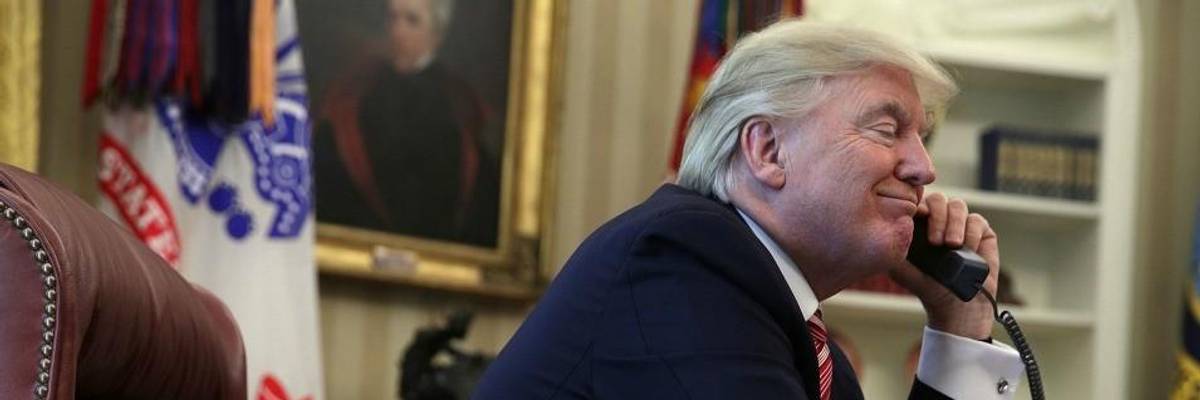
Then-President Donald Trump speaks on the phone in the Oval Office of the White House. (Photo: Alex Wong/Getty Images)
Local Georgia Prosecutor Launches Criminal Probe Into Trump's Request to 'Find' the Votes
The former president also faces the ongoing U.S. Senate impeachment trial as well as civil and criminal probes in New York.
On day two of former President Donald Trump's historic second Senate impeachment trial, the New York Times revealed Wednesday that Fulton County prosecutors have launched a criminal investigation into a January 2 phone call in which Trump asked Georgia GOP Secretary of State Brad Raffensperger to "find" over 11,000 votes.
The Fulton County probe comes after Raffensperger's office on Monday opened an administrative inquiry into the call and as the former president faces not only the Senate trial but also civil and criminal investigations of his business empire in New York state as well as lawsuits from two women who say he sexually assaulted them.
Trump could face legal trouble for his leaked call to Raffensperger as well as a December call to Georgia Gov. Brian Kemp in which Trump reportedly pressured the Republican to call a special election to reverse his electoral loss of the southern state to the Democratic candidate, President Joe Biden.
During the January call, the recording of which was obtained by The Washington Post, Trump said: "So look, all I want to do is this. I just want to find 11,780 votes, which is one more than we have. Because we won the state."
At the time, as Common Dreams reported, the effort by the president was immediately seen by critics as attempted "criminal extortion" and demands went up for Trump to be prosecuted under state election statutes.
According to the Times:
On Wednesday, Fani Willis, the recently elected Democratic prosecutor in Fulton County, sent a letter to numerous officials in state government, including Mr. Raffensperger, requesting that they preserve documents related to Mr. Trump's call, according to a state official with knowledge of the letter. The letter explicitly stated that the request was part of a criminal investigation, said the official, who insisted on anonymity to discuss internal matters.
[...]
Former prosecutors said Mr. Trump's calls might run afoul of at least three state laws. One is criminal solicitation to commit election fraud, which can be either a felony or a misdemeanor; as a felony, it is punishable by at least a year in prison. There is also a related conspiracy charge, which can be prosecuted either as a misdemeanor or a felony. A third law, a misdemeanor offense, bars "intentional interference" with another person's "performance of election duties."
The Fulton County investigation was welcomed by critics of Trump who have demanded accountability for his lies about election fraud in the wake of his November loss--which led to a violent mob storming the U.S. Capitol on January 6, the event that provoked Trump's unprecedented second impeachment by the U.S. House.
In a statement, Citizens for Responsibility and Ethics in Washington (CREW) president Noah Bookbinder, a former federal corruption prosecutor, welcomed the Fulton County probe.
"Last month we sent a criminal complaint to the Fulton County district attorney laying out the multiple laws Donald Trump appeared to violate by pressuring Georgia Secretary of State Brad Raffensperger to overturn the results of Georgia's presidential election, and called on prosecutors to begin a criminal investigation into Trump," Bookbinder noted. "They are now doing exactly that."
"Trump's conduct violates not only the law, but the foundation on which our democracy is built," Bookbinder said. "He may have been able to evade facing criminal charges as president, but he is no longer president. We applaud Fulton County District Attorney Willis for launching this investigation and showing that no one is above the law."
As for the probe by the secretary of state's office, The Atlanta Journal-Constitution noted Monday that "election investigations can take months or years before they're referred to the State Election Board, where Raffensperger is the chairman. The board can dismiss cases, levy fines or refer cases to the attorney general's office for potential criminal investigation."
Walter Jones, a spokesperson for Raffensperger's office, said Monday that "the secretary of state's office investigates complaints it receives. The investigations are fact-finding and administrative in nature. Any further legal efforts will be left to the attorney general."
Jones confirmed that investigation was prompted by a Monday complaint from George Washington University law professor John Banzhaf, who told Reuters that he had filed four complaints about Trump's call to Raffensperger since January 2.
Trump adviser Jason Miller responded to the that probe by telling Reuters: "There was nothing improper or untoward about a scheduled call between President Trump, Secretary Raffensperger, and lawyers on both sides. If Mr. Raffensperger didn't want to receive calls about the election, he shouldn't have run for secretary of state."
This post has been updated with comment from CREW.
We are at a crossroads
This country and this world are at a monumental crossroads. In a few short weeks, US voters will have an opportunity to beat back the forces of fascism and confront the billionaires who are rigging the economy, our media system, and our democracy, making it increasingly impossible for ordinary people to get by. We’re not just talking about the election. We’re talking about what must be done once these fascist elements are vanquished from power. We need a bolder set of solutions than what either major party has so far been willing to offer and a working-class movement ready to fight like hell for it. Trump didn't emerge from nowhere. The conditions that fueled MAGA authoritarianism were created by decades of radical neoliberal economic policies and a corrupt political system dominated by corporate interests. They slashed taxes on the super-rich, promising that the benefits would trickle down. They said giveaways to the corporate titans would make life more affordable for the rest of us. It was all bullshit. And when a bitter, betrayed populace searches for someone to blame, right-wing demagogues have little trouble finding scapegoats. People know when they're being lied to, but you won't hear any of this from the corporate media. Only independent journalism—powered and funded by people who believe in building a better world—can deliver truly trustworthy daily news. Our Fall Campaign is underway, and we need your help. To power our newsroom through the rest of the year, we need to raise $125,000 by midnight on October 31. So if you share our vision, please contribute whatever you can to sustain our work. |
On day two of former President Donald Trump's historic second Senate impeachment trial, the New York Times revealed Wednesday that Fulton County prosecutors have launched a criminal investigation into a January 2 phone call in which Trump asked Georgia GOP Secretary of State Brad Raffensperger to "find" over 11,000 votes.
The Fulton County probe comes after Raffensperger's office on Monday opened an administrative inquiry into the call and as the former president faces not only the Senate trial but also civil and criminal investigations of his business empire in New York state as well as lawsuits from two women who say he sexually assaulted them.
Trump could face legal trouble for his leaked call to Raffensperger as well as a December call to Georgia Gov. Brian Kemp in which Trump reportedly pressured the Republican to call a special election to reverse his electoral loss of the southern state to the Democratic candidate, President Joe Biden.
During the January call, the recording of which was obtained by The Washington Post, Trump said: "So look, all I want to do is this. I just want to find 11,780 votes, which is one more than we have. Because we won the state."
At the time, as Common Dreams reported, the effort by the president was immediately seen by critics as attempted "criminal extortion" and demands went up for Trump to be prosecuted under state election statutes.
According to the Times:
On Wednesday, Fani Willis, the recently elected Democratic prosecutor in Fulton County, sent a letter to numerous officials in state government, including Mr. Raffensperger, requesting that they preserve documents related to Mr. Trump's call, according to a state official with knowledge of the letter. The letter explicitly stated that the request was part of a criminal investigation, said the official, who insisted on anonymity to discuss internal matters.
[...]
Former prosecutors said Mr. Trump's calls might run afoul of at least three state laws. One is criminal solicitation to commit election fraud, which can be either a felony or a misdemeanor; as a felony, it is punishable by at least a year in prison. There is also a related conspiracy charge, which can be prosecuted either as a misdemeanor or a felony. A third law, a misdemeanor offense, bars "intentional interference" with another person's "performance of election duties."
The Fulton County investigation was welcomed by critics of Trump who have demanded accountability for his lies about election fraud in the wake of his November loss--which led to a violent mob storming the U.S. Capitol on January 6, the event that provoked Trump's unprecedented second impeachment by the U.S. House.
In a statement, Citizens for Responsibility and Ethics in Washington (CREW) president Noah Bookbinder, a former federal corruption prosecutor, welcomed the Fulton County probe.
"Last month we sent a criminal complaint to the Fulton County district attorney laying out the multiple laws Donald Trump appeared to violate by pressuring Georgia Secretary of State Brad Raffensperger to overturn the results of Georgia's presidential election, and called on prosecutors to begin a criminal investigation into Trump," Bookbinder noted. "They are now doing exactly that."
"Trump's conduct violates not only the law, but the foundation on which our democracy is built," Bookbinder said. "He may have been able to evade facing criminal charges as president, but he is no longer president. We applaud Fulton County District Attorney Willis for launching this investigation and showing that no one is above the law."
As for the probe by the secretary of state's office, The Atlanta Journal-Constitution noted Monday that "election investigations can take months or years before they're referred to the State Election Board, where Raffensperger is the chairman. The board can dismiss cases, levy fines or refer cases to the attorney general's office for potential criminal investigation."
Walter Jones, a spokesperson for Raffensperger's office, said Monday that "the secretary of state's office investigates complaints it receives. The investigations are fact-finding and administrative in nature. Any further legal efforts will be left to the attorney general."
Jones confirmed that investigation was prompted by a Monday complaint from George Washington University law professor John Banzhaf, who told Reuters that he had filed four complaints about Trump's call to Raffensperger since January 2.
Trump adviser Jason Miller responded to the that probe by telling Reuters: "There was nothing improper or untoward about a scheduled call between President Trump, Secretary Raffensperger, and lawyers on both sides. If Mr. Raffensperger didn't want to receive calls about the election, he shouldn't have run for secretary of state."
This post has been updated with comment from CREW.
On day two of former President Donald Trump's historic second Senate impeachment trial, the New York Times revealed Wednesday that Fulton County prosecutors have launched a criminal investigation into a January 2 phone call in which Trump asked Georgia GOP Secretary of State Brad Raffensperger to "find" over 11,000 votes.
The Fulton County probe comes after Raffensperger's office on Monday opened an administrative inquiry into the call and as the former president faces not only the Senate trial but also civil and criminal investigations of his business empire in New York state as well as lawsuits from two women who say he sexually assaulted them.
Trump could face legal trouble for his leaked call to Raffensperger as well as a December call to Georgia Gov. Brian Kemp in which Trump reportedly pressured the Republican to call a special election to reverse his electoral loss of the southern state to the Democratic candidate, President Joe Biden.
During the January call, the recording of which was obtained by The Washington Post, Trump said: "So look, all I want to do is this. I just want to find 11,780 votes, which is one more than we have. Because we won the state."
At the time, as Common Dreams reported, the effort by the president was immediately seen by critics as attempted "criminal extortion" and demands went up for Trump to be prosecuted under state election statutes.
According to the Times:
On Wednesday, Fani Willis, the recently elected Democratic prosecutor in Fulton County, sent a letter to numerous officials in state government, including Mr. Raffensperger, requesting that they preserve documents related to Mr. Trump's call, according to a state official with knowledge of the letter. The letter explicitly stated that the request was part of a criminal investigation, said the official, who insisted on anonymity to discuss internal matters.
[...]
Former prosecutors said Mr. Trump's calls might run afoul of at least three state laws. One is criminal solicitation to commit election fraud, which can be either a felony or a misdemeanor; as a felony, it is punishable by at least a year in prison. There is also a related conspiracy charge, which can be prosecuted either as a misdemeanor or a felony. A third law, a misdemeanor offense, bars "intentional interference" with another person's "performance of election duties."
The Fulton County investigation was welcomed by critics of Trump who have demanded accountability for his lies about election fraud in the wake of his November loss--which led to a violent mob storming the U.S. Capitol on January 6, the event that provoked Trump's unprecedented second impeachment by the U.S. House.
In a statement, Citizens for Responsibility and Ethics in Washington (CREW) president Noah Bookbinder, a former federal corruption prosecutor, welcomed the Fulton County probe.
"Last month we sent a criminal complaint to the Fulton County district attorney laying out the multiple laws Donald Trump appeared to violate by pressuring Georgia Secretary of State Brad Raffensperger to overturn the results of Georgia's presidential election, and called on prosecutors to begin a criminal investigation into Trump," Bookbinder noted. "They are now doing exactly that."
"Trump's conduct violates not only the law, but the foundation on which our democracy is built," Bookbinder said. "He may have been able to evade facing criminal charges as president, but he is no longer president. We applaud Fulton County District Attorney Willis for launching this investigation and showing that no one is above the law."
As for the probe by the secretary of state's office, The Atlanta Journal-Constitution noted Monday that "election investigations can take months or years before they're referred to the State Election Board, where Raffensperger is the chairman. The board can dismiss cases, levy fines or refer cases to the attorney general's office for potential criminal investigation."
Walter Jones, a spokesperson for Raffensperger's office, said Monday that "the secretary of state's office investigates complaints it receives. The investigations are fact-finding and administrative in nature. Any further legal efforts will be left to the attorney general."
Jones confirmed that investigation was prompted by a Monday complaint from George Washington University law professor John Banzhaf, who told Reuters that he had filed four complaints about Trump's call to Raffensperger since January 2.
Trump adviser Jason Miller responded to the that probe by telling Reuters: "There was nothing improper or untoward about a scheduled call between President Trump, Secretary Raffensperger, and lawyers on both sides. If Mr. Raffensperger didn't want to receive calls about the election, he shouldn't have run for secretary of state."
This post has been updated with comment from CREW.