

SUBSCRIBE TO OUR FREE NEWSLETTER
Daily news & progressive opinion—funded by the people, not the corporations—delivered straight to your inbox.
5
#000000
#FFFFFF
To donate by check, phone, or other method, see our More Ways to Give page.
Daily news & progressive opinion—funded by the people, not the corporations—delivered straight to your inbox.
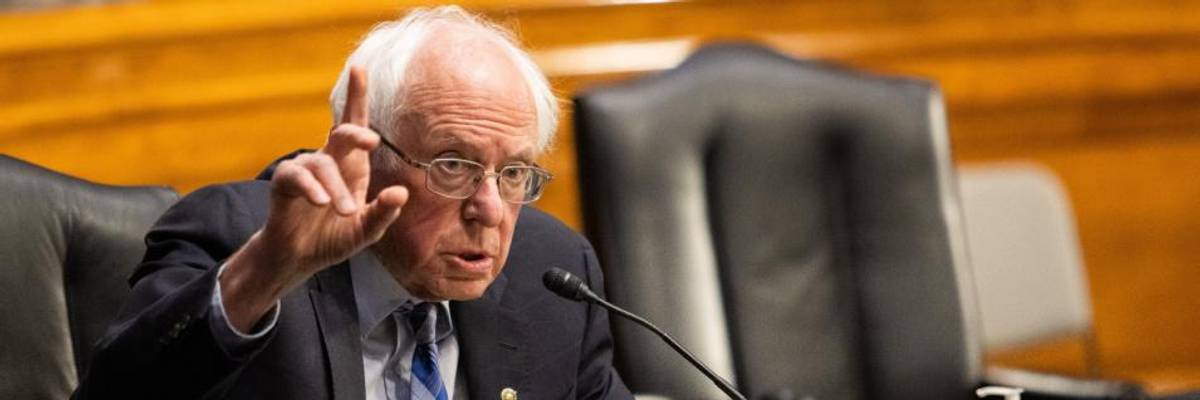
Sen. Bernie Sanders (I-Vt.) speaks during a hearing on Capitol Hill in Washington, D.C. on January 27, 2021. (Photo: Graeme Jennings/Pool/AFP via Getty Images)
In his first speech on the Senate floor since officially becoming chairman of the chamber's budget committee on Wednesday, Sen. Bernie Sanders reminded Republican senators complaining about the Democratic majority's effort to pass coronavirus relief through the filibuster-proof reconciliation process that the GOP used the same tool to unilaterally ram through tax cuts for the wealthy just over three years ago.
"There has been some discussion here, the media seems fixated, on the issue of partisanship," said the Vermont senator. "Oh my god, we're being so partisan. So let me remind everybody... under the Trump administration, massive tax breaks were passed that went to the top 1% and large corporations--83% of the benefits of the Trump tax plan went to the 1% and large corporations. And you know how bipartisan that bill was, passed in reconciliation? There was not one Democrat that voted for that bill. It was [passed] just with Republican votes."
"Then outrageously, as part of reconciliation, Republicans came forward and said, 'Hey, we think it's a brilliant idea to repeal the Affordable Care Act and throw up to 32 million people off the healthcare that they have," Sanders said, recounting the GOP's failed 2017 effort. "Not one Democrat voted for that bill. My point is that it's one thing for my Republican friends here to be talking about the need for bipartisanship, which all of us support. But the reality is they used exactly the same process to pass--or at least try to pass--major, major pieces of legislation."
Watch:
Sanders floor remarks came after Senate Minority Leader Mitch McConnell (R-Ky.) and other Republicans delivered speeches Wednesday denouncing Democrats' efforts to go it alone on coronavirus relief amid open GOP hostility to the level of spending that experts say is needed to combat the ongoing public health emergency and bring the U.S. economy out of deep recession.
"Less than a day after several Senate Republicans spent two hours meeting with President Biden, Senate Democrats plowed ahead with a party-line vote to set the table for a partisan jam," said McConnell, who led the Senate GOP's unilateral tax-cut push in 2017. In 2018, the Congressional Budget Office estimated that the tax legislation would add $1.9 trillion to the national debt over ten years.
Coincidentally, $1.9 trillion is also the top-line price tag of President Joe Biden's relief proposal, which Republican senators have rejected as excessive even as the coronavirus continues to spread across the country and the economy remains in shambles, leaving millions hungry, out of work, and at risk of eviction.
In an appearance on CNN late Wednesday, Sanders said he does not support making changes to the president's opening relief offer in an effort to win the backing of Republicans who, now that a Democrat is in the White House, are suddenly concerned about the soaring deficit.
Sanders specifically rejected an ongoing push by some Democratic senators to narrow eligibility for the $1,400 direct payments in Biden's plan. Economic relief, the Vermont senator argued, should not be needlessly curtailed amid such widespread suffering.
"The priority that I see is addressing the crises facing working families," said Sanders. "When you got millions of people out there worried about how they're gonna feed their kids, or how they're gonna get enough income to pay the rent, that is the priority that we have to address."
"Right now, tens of millions of working families, middle-class people, low-income people are in crisis," the Vermont senator added. "They need help, they need help now."
This country and this world are at a monumental crossroads. US voters have an opportunity to beat back the forces of fascism and confront the billionaires who are rigging the economy, our media system, and our democracy, making it increasingly impossible for ordinary people to get by. We’re not just talking about the election. We’re talking about what must be done once these fascist elements are vanquished from power. We need a bolder set of solutions than what either major party has so far been willing to offer and a working-class movement ready to fight like hell for it. Trump didn't emerge from nowhere. The conditions that fueled MAGA authoritarianism were created by decades of radical neoliberal economic policies and a corrupt political system dominated by corporate interests. They slashed taxes on the super-rich, promising that the benefits would trickle down. They said giveaways to the corporate titans would make life more affordable for the rest of us. It was all bullshit. And when a bitter, betrayed populace searches for someone to blame, right-wing demagogues have little trouble finding scapegoats. People know when they're being lied to, but you won't hear any of this from the corporate media. Only independent journalism—powered and funded by people who believe in building a better world—can deliver truly trustworthy daily news. If you share our vision, please contribute whatever you can to sustain our work. |
In his first speech on the Senate floor since officially becoming chairman of the chamber's budget committee on Wednesday, Sen. Bernie Sanders reminded Republican senators complaining about the Democratic majority's effort to pass coronavirus relief through the filibuster-proof reconciliation process that the GOP used the same tool to unilaterally ram through tax cuts for the wealthy just over three years ago.
"There has been some discussion here, the media seems fixated, on the issue of partisanship," said the Vermont senator. "Oh my god, we're being so partisan. So let me remind everybody... under the Trump administration, massive tax breaks were passed that went to the top 1% and large corporations--83% of the benefits of the Trump tax plan went to the 1% and large corporations. And you know how bipartisan that bill was, passed in reconciliation? There was not one Democrat that voted for that bill. It was [passed] just with Republican votes."
"Then outrageously, as part of reconciliation, Republicans came forward and said, 'Hey, we think it's a brilliant idea to repeal the Affordable Care Act and throw up to 32 million people off the healthcare that they have," Sanders said, recounting the GOP's failed 2017 effort. "Not one Democrat voted for that bill. My point is that it's one thing for my Republican friends here to be talking about the need for bipartisanship, which all of us support. But the reality is they used exactly the same process to pass--or at least try to pass--major, major pieces of legislation."
Watch:
Sanders floor remarks came after Senate Minority Leader Mitch McConnell (R-Ky.) and other Republicans delivered speeches Wednesday denouncing Democrats' efforts to go it alone on coronavirus relief amid open GOP hostility to the level of spending that experts say is needed to combat the ongoing public health emergency and bring the U.S. economy out of deep recession.
"Less than a day after several Senate Republicans spent two hours meeting with President Biden, Senate Democrats plowed ahead with a party-line vote to set the table for a partisan jam," said McConnell, who led the Senate GOP's unilateral tax-cut push in 2017. In 2018, the Congressional Budget Office estimated that the tax legislation would add $1.9 trillion to the national debt over ten years.
Coincidentally, $1.9 trillion is also the top-line price tag of President Joe Biden's relief proposal, which Republican senators have rejected as excessive even as the coronavirus continues to spread across the country and the economy remains in shambles, leaving millions hungry, out of work, and at risk of eviction.
In an appearance on CNN late Wednesday, Sanders said he does not support making changes to the president's opening relief offer in an effort to win the backing of Republicans who, now that a Democrat is in the White House, are suddenly concerned about the soaring deficit.
Sanders specifically rejected an ongoing push by some Democratic senators to narrow eligibility for the $1,400 direct payments in Biden's plan. Economic relief, the Vermont senator argued, should not be needlessly curtailed amid such widespread suffering.
"The priority that I see is addressing the crises facing working families," said Sanders. "When you got millions of people out there worried about how they're gonna feed their kids, or how they're gonna get enough income to pay the rent, that is the priority that we have to address."
"Right now, tens of millions of working families, middle-class people, low-income people are in crisis," the Vermont senator added. "They need help, they need help now."

