SUBSCRIBE TO OUR FREE NEWSLETTER
Daily news & progressive opinion—funded by the people, not the corporations—delivered straight to your inbox.
5
#000000
#FFFFFF
To donate by check, phone, or other method, see our More Ways to Give page.
Daily news & progressive opinion—funded by the people, not the corporations—delivered straight to your inbox.
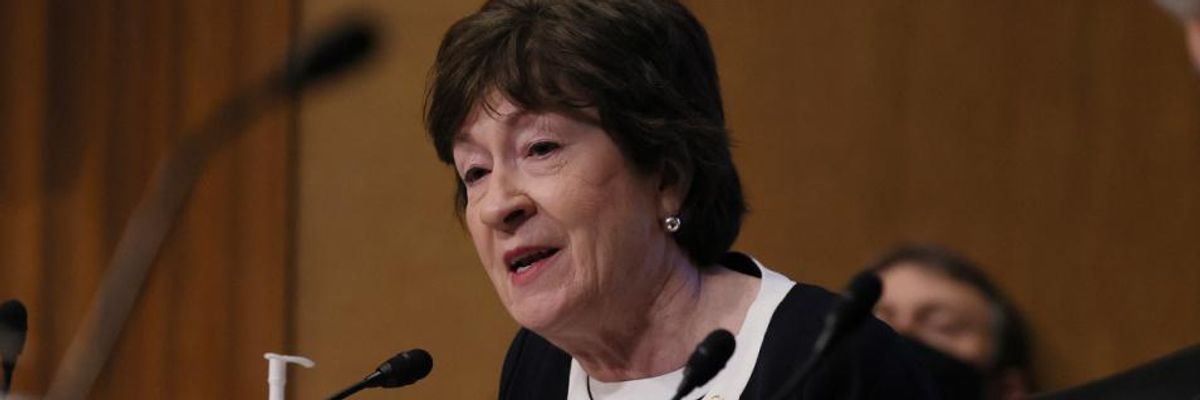
Sen. Susan Collins (R-Maine) speaks during a Senate Intelligence Committee to be President-elect Joe Bidens pick for Director of National Intelligence on Capitol Hill on January 19, 2021 in Washington, D.C. (Photo: Joe Raedle/Pool/AFP via Getty Images)
Republican Sen. Susan Collins of Maine complained during a call with Biden administration officials on Sunday that the $1,400 direct relief payments the president has proposed are not sufficiently "targeted," an argument that critics dismissed as absurd and cynical given her 2017 vote for tax cuts that disproportionately benefited wealthy Americans.
Politico reported late Sunday that Collins "pressed the Biden officials on why families making $300,000 would be eligible" for direct payments under Biden's $1.9 trillion relief plan and "urged a focus on lower-income workers."
"I was the first to raise that issue, but there seemed to be a lot of agreement... that those payments need to be more targeted," Collins told Politico in an interview following the Sunday call, which was joined by more than a dozen lawmakers from both parties.
"Senate Republicans' tax bill showered billions of dollars on actual billionaires."
--Ashley Schapitl, spokesperson for Sen. Ron Wyden
If Biden models his direct payments plan after the House-passed CASH Act, only individuals with incomes of $75,000 or less per year and couples with a combined annual income of $150,000 or less would receive the full $1,400 check. The payments would begin phasing out for those with incomes above those thresholds; under the CASH Act, married couples with a combined annual income of $300,000 and two or more children would have been eligible for some money.
But according to an analysis by the Tax Policy Center, less than one percent of the benefits of the CASH Act would have gone to the top five percent of the income distribution. By contrast, 52% of the benefits of the $1.5 trillion tax bill that Collins happily voted for in 2017 went to the top five percent in 2020.
"Weird that Susan Collins didn't care so much about the 'rich people getting more than they need' issue when it was massive upper income tax cuts on the table," New York Times columnist Jamelle Bouie tweeted sardonically.
Ashley Schapitl, a spokesperson for Sen. Ron Wyden (D-Ore.), echoed that point, noting that "Senate Republicans' tax bill showered billions of dollars on actual billionaires."
Collins' objection to the $1,400 relief checks came as the Biden administration continued its effort to attract GOP support for a relief package that many Republicans have already dismissed as too expensive, even though the $1.9 trillion in spending the president has proposed is well below what experts say is necessary to reverse the ongoing economic collapse.
The concerns raised by Collins and other Republicans bolster progressives' case that the Biden team's outreach to the GOP is futile and potentially "dangerous," given that compromise with Republicans would inevitably weaken a package that is already inadequate.
Instead of wasting precious time seeking Republican support, progressive advocacy groups and analysts have argued that the White House and the Democrat-controlled Congress should use all available paths--from the budget reconciliation process to abolishing the 60-vote filibuster--to pass relief legislation without the minority party.
"In order to ensure this urgent and popular agenda is passed immediately and not watered down, as well as enact Biden's other important plans for green infrastructure, democracy reform, and more, the president-elect must work with Senate Majority Leader Chuck Schumer to abolish the filibuster now," Evan Weber, political director of the youth-led Sunrise Movement, said earlier this month. "No compromises, and no excuses."
Dear Common Dreams reader, It’s been nearly 30 years since I co-founded Common Dreams with my late wife, Lina Newhouser. We had the radical notion that journalism should serve the public good, not corporate profits. It was clear to us from the outset what it would take to build such a project. No paid advertisements. No corporate sponsors. No millionaire publisher telling us what to think or do. Many people said we wouldn't last a year, but we proved those doubters wrong. Together with a tremendous team of journalists and dedicated staff, we built an independent media outlet free from the constraints of profits and corporate control. Our mission has always been simple: To inform. To inspire. To ignite change for the common good. Building Common Dreams was not easy. Our survival was never guaranteed. When you take on the most powerful forces—Wall Street greed, fossil fuel industry destruction, Big Tech lobbyists, and uber-rich oligarchs who have spent billions upon billions rigging the economy and democracy in their favor—the only bulwark you have is supporters who believe in your work. But here’s the urgent message from me today. It's never been this bad out there. And it's never been this hard to keep us going. At the very moment Common Dreams is most needed, the threats we face are intensifying. We need your support now more than ever. We don't accept corporate advertising and never will. We don't have a paywall because we don't think people should be blocked from critical news based on their ability to pay. Everything we do is funded by the donations of readers like you. When everyone does the little they can afford, we are strong. But if that support retreats or dries up, so do we. Will you donate now to make sure Common Dreams not only survives but thrives? —Craig Brown, Co-founder |
Republican Sen. Susan Collins of Maine complained during a call with Biden administration officials on Sunday that the $1,400 direct relief payments the president has proposed are not sufficiently "targeted," an argument that critics dismissed as absurd and cynical given her 2017 vote for tax cuts that disproportionately benefited wealthy Americans.
Politico reported late Sunday that Collins "pressed the Biden officials on why families making $300,000 would be eligible" for direct payments under Biden's $1.9 trillion relief plan and "urged a focus on lower-income workers."
"I was the first to raise that issue, but there seemed to be a lot of agreement... that those payments need to be more targeted," Collins told Politico in an interview following the Sunday call, which was joined by more than a dozen lawmakers from both parties.
"Senate Republicans' tax bill showered billions of dollars on actual billionaires."
--Ashley Schapitl, spokesperson for Sen. Ron Wyden
If Biden models his direct payments plan after the House-passed CASH Act, only individuals with incomes of $75,000 or less per year and couples with a combined annual income of $150,000 or less would receive the full $1,400 check. The payments would begin phasing out for those with incomes above those thresholds; under the CASH Act, married couples with a combined annual income of $300,000 and two or more children would have been eligible for some money.
But according to an analysis by the Tax Policy Center, less than one percent of the benefits of the CASH Act would have gone to the top five percent of the income distribution. By contrast, 52% of the benefits of the $1.5 trillion tax bill that Collins happily voted for in 2017 went to the top five percent in 2020.
"Weird that Susan Collins didn't care so much about the 'rich people getting more than they need' issue when it was massive upper income tax cuts on the table," New York Times columnist Jamelle Bouie tweeted sardonically.
Ashley Schapitl, a spokesperson for Sen. Ron Wyden (D-Ore.), echoed that point, noting that "Senate Republicans' tax bill showered billions of dollars on actual billionaires."
Collins' objection to the $1,400 relief checks came as the Biden administration continued its effort to attract GOP support for a relief package that many Republicans have already dismissed as too expensive, even though the $1.9 trillion in spending the president has proposed is well below what experts say is necessary to reverse the ongoing economic collapse.
The concerns raised by Collins and other Republicans bolster progressives' case that the Biden team's outreach to the GOP is futile and potentially "dangerous," given that compromise with Republicans would inevitably weaken a package that is already inadequate.
Instead of wasting precious time seeking Republican support, progressive advocacy groups and analysts have argued that the White House and the Democrat-controlled Congress should use all available paths--from the budget reconciliation process to abolishing the 60-vote filibuster--to pass relief legislation without the minority party.
"In order to ensure this urgent and popular agenda is passed immediately and not watered down, as well as enact Biden's other important plans for green infrastructure, democracy reform, and more, the president-elect must work with Senate Majority Leader Chuck Schumer to abolish the filibuster now," Evan Weber, political director of the youth-led Sunrise Movement, said earlier this month. "No compromises, and no excuses."
Republican Sen. Susan Collins of Maine complained during a call with Biden administration officials on Sunday that the $1,400 direct relief payments the president has proposed are not sufficiently "targeted," an argument that critics dismissed as absurd and cynical given her 2017 vote for tax cuts that disproportionately benefited wealthy Americans.
Politico reported late Sunday that Collins "pressed the Biden officials on why families making $300,000 would be eligible" for direct payments under Biden's $1.9 trillion relief plan and "urged a focus on lower-income workers."
"I was the first to raise that issue, but there seemed to be a lot of agreement... that those payments need to be more targeted," Collins told Politico in an interview following the Sunday call, which was joined by more than a dozen lawmakers from both parties.
"Senate Republicans' tax bill showered billions of dollars on actual billionaires."
--Ashley Schapitl, spokesperson for Sen. Ron Wyden
If Biden models his direct payments plan after the House-passed CASH Act, only individuals with incomes of $75,000 or less per year and couples with a combined annual income of $150,000 or less would receive the full $1,400 check. The payments would begin phasing out for those with incomes above those thresholds; under the CASH Act, married couples with a combined annual income of $300,000 and two or more children would have been eligible for some money.
But according to an analysis by the Tax Policy Center, less than one percent of the benefits of the CASH Act would have gone to the top five percent of the income distribution. By contrast, 52% of the benefits of the $1.5 trillion tax bill that Collins happily voted for in 2017 went to the top five percent in 2020.
"Weird that Susan Collins didn't care so much about the 'rich people getting more than they need' issue when it was massive upper income tax cuts on the table," New York Times columnist Jamelle Bouie tweeted sardonically.
Ashley Schapitl, a spokesperson for Sen. Ron Wyden (D-Ore.), echoed that point, noting that "Senate Republicans' tax bill showered billions of dollars on actual billionaires."
Collins' objection to the $1,400 relief checks came as the Biden administration continued its effort to attract GOP support for a relief package that many Republicans have already dismissed as too expensive, even though the $1.9 trillion in spending the president has proposed is well below what experts say is necessary to reverse the ongoing economic collapse.
The concerns raised by Collins and other Republicans bolster progressives' case that the Biden team's outreach to the GOP is futile and potentially "dangerous," given that compromise with Republicans would inevitably weaken a package that is already inadequate.
Instead of wasting precious time seeking Republican support, progressive advocacy groups and analysts have argued that the White House and the Democrat-controlled Congress should use all available paths--from the budget reconciliation process to abolishing the 60-vote filibuster--to pass relief legislation without the minority party.
"In order to ensure this urgent and popular agenda is passed immediately and not watered down, as well as enact Biden's other important plans for green infrastructure, democracy reform, and more, the president-elect must work with Senate Majority Leader Chuck Schumer to abolish the filibuster now," Evan Weber, political director of the youth-led Sunrise Movement, said earlier this month. "No compromises, and no excuses."