SUBSCRIBE TO OUR FREE NEWSLETTER
Daily news & progressive opinion—funded by the people, not the corporations—delivered straight to your inbox.
5
#000000
#FFFFFF
To donate by check, phone, or other method, see our More Ways to Give page.
Daily news & progressive opinion—funded by the people, not the corporations—delivered straight to your inbox.
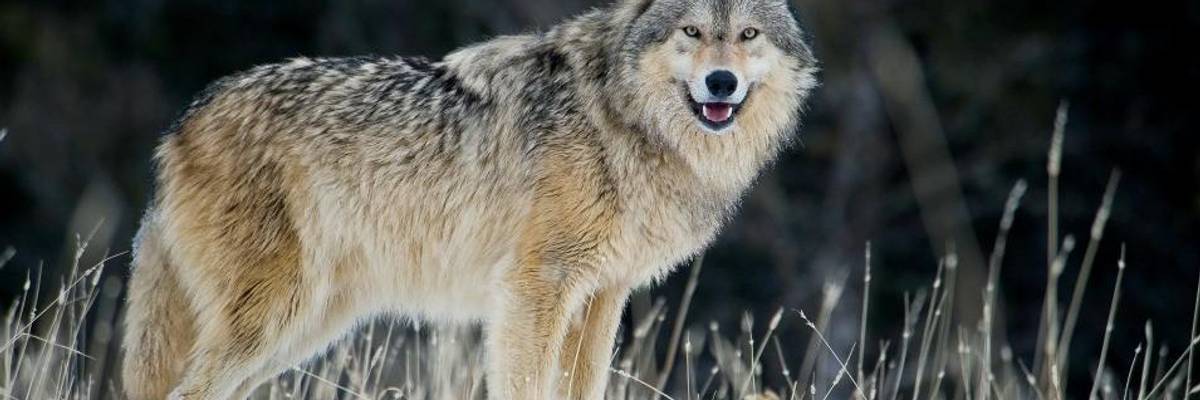
Western Environmental Law Center attorney Kelly Nokes warned that the Trump administation's elimination of federal protections for gray wolves in the lower 48 threatens "potentially catastrophic ripple effects on ecosystems where wolves have yet to fully recovery." (Photo: Dennis Fast/VWPics/Universal Images Group via Getty Images)
Over a dozen conservation groups on Thursday challenged the Trump administration's stripping of key protections for gray wolves in the lower 48 states.
"This delisting decision is what happens when bad science drives bad policy," said Earthjustice attorney Kristen Boyles in a statement.
Earthjustice, on behalf of organizations including the Center for Biologicial Diversity and Defenders of Wildlife, is one of the legal groups that filed suit against the Fish and Wildlife Service (FWS) rule--which took effect last week--removing endangered species protections. The Western Environmental Law Center, on behelf of groups including Cascadia Wildlands and WildEarth Guardians, filed a separate legal challenge (pdf) Thursday.
Western Environmental Law Center attorney Kelly Nokes said that areas where gray wolves had previously been delisted provide a cautionary tale.
"Allowing people to kill wolves in Idaho, Wyoming, and Montana has already stunted recovery in those states," said Nokes. "Applying this same death sentence to wolves throughout the contiguous U.S. would nationalize these negative effects, with potentially catastrophic ripple effects on ecosystems where wolves have yet to fully recovery."
Lindsay Larris, wildlife program director at WildEarth Guardians, concurred.
"Idaho, which allows an individual to kill up to 30 wolves annually, saw the slaughter of nearly 600 wolves and wolf pups in a recent 12-month period," said Larris. "Now other states are gearing up to allow wolf hunting and trapping this fall."
"Returning this type of unscientific and barbaric 'management' to states at this early juncture would spell disaster for true gray wolf recovery, plain and simple," she warned.
The wildlife advocates say the best available science shows that wolf populations across the nation have simply not recovered enough to warrant the delisting.
Both legal challenges frame FWS's logic as faulty. From Earthjustice's complaint:
Plaintiffs in this case challenge FWS's latest decision to eliminate all federal protections for gray wolves. Gray wolves still meet the [Endangered Species Act's] definition of an endangered species, one that is "in danger of extinction throughout all or a significant portion of its range." 16 U.S.C. SS 1532(6). FWS once again attempts to justify delisting by myopically focusing on wolves in a particular, limited geography (in this case, the Midwest) in order to justify delisting across the entire country. In doing so, the final rule selectively combined populations, ignored available historical wolf habitat, and disregarded relatively new wolf populations outside the Midwest as "colonizers" unnecessary to the survival and recovery of wolves in the Midwest. FWS's Delisting Rule does not satisfy the ESA requirements that FWS may delist only those species that are fully recovered and protected by adequate regulatory mechanisms. The Delisting Rule ignores the best available science, is arbitrary, capricious, an abuse of discretion, and contrary to law, and plaintiffs ask the court to vacate and remand it.
As Earthjustice's Boyles put it, "This is no 'Mission Accomplished' moment for wolf recovery."
In a Thursday tweet sharing information about the new lawsuit, Cascadia Wildlands noted that "wolves are integral to ecosystem health throughout North America."
"In the face of both the climate and the extinction crises, it is imperative that these invaluable animals are defended, not treated as a pest and hunted for sport," the group said.
Two separate lawsuits filed Thursday by Earthjustice on behalf of groups including WildEarth Guardians are challenging the Trump administration's broad attacks on the Endangered Species Act, including its reinterpreaton of "habitat" and narrowing of federal agencies' ability to establish critical habitat for ESA-listed species.
In a statement last month decyring the ESA assaults, Addie Haughey, Earthjustice's legislative director for Lands, Wildlife, and Oceans, said, "This administration is leaving office with a scorched earth policy for wildlife."
Dear Common Dreams reader, It’s been nearly 30 years since I co-founded Common Dreams with my late wife, Lina Newhouser. We had the radical notion that journalism should serve the public good, not corporate profits. It was clear to us from the outset what it would take to build such a project. No paid advertisements. No corporate sponsors. No millionaire publisher telling us what to think or do. Many people said we wouldn't last a year, but we proved those doubters wrong. Together with a tremendous team of journalists and dedicated staff, we built an independent media outlet free from the constraints of profits and corporate control. Our mission has always been simple: To inform. To inspire. To ignite change for the common good. Building Common Dreams was not easy. Our survival was never guaranteed. When you take on the most powerful forces—Wall Street greed, fossil fuel industry destruction, Big Tech lobbyists, and uber-rich oligarchs who have spent billions upon billions rigging the economy and democracy in their favor—the only bulwark you have is supporters who believe in your work. But here’s the urgent message from me today. It's never been this bad out there. And it's never been this hard to keep us going. At the very moment Common Dreams is most needed, the threats we face are intensifying. We need your support now more than ever. We don't accept corporate advertising and never will. We don't have a paywall because we don't think people should be blocked from critical news based on their ability to pay. Everything we do is funded by the donations of readers like you. When everyone does the little they can afford, we are strong. But if that support retreats or dries up, so do we. Will you donate now to make sure Common Dreams not only survives but thrives? —Craig Brown, Co-founder |
Over a dozen conservation groups on Thursday challenged the Trump administration's stripping of key protections for gray wolves in the lower 48 states.
"This delisting decision is what happens when bad science drives bad policy," said Earthjustice attorney Kristen Boyles in a statement.
Earthjustice, on behalf of organizations including the Center for Biologicial Diversity and Defenders of Wildlife, is one of the legal groups that filed suit against the Fish and Wildlife Service (FWS) rule--which took effect last week--removing endangered species protections. The Western Environmental Law Center, on behelf of groups including Cascadia Wildlands and WildEarth Guardians, filed a separate legal challenge (pdf) Thursday.
Western Environmental Law Center attorney Kelly Nokes said that areas where gray wolves had previously been delisted provide a cautionary tale.
"Allowing people to kill wolves in Idaho, Wyoming, and Montana has already stunted recovery in those states," said Nokes. "Applying this same death sentence to wolves throughout the contiguous U.S. would nationalize these negative effects, with potentially catastrophic ripple effects on ecosystems where wolves have yet to fully recovery."
Lindsay Larris, wildlife program director at WildEarth Guardians, concurred.
"Idaho, which allows an individual to kill up to 30 wolves annually, saw the slaughter of nearly 600 wolves and wolf pups in a recent 12-month period," said Larris. "Now other states are gearing up to allow wolf hunting and trapping this fall."
"Returning this type of unscientific and barbaric 'management' to states at this early juncture would spell disaster for true gray wolf recovery, plain and simple," she warned.
The wildlife advocates say the best available science shows that wolf populations across the nation have simply not recovered enough to warrant the delisting.
Both legal challenges frame FWS's logic as faulty. From Earthjustice's complaint:
Plaintiffs in this case challenge FWS's latest decision to eliminate all federal protections for gray wolves. Gray wolves still meet the [Endangered Species Act's] definition of an endangered species, one that is "in danger of extinction throughout all or a significant portion of its range." 16 U.S.C. SS 1532(6). FWS once again attempts to justify delisting by myopically focusing on wolves in a particular, limited geography (in this case, the Midwest) in order to justify delisting across the entire country. In doing so, the final rule selectively combined populations, ignored available historical wolf habitat, and disregarded relatively new wolf populations outside the Midwest as "colonizers" unnecessary to the survival and recovery of wolves in the Midwest. FWS's Delisting Rule does not satisfy the ESA requirements that FWS may delist only those species that are fully recovered and protected by adequate regulatory mechanisms. The Delisting Rule ignores the best available science, is arbitrary, capricious, an abuse of discretion, and contrary to law, and plaintiffs ask the court to vacate and remand it.
As Earthjustice's Boyles put it, "This is no 'Mission Accomplished' moment for wolf recovery."
In a Thursday tweet sharing information about the new lawsuit, Cascadia Wildlands noted that "wolves are integral to ecosystem health throughout North America."
"In the face of both the climate and the extinction crises, it is imperative that these invaluable animals are defended, not treated as a pest and hunted for sport," the group said.
Two separate lawsuits filed Thursday by Earthjustice on behalf of groups including WildEarth Guardians are challenging the Trump administration's broad attacks on the Endangered Species Act, including its reinterpreaton of "habitat" and narrowing of federal agencies' ability to establish critical habitat for ESA-listed species.
In a statement last month decyring the ESA assaults, Addie Haughey, Earthjustice's legislative director for Lands, Wildlife, and Oceans, said, "This administration is leaving office with a scorched earth policy for wildlife."
Over a dozen conservation groups on Thursday challenged the Trump administration's stripping of key protections for gray wolves in the lower 48 states.
"This delisting decision is what happens when bad science drives bad policy," said Earthjustice attorney Kristen Boyles in a statement.
Earthjustice, on behalf of organizations including the Center for Biologicial Diversity and Defenders of Wildlife, is one of the legal groups that filed suit against the Fish and Wildlife Service (FWS) rule--which took effect last week--removing endangered species protections. The Western Environmental Law Center, on behelf of groups including Cascadia Wildlands and WildEarth Guardians, filed a separate legal challenge (pdf) Thursday.
Western Environmental Law Center attorney Kelly Nokes said that areas where gray wolves had previously been delisted provide a cautionary tale.
"Allowing people to kill wolves in Idaho, Wyoming, and Montana has already stunted recovery in those states," said Nokes. "Applying this same death sentence to wolves throughout the contiguous U.S. would nationalize these negative effects, with potentially catastrophic ripple effects on ecosystems where wolves have yet to fully recovery."
Lindsay Larris, wildlife program director at WildEarth Guardians, concurred.
"Idaho, which allows an individual to kill up to 30 wolves annually, saw the slaughter of nearly 600 wolves and wolf pups in a recent 12-month period," said Larris. "Now other states are gearing up to allow wolf hunting and trapping this fall."
"Returning this type of unscientific and barbaric 'management' to states at this early juncture would spell disaster for true gray wolf recovery, plain and simple," she warned.
The wildlife advocates say the best available science shows that wolf populations across the nation have simply not recovered enough to warrant the delisting.
Both legal challenges frame FWS's logic as faulty. From Earthjustice's complaint:
Plaintiffs in this case challenge FWS's latest decision to eliminate all federal protections for gray wolves. Gray wolves still meet the [Endangered Species Act's] definition of an endangered species, one that is "in danger of extinction throughout all or a significant portion of its range." 16 U.S.C. SS 1532(6). FWS once again attempts to justify delisting by myopically focusing on wolves in a particular, limited geography (in this case, the Midwest) in order to justify delisting across the entire country. In doing so, the final rule selectively combined populations, ignored available historical wolf habitat, and disregarded relatively new wolf populations outside the Midwest as "colonizers" unnecessary to the survival and recovery of wolves in the Midwest. FWS's Delisting Rule does not satisfy the ESA requirements that FWS may delist only those species that are fully recovered and protected by adequate regulatory mechanisms. The Delisting Rule ignores the best available science, is arbitrary, capricious, an abuse of discretion, and contrary to law, and plaintiffs ask the court to vacate and remand it.
As Earthjustice's Boyles put it, "This is no 'Mission Accomplished' moment for wolf recovery."
In a Thursday tweet sharing information about the new lawsuit, Cascadia Wildlands noted that "wolves are integral to ecosystem health throughout North America."
"In the face of both the climate and the extinction crises, it is imperative that these invaluable animals are defended, not treated as a pest and hunted for sport," the group said.
Two separate lawsuits filed Thursday by Earthjustice on behalf of groups including WildEarth Guardians are challenging the Trump administration's broad attacks on the Endangered Species Act, including its reinterpreaton of "habitat" and narrowing of federal agencies' ability to establish critical habitat for ESA-listed species.
In a statement last month decyring the ESA assaults, Addie Haughey, Earthjustice's legislative director for Lands, Wildlife, and Oceans, said, "This administration is leaving office with a scorched earth policy for wildlife."