SUBSCRIBE TO OUR FREE NEWSLETTER
Daily news & progressive opinion—funded by the people, not the corporations—delivered straight to your inbox.
5
#000000
#FFFFFF
To donate by check, phone, or other method, see our More Ways to Give page.
Daily news & progressive opinion—funded by the people, not the corporations—delivered straight to your inbox.
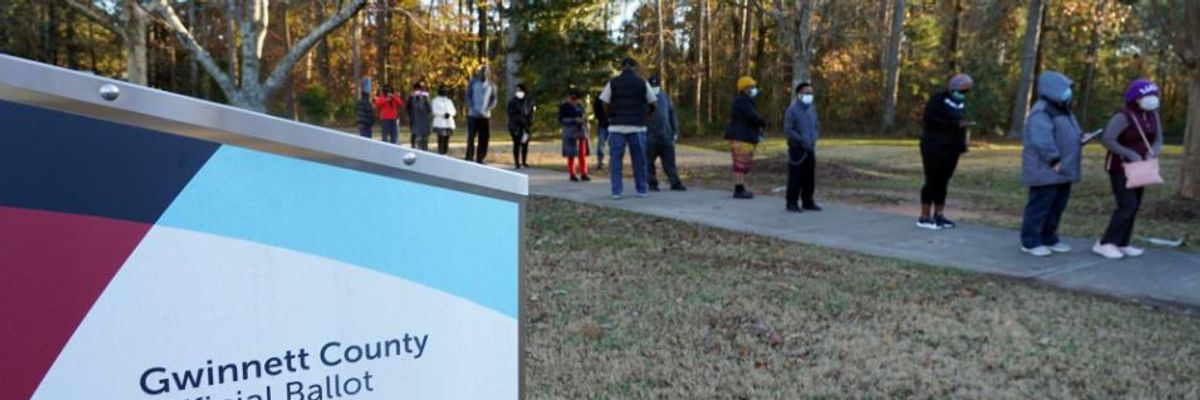
Voters stand in line to cast their ballots during the first day of early voting in the U.S. Senate runoffs on December 14, 2020, in Atlanta, Georgia. Voting rights advocates say President Donald Trump's attempts to cast doubt on the validity of the presidential election results could threaten voting rights for years to come.
Civil rights advocates and political observers are warning that while President Donald Trump has failed to introduce any successful challenges to the presidential election, which he decisively lost to President-elect Joe Biden on November 3, he and other Republicans have likely succeeded in laying the groundwork for a significant rollback of voting rights, particularly targeting communities where disenfranchisement is already rampant.
Trump and the Republican Party have now had more than 50 lawsuits dismissed by federal and state courts, and the Electoral College last week officially affirmed Biden's victory while the federal government's top cybersecurity official--a Trump appointee--called the election "the most secure in American history."
According to a Northeastern University survey, nearly 40% of GOP voters in states that flipped from Trump in 2016 to Biden in 2020 believe the president actually did not lose. And Republican officials are capitalizing on those beliefs and Trump's false claims of fraud to undermine efforts designed to expand voter access.
The doubt and distrust sowed by the president and dozens of Republican lawmakers over the last six weeks has now allowed Wisconsin Republicans to argue that events in public parks where absentee ballots were collected were unlawful, and that Democratic and nonpartisan attempts in the state to make it easier for residents to vote during the coronavirus pandemic "overstepped state law," according to Reuters.
Republicans, who control the Wisconsin state legislature, are expected to consider legislation to curtail in-person early voting, which has been permitted in previous elections.
In Georgia, where voting rights advocates and progressive grassroots groups worked tirelessly to register young voters and people of color--two years after a gubernatorial election in which Republican Gov. Brian Kemp narrowly won after overseeing the closure of dozens of polling locations--state GOP lawmakers said earlier this month that they would seek to end "no excuse" voting-by-mail, which the GOP itself introduced in 2005.
Party officials said doing away with the system would "secure our election process," despite several clear statements from Republican Secretary of State Brad Raffensperger that there was no evidence of election fraud or irregularities in Georgia.
"This appears to be laying the groundwork for what may be a more massive and coordinated voter suppression effort in the new year," Kristen Clarke, president of the Lawyers Committee for Civil Rights Under Law, told Reuters on Monday. "It is a brazen attempt to undermine and obstruct the progress that has been made in 2020 to make it easier for people to vote amid the pandemic."
The Brennan Center for Justice found that 29 states and the District of Columbia changed voting procedures this year to expand voting access, easing rules for voting by mail or by absentee ballot and expanding early voting so people could vote safely. The new rules made it possible for a record 158 million people to cast ballots amid the coronavirus pandemic, despite significant efforts by Trump and other Republicans to cal into questionl the validity of voting by mail and the use of drop boxes.
As Common Dreams reported, Trump ally Sen. Lindsey Graham (R-S.C.) admitted shortly after the election that Republican efforts to place strict controls on mail-in voting are aimed at hurting Democrats' electoral chances.
"If we don't do something about voting by mail, we're going to lose the ability to elect a Republican in this country," Graham told Fox News last month.
As lawsuits brought by Trump and the Republican Party repeatedly failed in the courts over the past month, Paul Blumenthal wrote at HuffPost that the claims being pushed by the president "could be used in years to come to justify unnecessary and damaging voting restrictions that would disproportionately affect Black voters."
"Just because this is all incredibly dumb and has no chance of successfully overturning Biden's win doesn't mean it's not incredibly dangerous," wrote Blumenthal. "The entire scheme involves the delegitimization and disenfranchisement of voters in predominantly Black municipalities. It undermines his supporters' faith in democracy."
While election law expert and former Justice Department attorney Justin Levitt told NBC News earlier this month that Trump's claims of fraud were unlikely to lead "to a different result in January... I am really afraid about what Donald Trump is currently doing to the country for February and beyond."
Dear Common Dreams reader, It’s been nearly 30 years since I co-founded Common Dreams with my late wife, Lina Newhouser. We had the radical notion that journalism should serve the public good, not corporate profits. It was clear to us from the outset what it would take to build such a project. No paid advertisements. No corporate sponsors. No millionaire publisher telling us what to think or do. Many people said we wouldn't last a year, but we proved those doubters wrong. Together with a tremendous team of journalists and dedicated staff, we built an independent media outlet free from the constraints of profits and corporate control. Our mission has always been simple: To inform. To inspire. To ignite change for the common good. Building Common Dreams was not easy. Our survival was never guaranteed. When you take on the most powerful forces—Wall Street greed, fossil fuel industry destruction, Big Tech lobbyists, and uber-rich oligarchs who have spent billions upon billions rigging the economy and democracy in their favor—the only bulwark you have is supporters who believe in your work. But here’s the urgent message from me today. It's never been this bad out there. And it's never been this hard to keep us going. At the very moment Common Dreams is most needed, the threats we face are intensifying. We need your support now more than ever. We don't accept corporate advertising and never will. We don't have a paywall because we don't think people should be blocked from critical news based on their ability to pay. Everything we do is funded by the donations of readers like you. When everyone does the little they can afford, we are strong. But if that support retreats or dries up, so do we. Will you donate now to make sure Common Dreams not only survives but thrives? —Craig Brown, Co-founder |
Civil rights advocates and political observers are warning that while President Donald Trump has failed to introduce any successful challenges to the presidential election, which he decisively lost to President-elect Joe Biden on November 3, he and other Republicans have likely succeeded in laying the groundwork for a significant rollback of voting rights, particularly targeting communities where disenfranchisement is already rampant.
Trump and the Republican Party have now had more than 50 lawsuits dismissed by federal and state courts, and the Electoral College last week officially affirmed Biden's victory while the federal government's top cybersecurity official--a Trump appointee--called the election "the most secure in American history."
According to a Northeastern University survey, nearly 40% of GOP voters in states that flipped from Trump in 2016 to Biden in 2020 believe the president actually did not lose. And Republican officials are capitalizing on those beliefs and Trump's false claims of fraud to undermine efforts designed to expand voter access.
The doubt and distrust sowed by the president and dozens of Republican lawmakers over the last six weeks has now allowed Wisconsin Republicans to argue that events in public parks where absentee ballots were collected were unlawful, and that Democratic and nonpartisan attempts in the state to make it easier for residents to vote during the coronavirus pandemic "overstepped state law," according to Reuters.
Republicans, who control the Wisconsin state legislature, are expected to consider legislation to curtail in-person early voting, which has been permitted in previous elections.
In Georgia, where voting rights advocates and progressive grassroots groups worked tirelessly to register young voters and people of color--two years after a gubernatorial election in which Republican Gov. Brian Kemp narrowly won after overseeing the closure of dozens of polling locations--state GOP lawmakers said earlier this month that they would seek to end "no excuse" voting-by-mail, which the GOP itself introduced in 2005.
Party officials said doing away with the system would "secure our election process," despite several clear statements from Republican Secretary of State Brad Raffensperger that there was no evidence of election fraud or irregularities in Georgia.
"This appears to be laying the groundwork for what may be a more massive and coordinated voter suppression effort in the new year," Kristen Clarke, president of the Lawyers Committee for Civil Rights Under Law, told Reuters on Monday. "It is a brazen attempt to undermine and obstruct the progress that has been made in 2020 to make it easier for people to vote amid the pandemic."
The Brennan Center for Justice found that 29 states and the District of Columbia changed voting procedures this year to expand voting access, easing rules for voting by mail or by absentee ballot and expanding early voting so people could vote safely. The new rules made it possible for a record 158 million people to cast ballots amid the coronavirus pandemic, despite significant efforts by Trump and other Republicans to cal into questionl the validity of voting by mail and the use of drop boxes.
As Common Dreams reported, Trump ally Sen. Lindsey Graham (R-S.C.) admitted shortly after the election that Republican efforts to place strict controls on mail-in voting are aimed at hurting Democrats' electoral chances.
"If we don't do something about voting by mail, we're going to lose the ability to elect a Republican in this country," Graham told Fox News last month.
As lawsuits brought by Trump and the Republican Party repeatedly failed in the courts over the past month, Paul Blumenthal wrote at HuffPost that the claims being pushed by the president "could be used in years to come to justify unnecessary and damaging voting restrictions that would disproportionately affect Black voters."
"Just because this is all incredibly dumb and has no chance of successfully overturning Biden's win doesn't mean it's not incredibly dangerous," wrote Blumenthal. "The entire scheme involves the delegitimization and disenfranchisement of voters in predominantly Black municipalities. It undermines his supporters' faith in democracy."
While election law expert and former Justice Department attorney Justin Levitt told NBC News earlier this month that Trump's claims of fraud were unlikely to lead "to a different result in January... I am really afraid about what Donald Trump is currently doing to the country for February and beyond."
Civil rights advocates and political observers are warning that while President Donald Trump has failed to introduce any successful challenges to the presidential election, which he decisively lost to President-elect Joe Biden on November 3, he and other Republicans have likely succeeded in laying the groundwork for a significant rollback of voting rights, particularly targeting communities where disenfranchisement is already rampant.
Trump and the Republican Party have now had more than 50 lawsuits dismissed by federal and state courts, and the Electoral College last week officially affirmed Biden's victory while the federal government's top cybersecurity official--a Trump appointee--called the election "the most secure in American history."
According to a Northeastern University survey, nearly 40% of GOP voters in states that flipped from Trump in 2016 to Biden in 2020 believe the president actually did not lose. And Republican officials are capitalizing on those beliefs and Trump's false claims of fraud to undermine efforts designed to expand voter access.
The doubt and distrust sowed by the president and dozens of Republican lawmakers over the last six weeks has now allowed Wisconsin Republicans to argue that events in public parks where absentee ballots were collected were unlawful, and that Democratic and nonpartisan attempts in the state to make it easier for residents to vote during the coronavirus pandemic "overstepped state law," according to Reuters.
Republicans, who control the Wisconsin state legislature, are expected to consider legislation to curtail in-person early voting, which has been permitted in previous elections.
In Georgia, where voting rights advocates and progressive grassroots groups worked tirelessly to register young voters and people of color--two years after a gubernatorial election in which Republican Gov. Brian Kemp narrowly won after overseeing the closure of dozens of polling locations--state GOP lawmakers said earlier this month that they would seek to end "no excuse" voting-by-mail, which the GOP itself introduced in 2005.
Party officials said doing away with the system would "secure our election process," despite several clear statements from Republican Secretary of State Brad Raffensperger that there was no evidence of election fraud or irregularities in Georgia.
"This appears to be laying the groundwork for what may be a more massive and coordinated voter suppression effort in the new year," Kristen Clarke, president of the Lawyers Committee for Civil Rights Under Law, told Reuters on Monday. "It is a brazen attempt to undermine and obstruct the progress that has been made in 2020 to make it easier for people to vote amid the pandemic."
The Brennan Center for Justice found that 29 states and the District of Columbia changed voting procedures this year to expand voting access, easing rules for voting by mail or by absentee ballot and expanding early voting so people could vote safely. The new rules made it possible for a record 158 million people to cast ballots amid the coronavirus pandemic, despite significant efforts by Trump and other Republicans to cal into questionl the validity of voting by mail and the use of drop boxes.
As Common Dreams reported, Trump ally Sen. Lindsey Graham (R-S.C.) admitted shortly after the election that Republican efforts to place strict controls on mail-in voting are aimed at hurting Democrats' electoral chances.
"If we don't do something about voting by mail, we're going to lose the ability to elect a Republican in this country," Graham told Fox News last month.
As lawsuits brought by Trump and the Republican Party repeatedly failed in the courts over the past month, Paul Blumenthal wrote at HuffPost that the claims being pushed by the president "could be used in years to come to justify unnecessary and damaging voting restrictions that would disproportionately affect Black voters."
"Just because this is all incredibly dumb and has no chance of successfully overturning Biden's win doesn't mean it's not incredibly dangerous," wrote Blumenthal. "The entire scheme involves the delegitimization and disenfranchisement of voters in predominantly Black municipalities. It undermines his supporters' faith in democracy."
While election law expert and former Justice Department attorney Justin Levitt told NBC News earlier this month that Trump's claims of fraud were unlikely to lead "to a different result in January... I am really afraid about what Donald Trump is currently doing to the country for February and beyond."