SUBSCRIBE TO OUR FREE NEWSLETTER
Daily news & progressive opinion—funded by the people, not the corporations—delivered straight to your inbox.
5
#000000
#FFFFFF
To donate by check, phone, or other method, see our More Ways to Give page.
Daily news & progressive opinion—funded by the people, not the corporations—delivered straight to your inbox.
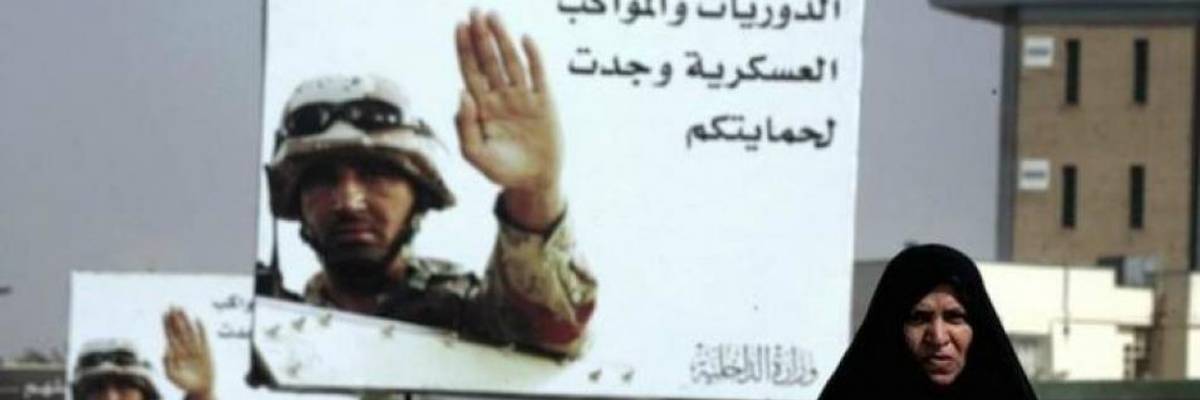
An Iraqi woman walks past billboards reading 'Patrols and military convoys are for your protection' in Baghdad in August 2006. (Photo by Karim Sahib/AFP/Getty Images)
The International Criminal Court's Office of the Prosecutor said Wednesday that--despite evidence of war crimes--it is not launching a probe into actions committed by British forces in Iraq.
Chief prosecutor Fatou Bensouda's office opened a preliminary examination in 2014 into allegations of systematic inhumane acts including sexual assault and torture against Iraqi detainees between 2003 to 2008. That development was praised at the time by the Berlin-based European Center for Constitutional and Human Rights (ECCHR), which submitted evidence to the court, as "a milestone for Iraqi victims and for international criminal law."
Wednesday's announcement, in contrast, drew fierce ire from the group.
In a statement, Bensouda said that her office had "previously found, and today confirmed, that there is a reasonable basis to believe that members of the British armed forces committed the war crimes of wilful killing, torture, inhuman/cruel treatment, outrages upon personal dignity, and rape and/or other forms of sexual violence. The office has identified a confined number of incidents to reach this determination which, while not exhaustive, appear to correspond to the most serious allegations of violence against persons in UK custody."
"The office further found that several levels of institutional civilian supervisory and military command failures contributed to the commission of crimes against detainees by UK soldiers in Iraq," Bensouda continued.
However, she pointed to investigations carried out by British authorities into the allegations as reason to quash a full probe.
The prosecutor's office "assessed that it could not conclude that the UK authorities had remained inactive" and said it "could not substantiate allegations that the UK investigative and prosecutorial bodies had engaged in shielding" individuals from criminal responsibility, according to the statement.
"I therefore determined that the only professionally appropriate decision at this stage is to close the preliminary examination," said Bensouda.
She acknowledged that the decision might elicit "dismay and disappointment," and noted in her full report that the British authorities' process "has resulted in not one single case being submitted for prosecution: a result that has deprived victims of justice."
The decision, said ECCHR General Secretary Wolfgang Kaleck, "reinforces longstanding double standards in international justice and shows once again that powerful actors can get away with systematic torture."
"To this day, the UK has failed to fully investigate and prosecute systematic torture by its armed forces in Iraq; in particular, it has refused to investigate those at the top of command," Kaleck continued. "The ICC and the international justice system are failing in their primary purpose: to ensure accountability for grave crimes. "
"The decision is a severe blow to Iraqi torture survivors," Kaleck added.
Human Rights Watch also lamented the decision.
"The UK government has repeatedly shown precious little interest in investigating and prosecuting atrocities committed abroad by British troops," said Clive Baldwin, senior legal advisor at Human Rights Watch. "The prosecutor's decision to close her UK inquiry will doubtless fuel perceptions of an ugly double standard in justice: one approach to powerful states and quite another for those with less clout."
Dear Common Dreams reader, It’s been nearly 30 years since I co-founded Common Dreams with my late wife, Lina Newhouser. We had the radical notion that journalism should serve the public good, not corporate profits. It was clear to us from the outset what it would take to build such a project. No paid advertisements. No corporate sponsors. No millionaire publisher telling us what to think or do. Many people said we wouldn't last a year, but we proved those doubters wrong. Together with a tremendous team of journalists and dedicated staff, we built an independent media outlet free from the constraints of profits and corporate control. Our mission has always been simple: To inform. To inspire. To ignite change for the common good. Building Common Dreams was not easy. Our survival was never guaranteed. When you take on the most powerful forces—Wall Street greed, fossil fuel industry destruction, Big Tech lobbyists, and uber-rich oligarchs who have spent billions upon billions rigging the economy and democracy in their favor—the only bulwark you have is supporters who believe in your work. But here’s the urgent message from me today. It's never been this bad out there. And it's never been this hard to keep us going. At the very moment Common Dreams is most needed, the threats we face are intensifying. We need your support now more than ever. We don't accept corporate advertising and never will. We don't have a paywall because we don't think people should be blocked from critical news based on their ability to pay. Everything we do is funded by the donations of readers like you. When everyone does the little they can afford, we are strong. But if that support retreats or dries up, so do we. Will you donate now to make sure Common Dreams not only survives but thrives? —Craig Brown, Co-founder |
The International Criminal Court's Office of the Prosecutor said Wednesday that--despite evidence of war crimes--it is not launching a probe into actions committed by British forces in Iraq.
Chief prosecutor Fatou Bensouda's office opened a preliminary examination in 2014 into allegations of systematic inhumane acts including sexual assault and torture against Iraqi detainees between 2003 to 2008. That development was praised at the time by the Berlin-based European Center for Constitutional and Human Rights (ECCHR), which submitted evidence to the court, as "a milestone for Iraqi victims and for international criminal law."
Wednesday's announcement, in contrast, drew fierce ire from the group.
In a statement, Bensouda said that her office had "previously found, and today confirmed, that there is a reasonable basis to believe that members of the British armed forces committed the war crimes of wilful killing, torture, inhuman/cruel treatment, outrages upon personal dignity, and rape and/or other forms of sexual violence. The office has identified a confined number of incidents to reach this determination which, while not exhaustive, appear to correspond to the most serious allegations of violence against persons in UK custody."
"The office further found that several levels of institutional civilian supervisory and military command failures contributed to the commission of crimes against detainees by UK soldiers in Iraq," Bensouda continued.
However, she pointed to investigations carried out by British authorities into the allegations as reason to quash a full probe.
The prosecutor's office "assessed that it could not conclude that the UK authorities had remained inactive" and said it "could not substantiate allegations that the UK investigative and prosecutorial bodies had engaged in shielding" individuals from criminal responsibility, according to the statement.
"I therefore determined that the only professionally appropriate decision at this stage is to close the preliminary examination," said Bensouda.
She acknowledged that the decision might elicit "dismay and disappointment," and noted in her full report that the British authorities' process "has resulted in not one single case being submitted for prosecution: a result that has deprived victims of justice."
The decision, said ECCHR General Secretary Wolfgang Kaleck, "reinforces longstanding double standards in international justice and shows once again that powerful actors can get away with systematic torture."
"To this day, the UK has failed to fully investigate and prosecute systematic torture by its armed forces in Iraq; in particular, it has refused to investigate those at the top of command," Kaleck continued. "The ICC and the international justice system are failing in their primary purpose: to ensure accountability for grave crimes. "
"The decision is a severe blow to Iraqi torture survivors," Kaleck added.
Human Rights Watch also lamented the decision.
"The UK government has repeatedly shown precious little interest in investigating and prosecuting atrocities committed abroad by British troops," said Clive Baldwin, senior legal advisor at Human Rights Watch. "The prosecutor's decision to close her UK inquiry will doubtless fuel perceptions of an ugly double standard in justice: one approach to powerful states and quite another for those with less clout."
The International Criminal Court's Office of the Prosecutor said Wednesday that--despite evidence of war crimes--it is not launching a probe into actions committed by British forces in Iraq.
Chief prosecutor Fatou Bensouda's office opened a preliminary examination in 2014 into allegations of systematic inhumane acts including sexual assault and torture against Iraqi detainees between 2003 to 2008. That development was praised at the time by the Berlin-based European Center for Constitutional and Human Rights (ECCHR), which submitted evidence to the court, as "a milestone for Iraqi victims and for international criminal law."
Wednesday's announcement, in contrast, drew fierce ire from the group.
In a statement, Bensouda said that her office had "previously found, and today confirmed, that there is a reasonable basis to believe that members of the British armed forces committed the war crimes of wilful killing, torture, inhuman/cruel treatment, outrages upon personal dignity, and rape and/or other forms of sexual violence. The office has identified a confined number of incidents to reach this determination which, while not exhaustive, appear to correspond to the most serious allegations of violence against persons in UK custody."
"The office further found that several levels of institutional civilian supervisory and military command failures contributed to the commission of crimes against detainees by UK soldiers in Iraq," Bensouda continued.
However, she pointed to investigations carried out by British authorities into the allegations as reason to quash a full probe.
The prosecutor's office "assessed that it could not conclude that the UK authorities had remained inactive" and said it "could not substantiate allegations that the UK investigative and prosecutorial bodies had engaged in shielding" individuals from criminal responsibility, according to the statement.
"I therefore determined that the only professionally appropriate decision at this stage is to close the preliminary examination," said Bensouda.
She acknowledged that the decision might elicit "dismay and disappointment," and noted in her full report that the British authorities' process "has resulted in not one single case being submitted for prosecution: a result that has deprived victims of justice."
The decision, said ECCHR General Secretary Wolfgang Kaleck, "reinforces longstanding double standards in international justice and shows once again that powerful actors can get away with systematic torture."
"To this day, the UK has failed to fully investigate and prosecute systematic torture by its armed forces in Iraq; in particular, it has refused to investigate those at the top of command," Kaleck continued. "The ICC and the international justice system are failing in their primary purpose: to ensure accountability for grave crimes. "
"The decision is a severe blow to Iraqi torture survivors," Kaleck added.
Human Rights Watch also lamented the decision.
"The UK government has repeatedly shown precious little interest in investigating and prosecuting atrocities committed abroad by British troops," said Clive Baldwin, senior legal advisor at Human Rights Watch. "The prosecutor's decision to close her UK inquiry will doubtless fuel perceptions of an ugly double standard in justice: one approach to powerful states and quite another for those with less clout."