SUBSCRIBE TO OUR FREE NEWSLETTER
Daily news & progressive opinion—funded by the people, not the corporations—delivered straight to your inbox.
5
#000000
#FFFFFF
To donate by check, phone, or other method, see our More Ways to Give page.
Daily news & progressive opinion—funded by the people, not the corporations—delivered straight to your inbox.
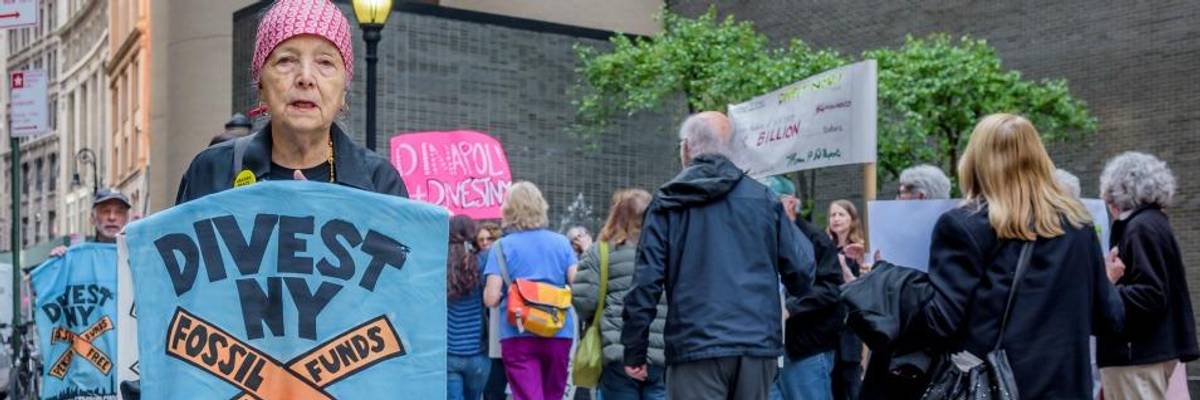
Fossil Free Divest NY, in coordination with community members and dozens of groups across America, held a rally outside the office of the New York State Comptroller in New York City, on May 14, 2018, to press N.Y. State Comptroller Tom DiNapoli divest the state pension fund from its $6 billion in fossil fuel holdings, including $1 billion in ExxonMobil. (Photo: Erik McGregor/LightRocket via Getty Images)
After eight years of tireless campaigning, the grassroots coalition DivestNY celebrated a major victory and turning point in the fossil fuel divestment movement Wednesday as New York State Comptroller Thomas DiNapoli announced the state's plan to end its investments in oil and gas by 2040, with reviews of the "riskiest" fossil fuel assets beginning in the coming weeks.
"This victory--after years of campaigning by so many people--is a great victory for the climate, because it both demonstrates the waning power of the fossil fuel industry and because it accelerates that decline. It is a morally bankrupt industry, and increasingly a financially bankrupt one as well."
-- Bill McKibben, 350.org
The divestment plan was praised by DivestNY as "a ground-breaking, systematic approach" and by 350.org as one that "goes beyond what activists and state lawmakers had envisioned," with a four-year timeline for divesting from some of the biggest corporate polluters in the world.
"New York's announcement is the biggest leap forward worldwide on climate finance action in 2020, an otherwise bleak year for the planet," said DivestNY. "It creates the most comprehensive program of any large public fund worldwide to divest from fossil fuels, decarbonize across a massive portfolio, and put major financial pressure on public companies--from auto companies to utilities--to align their operations with the scale of climate action needed to stave off worldwide catastrophe."
By March 2021, officials will complete a review of the $226 billion New York State Common Retirement Fund's investments in companies that generate at least 10% of their revenue from highly pollutive tar sands oil. The "riskiest" oil and gas stocks--potentially those involved with and major pipeline projects as well as industry majors like Exxon Mobil and Royal Dutch Shell--will be sold off by 2025 and the state will completely eliminate its investments in carbon polluters by 2040.
New York is now the first U.S. state to release a fossil fuel divestment plan, and the pension fund, which distributes $1 billion in benefits per year to state retirees, is the largest anywhere to divest. The Common Retirement Fund has historically invested more than $12 billion in the fossil fuel industry, including more than $1 billion in ExxonMobil.
At Earther, Brian Kahn described DiNapoli's announcement as "a lightning bolt that radically ups the ante" for the fight to secure divestment from oil, gas, and coal.
"We'll look back on this as a big moment in the story of the fossil fuel divestment movement," Richard Brooks, a campaign coordinator with 350.org, told Earther.
DiNapoli's announcement came after nearly a decade of campaigning by DivestNY, a coalition of more than 40 groups that was formed after Hurricane Sandy devastated parts of the New York City area in 2012.
"This victory--after years of campaigning by so many people--is a great victory for the climate, because it both demonstrates the waning power of the fossil fuel industry and because it accelerates that decline," said Bill McKibben, co-founder of 350.org. "It is a morally bankrupt industry, and increasingly a financially bankrupt one as well."
Early last year, CNBC host Jim Cramer told viewers that he could no longer advise them to invest in fossil fuels, as oil fell to its lowest level in more than a year and OPEC considered production cuts.
"My job is to help you try to make money," Cramer said, weeks before oil prices dropped to $0 per barrel in April amid the coronavirus pandemic. "And the honest truth is I don't think I can help you make money in the oil and gas stocks anymore."
May Boeve, executive director of 350.org, praised New York State for joining the government of Ireland, Norway's sovereign wealth fund, New York City, Oslo, and more than 1,200 institutions--all of which have announced divestment plans in the last two years--in "sending a global signal that economic recovery goes hand in hand with transformative climate action."
"This is a victory for all of us fighting for a safe climate, quality jobs, and an equitable society that holds fossil fuel companies accountable," said Boeve. "History will show December 2020 as a turn in the tides shifting finance away from coal, oil, and gas of the past, toward our communities and a just recovery. If the $226 billion New York State pension fund can do it, then every bank, pension fund, sovereign fund, and insurer can do it too. We call on the world's investment funds to take action like New York's bold and comprehensive model. Now."
Dear Common Dreams reader, It’s been nearly 30 years since I co-founded Common Dreams with my late wife, Lina Newhouser. We had the radical notion that journalism should serve the public good, not corporate profits. It was clear to us from the outset what it would take to build such a project. No paid advertisements. No corporate sponsors. No millionaire publisher telling us what to think or do. Many people said we wouldn't last a year, but we proved those doubters wrong. Together with a tremendous team of journalists and dedicated staff, we built an independent media outlet free from the constraints of profits and corporate control. Our mission has always been simple: To inform. To inspire. To ignite change for the common good. Building Common Dreams was not easy. Our survival was never guaranteed. When you take on the most powerful forces—Wall Street greed, fossil fuel industry destruction, Big Tech lobbyists, and uber-rich oligarchs who have spent billions upon billions rigging the economy and democracy in their favor—the only bulwark you have is supporters who believe in your work. But here’s the urgent message from me today. It's never been this bad out there. And it's never been this hard to keep us going. At the very moment Common Dreams is most needed, the threats we face are intensifying. We need your support now more than ever. We don't accept corporate advertising and never will. We don't have a paywall because we don't think people should be blocked from critical news based on their ability to pay. Everything we do is funded by the donations of readers like you. When everyone does the little they can afford, we are strong. But if that support retreats or dries up, so do we. Will you donate now to make sure Common Dreams not only survives but thrives? —Craig Brown, Co-founder |
After eight years of tireless campaigning, the grassroots coalition DivestNY celebrated a major victory and turning point in the fossil fuel divestment movement Wednesday as New York State Comptroller Thomas DiNapoli announced the state's plan to end its investments in oil and gas by 2040, with reviews of the "riskiest" fossil fuel assets beginning in the coming weeks.
"This victory--after years of campaigning by so many people--is a great victory for the climate, because it both demonstrates the waning power of the fossil fuel industry and because it accelerates that decline. It is a morally bankrupt industry, and increasingly a financially bankrupt one as well."
-- Bill McKibben, 350.org
The divestment plan was praised by DivestNY as "a ground-breaking, systematic approach" and by 350.org as one that "goes beyond what activists and state lawmakers had envisioned," with a four-year timeline for divesting from some of the biggest corporate polluters in the world.
"New York's announcement is the biggest leap forward worldwide on climate finance action in 2020, an otherwise bleak year for the planet," said DivestNY. "It creates the most comprehensive program of any large public fund worldwide to divest from fossil fuels, decarbonize across a massive portfolio, and put major financial pressure on public companies--from auto companies to utilities--to align their operations with the scale of climate action needed to stave off worldwide catastrophe."
By March 2021, officials will complete a review of the $226 billion New York State Common Retirement Fund's investments in companies that generate at least 10% of their revenue from highly pollutive tar sands oil. The "riskiest" oil and gas stocks--potentially those involved with and major pipeline projects as well as industry majors like Exxon Mobil and Royal Dutch Shell--will be sold off by 2025 and the state will completely eliminate its investments in carbon polluters by 2040.
New York is now the first U.S. state to release a fossil fuel divestment plan, and the pension fund, which distributes $1 billion in benefits per year to state retirees, is the largest anywhere to divest. The Common Retirement Fund has historically invested more than $12 billion in the fossil fuel industry, including more than $1 billion in ExxonMobil.
At Earther, Brian Kahn described DiNapoli's announcement as "a lightning bolt that radically ups the ante" for the fight to secure divestment from oil, gas, and coal.
"We'll look back on this as a big moment in the story of the fossil fuel divestment movement," Richard Brooks, a campaign coordinator with 350.org, told Earther.
DiNapoli's announcement came after nearly a decade of campaigning by DivestNY, a coalition of more than 40 groups that was formed after Hurricane Sandy devastated parts of the New York City area in 2012.
"This victory--after years of campaigning by so many people--is a great victory for the climate, because it both demonstrates the waning power of the fossil fuel industry and because it accelerates that decline," said Bill McKibben, co-founder of 350.org. "It is a morally bankrupt industry, and increasingly a financially bankrupt one as well."
Early last year, CNBC host Jim Cramer told viewers that he could no longer advise them to invest in fossil fuels, as oil fell to its lowest level in more than a year and OPEC considered production cuts.
"My job is to help you try to make money," Cramer said, weeks before oil prices dropped to $0 per barrel in April amid the coronavirus pandemic. "And the honest truth is I don't think I can help you make money in the oil and gas stocks anymore."
May Boeve, executive director of 350.org, praised New York State for joining the government of Ireland, Norway's sovereign wealth fund, New York City, Oslo, and more than 1,200 institutions--all of which have announced divestment plans in the last two years--in "sending a global signal that economic recovery goes hand in hand with transformative climate action."
"This is a victory for all of us fighting for a safe climate, quality jobs, and an equitable society that holds fossil fuel companies accountable," said Boeve. "History will show December 2020 as a turn in the tides shifting finance away from coal, oil, and gas of the past, toward our communities and a just recovery. If the $226 billion New York State pension fund can do it, then every bank, pension fund, sovereign fund, and insurer can do it too. We call on the world's investment funds to take action like New York's bold and comprehensive model. Now."
After eight years of tireless campaigning, the grassroots coalition DivestNY celebrated a major victory and turning point in the fossil fuel divestment movement Wednesday as New York State Comptroller Thomas DiNapoli announced the state's plan to end its investments in oil and gas by 2040, with reviews of the "riskiest" fossil fuel assets beginning in the coming weeks.
"This victory--after years of campaigning by so many people--is a great victory for the climate, because it both demonstrates the waning power of the fossil fuel industry and because it accelerates that decline. It is a morally bankrupt industry, and increasingly a financially bankrupt one as well."
-- Bill McKibben, 350.org
The divestment plan was praised by DivestNY as "a ground-breaking, systematic approach" and by 350.org as one that "goes beyond what activists and state lawmakers had envisioned," with a four-year timeline for divesting from some of the biggest corporate polluters in the world.
"New York's announcement is the biggest leap forward worldwide on climate finance action in 2020, an otherwise bleak year for the planet," said DivestNY. "It creates the most comprehensive program of any large public fund worldwide to divest from fossil fuels, decarbonize across a massive portfolio, and put major financial pressure on public companies--from auto companies to utilities--to align their operations with the scale of climate action needed to stave off worldwide catastrophe."
By March 2021, officials will complete a review of the $226 billion New York State Common Retirement Fund's investments in companies that generate at least 10% of their revenue from highly pollutive tar sands oil. The "riskiest" oil and gas stocks--potentially those involved with and major pipeline projects as well as industry majors like Exxon Mobil and Royal Dutch Shell--will be sold off by 2025 and the state will completely eliminate its investments in carbon polluters by 2040.
New York is now the first U.S. state to release a fossil fuel divestment plan, and the pension fund, which distributes $1 billion in benefits per year to state retirees, is the largest anywhere to divest. The Common Retirement Fund has historically invested more than $12 billion in the fossil fuel industry, including more than $1 billion in ExxonMobil.
At Earther, Brian Kahn described DiNapoli's announcement as "a lightning bolt that radically ups the ante" for the fight to secure divestment from oil, gas, and coal.
"We'll look back on this as a big moment in the story of the fossil fuel divestment movement," Richard Brooks, a campaign coordinator with 350.org, told Earther.
DiNapoli's announcement came after nearly a decade of campaigning by DivestNY, a coalition of more than 40 groups that was formed after Hurricane Sandy devastated parts of the New York City area in 2012.
"This victory--after years of campaigning by so many people--is a great victory for the climate, because it both demonstrates the waning power of the fossil fuel industry and because it accelerates that decline," said Bill McKibben, co-founder of 350.org. "It is a morally bankrupt industry, and increasingly a financially bankrupt one as well."
Early last year, CNBC host Jim Cramer told viewers that he could no longer advise them to invest in fossil fuels, as oil fell to its lowest level in more than a year and OPEC considered production cuts.
"My job is to help you try to make money," Cramer said, weeks before oil prices dropped to $0 per barrel in April amid the coronavirus pandemic. "And the honest truth is I don't think I can help you make money in the oil and gas stocks anymore."
May Boeve, executive director of 350.org, praised New York State for joining the government of Ireland, Norway's sovereign wealth fund, New York City, Oslo, and more than 1,200 institutions--all of which have announced divestment plans in the last two years--in "sending a global signal that economic recovery goes hand in hand with transformative climate action."
"This is a victory for all of us fighting for a safe climate, quality jobs, and an equitable society that holds fossil fuel companies accountable," said Boeve. "History will show December 2020 as a turn in the tides shifting finance away from coal, oil, and gas of the past, toward our communities and a just recovery. If the $226 billion New York State pension fund can do it, then every bank, pension fund, sovereign fund, and insurer can do it too. We call on the world's investment funds to take action like New York's bold and comprehensive model. Now."