

SUBSCRIBE TO OUR FREE NEWSLETTER
Daily news & progressive opinion—funded by the people, not the corporations—delivered straight to your inbox.
5
#000000
#FFFFFF
To donate by check, phone, or other method, see our More Ways to Give page.
Daily news & progressive opinion—funded by the people, not the corporations—delivered straight to your inbox.
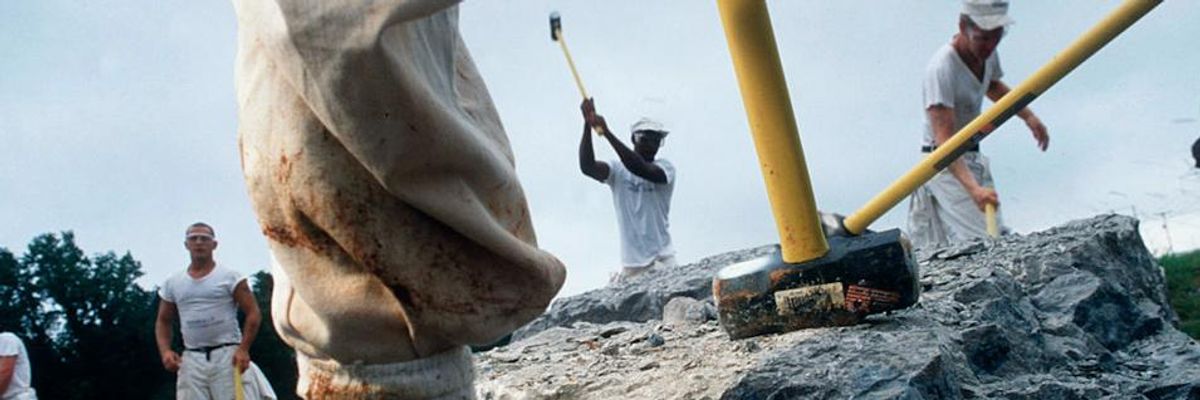
Alabama prisoners at Limestone Correctional Facility are seen here being forced to break up boulders with sledgehammers. (Photo: Mark Peterson/Corbis/Getty Images)
Over a century and a half after the 13th Amendment outlawed slavery and involuntary servitude for most--but not all--people in the United States, congressional Democrats this week introduced a joint resolution that would amend the Constitution and close what is arguably its most egregious loophole.
"Slavery is our nation's original sin and this loophole has been exploited for far too long to criminalize Black and Brown Americans."
--Sen. Ed Markey
The resolution (pdf), dubbed the Abolition Amendment, is led in the House of Representatives by outgoing Rep. Lacy Clay (D-Mo.) and in the Senate by Sens. Chris Van Hollen (D-Md.), Ed Markey (D-Mass.), Jeff Merkley (D-Ore.), and Bernie Sanders (I-Vt.). Thirteen additional House members joined in introducing the measure Wednesday.
As ratified in 1865, Section 1 of the 13th Amendment states that "neither slavery nor involuntary servitude, except as a punishment for crime whereof the party shall have been duly convicted, shall exist within the United States, or any place subject to their jurisdiction."
The new measure would change that language to "neither slavery nor involuntary servitude may be imposed as a punishment for a crime."
"Our 'Abolition Amendment' seeks to finish the job that President [Abraham] Lincoln started by ending the punishment clause in the 13th Amendment to eliminate the dehumanizing and discriminatory forced labor of prisoners for profit that has been used to drive the over-incarceration of African Americans since the end of the Civil War," Clay said in a statement.
Markey said that "as we take on the long and difficult challenge of rooting out systemic racism in our nation, ending the slavery loophole in the 13th Amendment is critical step in that challenge."
"Our 'Abolition Amendment' seeks to finish the job that President Lincoln started by ending the punishment clause in the 13th Amendment to eliminate the dehumanizing and discriminatory forced labor of prisoners for profit that has been used to drive the over-incarceration of African Americans since the end of the Civil War."
--Rep. Lacy Clay
"Slavery is our nation's original sin and this loophole has been exploited for far too long to criminalize Black and Brown Americans," he added. "I am proud to cosponsor the Abolition Amendment that pushes us as a nation to address our failures and create a path towards true justice for all Americans."
Human rights advocates applauded the resolution.
"This change is long overdue. The punishment clause in the 13th Amendment is a legacy of slavery that has allowed people incarcerated, disproportionately Black and Brown, to be exploited for decades," said Laura Pitter, deputy director of the U.S. Program at Human Rights Watch. "It is long past time that Congress excise this language from the U.S. Constitution which should begin to put an end the abusive practices derived from it."
The so-called slavery loophole was first used in the wake of abolition during the Reconstruction period, when under the so-called Black Codes Southern jurisdictions arrested many ostensibly free Black people for minor, often contrived, infractions such as loitering or vagrancy.
Under the so-called punishment clause, Southern sheriffs leased out Black prisoners to plantation owners--sometimes the same people who once owned them as chattel slaves--for free labor from which both police and planters profited. This lucrative system of "slavery by another name" persisted deep into the 20th century. It was so prevalent that at the turn of the 20th century nearly three-quarters of Alabama's revenue came from forced Black labor.
In recent decades, the 13th Amendment's permission of involuntary servitude has created one of the financial incentives for mass incarceration, which disproportionately affects Black, Brown, and Indigenous Americans.
"It also continued to fan the flames of the War on Drugs and the proliferation of 'three strike' laws, severe plea deals, and harsh mandatory minimum policies, which have had a disproportionate impact on communities of color in America for generations," asserted Merkley. "Those policies have driven an $80 billion detention industry and a rate of American incarceration that is nothing short of a crisis, with 2.3 million prisoners--20% of the world's incarcerated population--residing in the United States."
According to the Prison Policy Initiative, unpaid or nominally compensated prison labor generates $2 billion annually in the United States. Earlier this year, NPR reported major companies like Walmart, AT&T, Whole Foods, and Victoria's Secret have all profited from prison labor.
The slavery loophole was explored in depth in Ava DuVernay's Academy Award-nominated 2016 Netflix documentary 13th.
While the Abolition Amendment is unlikely to be taken up by the current Congress, Markey told the Associated Press--the first major media outlet to report the measure--that he hopes it will be revived next year. As Clay was defeated in November by Black Lives Matter activist Cori Bush, a new lead sponsor would be needed in the House. The measure would then face a tough uphill battle.
Article V requires two-thirds of the House and Senate propose, and at least 38 of 50 of state legislatures approve, a resolution to amend the Constitution. Alternately, an amendment can be passed via a constitutional convention called for by two-thirds of state legislatures.
None of the Constitution's 27 amendments have been enacted via convention. The most recent one, which concerns congressional pay, was originally proposed in 1789 but was then largely forgotten until a 19-year-old college student revived it in the 1980s, leading to its eventual ratification in 1992.
Dear Common Dreams reader, It’s been nearly 30 years since I co-founded Common Dreams with my late wife, Lina Newhouser. We had the radical notion that journalism should serve the public good, not corporate profits. It was clear to us from the outset what it would take to build such a project. No paid advertisements. No corporate sponsors. No millionaire publisher telling us what to think or do. Many people said we wouldn't last a year, but we proved those doubters wrong. Together with a tremendous team of journalists and dedicated staff, we built an independent media outlet free from the constraints of profits and corporate control. Our mission has always been simple: To inform. To inspire. To ignite change for the common good. Building Common Dreams was not easy. Our survival was never guaranteed. When you take on the most powerful forces—Wall Street greed, fossil fuel industry destruction, Big Tech lobbyists, and uber-rich oligarchs who have spent billions upon billions rigging the economy and democracy in their favor—the only bulwark you have is supporters who believe in your work. But here’s the urgent message from me today. It's never been this bad out there. And it's never been this hard to keep us going. At the very moment Common Dreams is most needed, the threats we face are intensifying. We need your support now more than ever. We don't accept corporate advertising and never will. We don't have a paywall because we don't think people should be blocked from critical news based on their ability to pay. Everything we do is funded by the donations of readers like you. When everyone does the little they can afford, we are strong. But if that support retreats or dries up, so do we. Will you donate now to make sure Common Dreams not only survives but thrives? —Craig Brown, Co-founder |
Over a century and a half after the 13th Amendment outlawed slavery and involuntary servitude for most--but not all--people in the United States, congressional Democrats this week introduced a joint resolution that would amend the Constitution and close what is arguably its most egregious loophole.
"Slavery is our nation's original sin and this loophole has been exploited for far too long to criminalize Black and Brown Americans."
--Sen. Ed Markey
The resolution (pdf), dubbed the Abolition Amendment, is led in the House of Representatives by outgoing Rep. Lacy Clay (D-Mo.) and in the Senate by Sens. Chris Van Hollen (D-Md.), Ed Markey (D-Mass.), Jeff Merkley (D-Ore.), and Bernie Sanders (I-Vt.). Thirteen additional House members joined in introducing the measure Wednesday.
As ratified in 1865, Section 1 of the 13th Amendment states that "neither slavery nor involuntary servitude, except as a punishment for crime whereof the party shall have been duly convicted, shall exist within the United States, or any place subject to their jurisdiction."
The new measure would change that language to "neither slavery nor involuntary servitude may be imposed as a punishment for a crime."
"Our 'Abolition Amendment' seeks to finish the job that President [Abraham] Lincoln started by ending the punishment clause in the 13th Amendment to eliminate the dehumanizing and discriminatory forced labor of prisoners for profit that has been used to drive the over-incarceration of African Americans since the end of the Civil War," Clay said in a statement.
Markey said that "as we take on the long and difficult challenge of rooting out systemic racism in our nation, ending the slavery loophole in the 13th Amendment is critical step in that challenge."
"Our 'Abolition Amendment' seeks to finish the job that President Lincoln started by ending the punishment clause in the 13th Amendment to eliminate the dehumanizing and discriminatory forced labor of prisoners for profit that has been used to drive the over-incarceration of African Americans since the end of the Civil War."
--Rep. Lacy Clay
"Slavery is our nation's original sin and this loophole has been exploited for far too long to criminalize Black and Brown Americans," he added. "I am proud to cosponsor the Abolition Amendment that pushes us as a nation to address our failures and create a path towards true justice for all Americans."
Human rights advocates applauded the resolution.
"This change is long overdue. The punishment clause in the 13th Amendment is a legacy of slavery that has allowed people incarcerated, disproportionately Black and Brown, to be exploited for decades," said Laura Pitter, deputy director of the U.S. Program at Human Rights Watch. "It is long past time that Congress excise this language from the U.S. Constitution which should begin to put an end the abusive practices derived from it."
The so-called slavery loophole was first used in the wake of abolition during the Reconstruction period, when under the so-called Black Codes Southern jurisdictions arrested many ostensibly free Black people for minor, often contrived, infractions such as loitering or vagrancy.
Under the so-called punishment clause, Southern sheriffs leased out Black prisoners to plantation owners--sometimes the same people who once owned them as chattel slaves--for free labor from which both police and planters profited. This lucrative system of "slavery by another name" persisted deep into the 20th century. It was so prevalent that at the turn of the 20th century nearly three-quarters of Alabama's revenue came from forced Black labor.
In recent decades, the 13th Amendment's permission of involuntary servitude has created one of the financial incentives for mass incarceration, which disproportionately affects Black, Brown, and Indigenous Americans.
"It also continued to fan the flames of the War on Drugs and the proliferation of 'three strike' laws, severe plea deals, and harsh mandatory minimum policies, which have had a disproportionate impact on communities of color in America for generations," asserted Merkley. "Those policies have driven an $80 billion detention industry and a rate of American incarceration that is nothing short of a crisis, with 2.3 million prisoners--20% of the world's incarcerated population--residing in the United States."
According to the Prison Policy Initiative, unpaid or nominally compensated prison labor generates $2 billion annually in the United States. Earlier this year, NPR reported major companies like Walmart, AT&T, Whole Foods, and Victoria's Secret have all profited from prison labor.
The slavery loophole was explored in depth in Ava DuVernay's Academy Award-nominated 2016 Netflix documentary 13th.
While the Abolition Amendment is unlikely to be taken up by the current Congress, Markey told the Associated Press--the first major media outlet to report the measure--that he hopes it will be revived next year. As Clay was defeated in November by Black Lives Matter activist Cori Bush, a new lead sponsor would be needed in the House. The measure would then face a tough uphill battle.
Article V requires two-thirds of the House and Senate propose, and at least 38 of 50 of state legislatures approve, a resolution to amend the Constitution. Alternately, an amendment can be passed via a constitutional convention called for by two-thirds of state legislatures.
None of the Constitution's 27 amendments have been enacted via convention. The most recent one, which concerns congressional pay, was originally proposed in 1789 but was then largely forgotten until a 19-year-old college student revived it in the 1980s, leading to its eventual ratification in 1992.
Over a century and a half after the 13th Amendment outlawed slavery and involuntary servitude for most--but not all--people in the United States, congressional Democrats this week introduced a joint resolution that would amend the Constitution and close what is arguably its most egregious loophole.
"Slavery is our nation's original sin and this loophole has been exploited for far too long to criminalize Black and Brown Americans."
--Sen. Ed Markey
The resolution (pdf), dubbed the Abolition Amendment, is led in the House of Representatives by outgoing Rep. Lacy Clay (D-Mo.) and in the Senate by Sens. Chris Van Hollen (D-Md.), Ed Markey (D-Mass.), Jeff Merkley (D-Ore.), and Bernie Sanders (I-Vt.). Thirteen additional House members joined in introducing the measure Wednesday.
As ratified in 1865, Section 1 of the 13th Amendment states that "neither slavery nor involuntary servitude, except as a punishment for crime whereof the party shall have been duly convicted, shall exist within the United States, or any place subject to their jurisdiction."
The new measure would change that language to "neither slavery nor involuntary servitude may be imposed as a punishment for a crime."
"Our 'Abolition Amendment' seeks to finish the job that President [Abraham] Lincoln started by ending the punishment clause in the 13th Amendment to eliminate the dehumanizing and discriminatory forced labor of prisoners for profit that has been used to drive the over-incarceration of African Americans since the end of the Civil War," Clay said in a statement.
Markey said that "as we take on the long and difficult challenge of rooting out systemic racism in our nation, ending the slavery loophole in the 13th Amendment is critical step in that challenge."
"Our 'Abolition Amendment' seeks to finish the job that President Lincoln started by ending the punishment clause in the 13th Amendment to eliminate the dehumanizing and discriminatory forced labor of prisoners for profit that has been used to drive the over-incarceration of African Americans since the end of the Civil War."
--Rep. Lacy Clay
"Slavery is our nation's original sin and this loophole has been exploited for far too long to criminalize Black and Brown Americans," he added. "I am proud to cosponsor the Abolition Amendment that pushes us as a nation to address our failures and create a path towards true justice for all Americans."
Human rights advocates applauded the resolution.
"This change is long overdue. The punishment clause in the 13th Amendment is a legacy of slavery that has allowed people incarcerated, disproportionately Black and Brown, to be exploited for decades," said Laura Pitter, deputy director of the U.S. Program at Human Rights Watch. "It is long past time that Congress excise this language from the U.S. Constitution which should begin to put an end the abusive practices derived from it."
The so-called slavery loophole was first used in the wake of abolition during the Reconstruction period, when under the so-called Black Codes Southern jurisdictions arrested many ostensibly free Black people for minor, often contrived, infractions such as loitering or vagrancy.
Under the so-called punishment clause, Southern sheriffs leased out Black prisoners to plantation owners--sometimes the same people who once owned them as chattel slaves--for free labor from which both police and planters profited. This lucrative system of "slavery by another name" persisted deep into the 20th century. It was so prevalent that at the turn of the 20th century nearly three-quarters of Alabama's revenue came from forced Black labor.
In recent decades, the 13th Amendment's permission of involuntary servitude has created one of the financial incentives for mass incarceration, which disproportionately affects Black, Brown, and Indigenous Americans.
"It also continued to fan the flames of the War on Drugs and the proliferation of 'three strike' laws, severe plea deals, and harsh mandatory minimum policies, which have had a disproportionate impact on communities of color in America for generations," asserted Merkley. "Those policies have driven an $80 billion detention industry and a rate of American incarceration that is nothing short of a crisis, with 2.3 million prisoners--20% of the world's incarcerated population--residing in the United States."
According to the Prison Policy Initiative, unpaid or nominally compensated prison labor generates $2 billion annually in the United States. Earlier this year, NPR reported major companies like Walmart, AT&T, Whole Foods, and Victoria's Secret have all profited from prison labor.
The slavery loophole was explored in depth in Ava DuVernay's Academy Award-nominated 2016 Netflix documentary 13th.
While the Abolition Amendment is unlikely to be taken up by the current Congress, Markey told the Associated Press--the first major media outlet to report the measure--that he hopes it will be revived next year. As Clay was defeated in November by Black Lives Matter activist Cori Bush, a new lead sponsor would be needed in the House. The measure would then face a tough uphill battle.
Article V requires two-thirds of the House and Senate propose, and at least 38 of 50 of state legislatures approve, a resolution to amend the Constitution. Alternately, an amendment can be passed via a constitutional convention called for by two-thirds of state legislatures.
None of the Constitution's 27 amendments have been enacted via convention. The most recent one, which concerns congressional pay, was originally proposed in 1789 but was then largely forgotten until a 19-year-old college student revived it in the 1980s, leading to its eventual ratification in 1992.

