SUBSCRIBE TO OUR FREE NEWSLETTER
Daily news & progressive opinion—funded by the people, not the corporations—delivered straight to your inbox.
5
#000000
#FFFFFF
To donate by check, phone, or other method, see our More Ways to Give page.
Daily news & progressive opinion—funded by the people, not the corporations—delivered straight to your inbox.
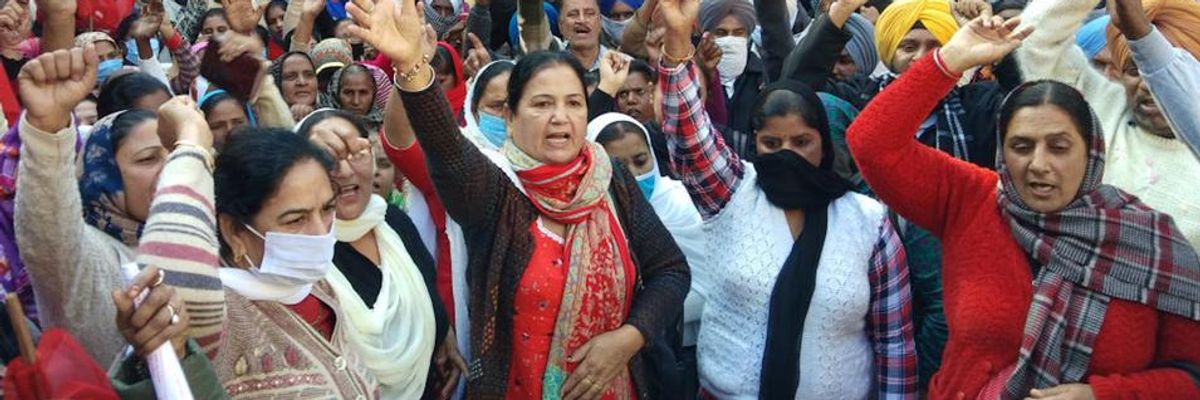
Communist Party of India (CPI) Amritsar members participate in a nationwide strike called by trade unions against the government's economic policies, at Bhandari Bridge on November 26, 2020 in Amritsar, India. (Photo: Sameer Sehgal/Hindustan Times via Getty Images)
In what is being called the largest protest in human history, over 250 million Indians have taken to the streets nationwide over the past week to protest agriculture deregulation and other neoliberal policies of Prime Minister Narendra Modi's right-wing Hindu nationalist government.
"This government has pushed us into hell. We are barely able to survive, ground down between price rises on the one hand and low wages on the other."
--Sukhdev Prasad, farmer
Despite being attacked by police and security forces with water cannons, chemical agents, batons, and other weapons, the peaceful farmer-led demonstrators on Thursday vowed to continue their protests after talks in the capital New Delhi with the central government--which is refusing to bow to the protesters' demands--broke down.
The farmers are being barred from entering the capital; however, hundreds of thousands of them have massed at entry points to the city, where many of them are encamped.
"The government did not agree to our points and rejected our demands outright," Chanda Singh, a farmer and protest organizer who on Tuesday met with Agriculture Minister Narendra Singh, told Al Jazeera. "The members of the delegation from the government side were not ready to listen to any of our demands and they have left us with no choice but to protest on the streets."
"We will continue our protest unless our demands are met," Singh vowed.
Amid multiple crises--including an economic recession that has seen GDP plummet by a staggering 23.9% and unemployment soar to an unprecedented 27% this year, as well as the ongoing coronavirus pandemic--hundreds of millions of Indians rose up on November 26, Constitution Day, to protest their shared hardship in a massive general strike.
The strike--which was led by farmers and labor unions and joined by allies including student activists, industrial and transportation workers, women's rights organizations, domestic servants, and civil society groups--was held to demand a set of actions by the BJP-led government. These include:
"This government has pushed us into hell," fumed Sukhdev Prasad, a lathe machine operator from Ghaziabad who took part in the strike. "We are barely able to survive, ground down between price rises on the one hand and low wages on the other," he told People's World. "Now, they have changed labor laws so that employers are sitting on our chests."
Economic inequality was a central theme of the protests. P. Sainath, a veteran journalist and founder of the People's Archive of Rural India (PARI), told Democracy Now!:
The entire protests, driven by a deepening agrarian crisis, are very fundamentally tied to the larger structural inequalities... In just four months of the pandemic, just up to July... Indian billionaires, dollar billionaires--there's about 120 of them--added 35% to their wealth... and it's now around $485 billion cumulatively...
At the same time, there are new studies showing us 76% of the rural population... cannot afford a nutritious meal. They cannot afford a basic nutritious diet, even if they spend two-thirds of their income on food... So you're seeing these unbelievable gaps, phenomenal gaps. India ranks fourth or fifth in the list of dollar billionaires in the world, and 129th on the U.N. Human Development Index.
Others protested the government's response to the coronavirus pandemic. In a statement, the Bombay University and College Teachers' Union said that "this strike is against the devastating health and economic crisis unleashed by Covid-19 and the lockdown on the working people of the country."
"This strike is against the devastating health and economic crisis unleashed by Covid-19 and the lockdown on the working people of the country."
--Bombay University and College Teachers' Union
"This has been further aggravated by a series of anti-people legislations on agriculture and the labor code enacted by the central government," the union said. "Along with these measures, the National Education Policy (NEP) imposed on the nation during the pandemic will further cause irreparable harm to the equity of and access to education."
Modi has dismissed the farmers' concerns, calling the protesters "misled" and blaming the opposition for the crisis.
"The farmers are being misled on these historic agriculture reform laws by the same people who for decades have misled them," Modi said at a Monday rally, adding that his "intentions are as holy as the water of river Ganga."
Rahul Gandhi, head of the opposition Congress party, responded by accusing Modi of crony capitalism and serving foreign corporations at the expense of his own people.
"Our farmers are standing up against the black laws and have reached Delhi leaving their farms and families behind," he said. "Do you want to stand with them or with Modi's capitalist friends?"
Dear Common Dreams reader, It’s been nearly 30 years since I co-founded Common Dreams with my late wife, Lina Newhouser. We had the radical notion that journalism should serve the public good, not corporate profits. It was clear to us from the outset what it would take to build such a project. No paid advertisements. No corporate sponsors. No millionaire publisher telling us what to think or do. Many people said we wouldn't last a year, but we proved those doubters wrong. Together with a tremendous team of journalists and dedicated staff, we built an independent media outlet free from the constraints of profits and corporate control. Our mission has always been simple: To inform. To inspire. To ignite change for the common good. Building Common Dreams was not easy. Our survival was never guaranteed. When you take on the most powerful forces—Wall Street greed, fossil fuel industry destruction, Big Tech lobbyists, and uber-rich oligarchs who have spent billions upon billions rigging the economy and democracy in their favor—the only bulwark you have is supporters who believe in your work. But here’s the urgent message from me today. It's never been this bad out there. And it's never been this hard to keep us going. At the very moment Common Dreams is most needed, the threats we face are intensifying. We need your support now more than ever. We don't accept corporate advertising and never will. We don't have a paywall because we don't think people should be blocked from critical news based on their ability to pay. Everything we do is funded by the donations of readers like you. When everyone does the little they can afford, we are strong. But if that support retreats or dries up, so do we. Will you donate now to make sure Common Dreams not only survives but thrives? —Craig Brown, Co-founder |
In what is being called the largest protest in human history, over 250 million Indians have taken to the streets nationwide over the past week to protest agriculture deregulation and other neoliberal policies of Prime Minister Narendra Modi's right-wing Hindu nationalist government.
"This government has pushed us into hell. We are barely able to survive, ground down between price rises on the one hand and low wages on the other."
--Sukhdev Prasad, farmer
Despite being attacked by police and security forces with water cannons, chemical agents, batons, and other weapons, the peaceful farmer-led demonstrators on Thursday vowed to continue their protests after talks in the capital New Delhi with the central government--which is refusing to bow to the protesters' demands--broke down.
The farmers are being barred from entering the capital; however, hundreds of thousands of them have massed at entry points to the city, where many of them are encamped.
"The government did not agree to our points and rejected our demands outright," Chanda Singh, a farmer and protest organizer who on Tuesday met with Agriculture Minister Narendra Singh, told Al Jazeera. "The members of the delegation from the government side were not ready to listen to any of our demands and they have left us with no choice but to protest on the streets."
"We will continue our protest unless our demands are met," Singh vowed.
Amid multiple crises--including an economic recession that has seen GDP plummet by a staggering 23.9% and unemployment soar to an unprecedented 27% this year, as well as the ongoing coronavirus pandemic--hundreds of millions of Indians rose up on November 26, Constitution Day, to protest their shared hardship in a massive general strike.
The strike--which was led by farmers and labor unions and joined by allies including student activists, industrial and transportation workers, women's rights organizations, domestic servants, and civil society groups--was held to demand a set of actions by the BJP-led government. These include:
"This government has pushed us into hell," fumed Sukhdev Prasad, a lathe machine operator from Ghaziabad who took part in the strike. "We are barely able to survive, ground down between price rises on the one hand and low wages on the other," he told People's World. "Now, they have changed labor laws so that employers are sitting on our chests."
Economic inequality was a central theme of the protests. P. Sainath, a veteran journalist and founder of the People's Archive of Rural India (PARI), told Democracy Now!:
The entire protests, driven by a deepening agrarian crisis, are very fundamentally tied to the larger structural inequalities... In just four months of the pandemic, just up to July... Indian billionaires, dollar billionaires--there's about 120 of them--added 35% to their wealth... and it's now around $485 billion cumulatively...
At the same time, there are new studies showing us 76% of the rural population... cannot afford a nutritious meal. They cannot afford a basic nutritious diet, even if they spend two-thirds of their income on food... So you're seeing these unbelievable gaps, phenomenal gaps. India ranks fourth or fifth in the list of dollar billionaires in the world, and 129th on the U.N. Human Development Index.
Others protested the government's response to the coronavirus pandemic. In a statement, the Bombay University and College Teachers' Union said that "this strike is against the devastating health and economic crisis unleashed by Covid-19 and the lockdown on the working people of the country."
"This strike is against the devastating health and economic crisis unleashed by Covid-19 and the lockdown on the working people of the country."
--Bombay University and College Teachers' Union
"This has been further aggravated by a series of anti-people legislations on agriculture and the labor code enacted by the central government," the union said. "Along with these measures, the National Education Policy (NEP) imposed on the nation during the pandemic will further cause irreparable harm to the equity of and access to education."
Modi has dismissed the farmers' concerns, calling the protesters "misled" and blaming the opposition for the crisis.
"The farmers are being misled on these historic agriculture reform laws by the same people who for decades have misled them," Modi said at a Monday rally, adding that his "intentions are as holy as the water of river Ganga."
Rahul Gandhi, head of the opposition Congress party, responded by accusing Modi of crony capitalism and serving foreign corporations at the expense of his own people.
"Our farmers are standing up against the black laws and have reached Delhi leaving their farms and families behind," he said. "Do you want to stand with them or with Modi's capitalist friends?"
In what is being called the largest protest in human history, over 250 million Indians have taken to the streets nationwide over the past week to protest agriculture deregulation and other neoliberal policies of Prime Minister Narendra Modi's right-wing Hindu nationalist government.
"This government has pushed us into hell. We are barely able to survive, ground down between price rises on the one hand and low wages on the other."
--Sukhdev Prasad, farmer
Despite being attacked by police and security forces with water cannons, chemical agents, batons, and other weapons, the peaceful farmer-led demonstrators on Thursday vowed to continue their protests after talks in the capital New Delhi with the central government--which is refusing to bow to the protesters' demands--broke down.
The farmers are being barred from entering the capital; however, hundreds of thousands of them have massed at entry points to the city, where many of them are encamped.
"The government did not agree to our points and rejected our demands outright," Chanda Singh, a farmer and protest organizer who on Tuesday met with Agriculture Minister Narendra Singh, told Al Jazeera. "The members of the delegation from the government side were not ready to listen to any of our demands and they have left us with no choice but to protest on the streets."
"We will continue our protest unless our demands are met," Singh vowed.
Amid multiple crises--including an economic recession that has seen GDP plummet by a staggering 23.9% and unemployment soar to an unprecedented 27% this year, as well as the ongoing coronavirus pandemic--hundreds of millions of Indians rose up on November 26, Constitution Day, to protest their shared hardship in a massive general strike.
The strike--which was led by farmers and labor unions and joined by allies including student activists, industrial and transportation workers, women's rights organizations, domestic servants, and civil society groups--was held to demand a set of actions by the BJP-led government. These include:
"This government has pushed us into hell," fumed Sukhdev Prasad, a lathe machine operator from Ghaziabad who took part in the strike. "We are barely able to survive, ground down between price rises on the one hand and low wages on the other," he told People's World. "Now, they have changed labor laws so that employers are sitting on our chests."
Economic inequality was a central theme of the protests. P. Sainath, a veteran journalist and founder of the People's Archive of Rural India (PARI), told Democracy Now!:
The entire protests, driven by a deepening agrarian crisis, are very fundamentally tied to the larger structural inequalities... In just four months of the pandemic, just up to July... Indian billionaires, dollar billionaires--there's about 120 of them--added 35% to their wealth... and it's now around $485 billion cumulatively...
At the same time, there are new studies showing us 76% of the rural population... cannot afford a nutritious meal. They cannot afford a basic nutritious diet, even if they spend two-thirds of their income on food... So you're seeing these unbelievable gaps, phenomenal gaps. India ranks fourth or fifth in the list of dollar billionaires in the world, and 129th on the U.N. Human Development Index.
Others protested the government's response to the coronavirus pandemic. In a statement, the Bombay University and College Teachers' Union said that "this strike is against the devastating health and economic crisis unleashed by Covid-19 and the lockdown on the working people of the country."
"This strike is against the devastating health and economic crisis unleashed by Covid-19 and the lockdown on the working people of the country."
--Bombay University and College Teachers' Union
"This has been further aggravated by a series of anti-people legislations on agriculture and the labor code enacted by the central government," the union said. "Along with these measures, the National Education Policy (NEP) imposed on the nation during the pandemic will further cause irreparable harm to the equity of and access to education."
Modi has dismissed the farmers' concerns, calling the protesters "misled" and blaming the opposition for the crisis.
"The farmers are being misled on these historic agriculture reform laws by the same people who for decades have misled them," Modi said at a Monday rally, adding that his "intentions are as holy as the water of river Ganga."
Rahul Gandhi, head of the opposition Congress party, responded by accusing Modi of crony capitalism and serving foreign corporations at the expense of his own people.
"Our farmers are standing up against the black laws and have reached Delhi leaving their farms and families behind," he said. "Do you want to stand with them or with Modi's capitalist friends?"