SUBSCRIBE TO OUR FREE NEWSLETTER
Daily news & progressive opinion—funded by the people, not the corporations—delivered straight to your inbox.
5
#000000
#FFFFFF
To donate by check, phone, or other method, see our More Ways to Give page.
Daily news & progressive opinion—funded by the people, not the corporations—delivered straight to your inbox.
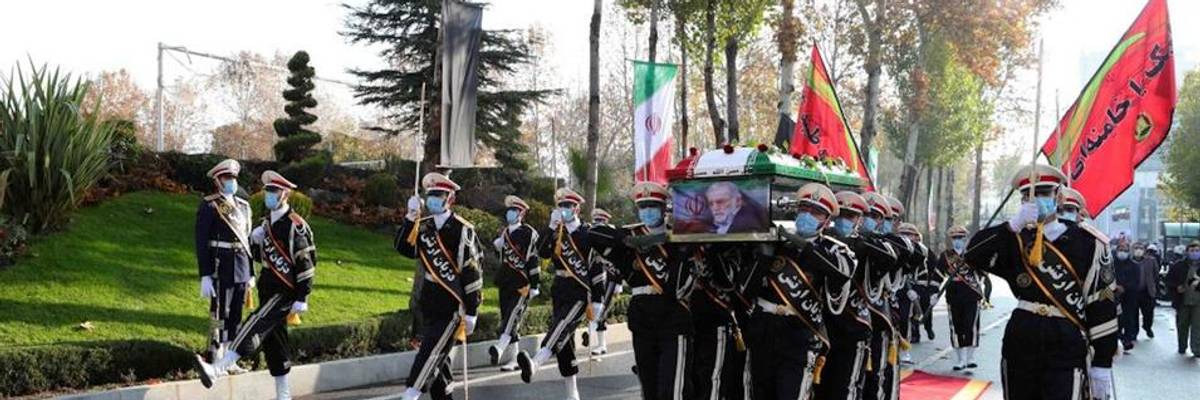
The funeral ceremony of Iranian nuclear scientist Mohsen Fakhrizadeh Mahabadi, held at the Defense Ministry of Iran in Tehran, on November 30, 2020. (Photo: Iranian Defense Ministry/Andalou Agency/Getty Images)
Progressive experts on U.S.-Iranian relations on Wednesday urged caution--and expressed hope for renewed diplomatic efforts from the incoming Biden administration--following news that Iran's parliament voted to increase uranium enrichment just days after the nation's top nuclear scientist was gunned down in an assassination plot endorsed by President Donald Trump and which many believe was carried out by the Israeli government.
"There is only one path that has succeeded in altering Iran's calculations and rolling back Iran's nuclear program: persistent, direct, and multilateral diplomacy."
--Ryan Costello, NIAC
Iran's response to the November 27 murder of nuclear physicist Dr. Mohsen Fakhrizadeh came on Tuesday in the form of a bill in the Majlis, or parliament, that would suspend United Nations inspections of the country's nuclear facilities and compel the government to increase uranium enrichment if Euoprean nations that signed the landmark 2015 Joint Comprehensive Plan of Action (JCPOA) don't provide relief from deadly U.S.-led economic sanctions.
Iranian state media reported that 251 of 260 Majlis members voted to approve a draft of the bill, even as President Hassan Rouhani opposed the measure, believing it to be "harmful to the trend of diplomatic activities" in service of saving the JCPOA, commonly called the Iran nuclear deal. Under pressure from hardliners in the U.S. and Israel, President Donald Trump unilaterally abrogated the six-nation agreement in May 2018--even after certifying Tehran regime's compliance with its terms.
Rouhani's opposition to parliament's move is likely aimed at President-elect Joe Biden, who repeated his intention to re-engage Iran and rejoin the JCPOA in an interview with New York Times columnist Thomas Friedman published Wednesday.
As it has periodically done over the past two decades, the U.S. intelligence community last year affirmed that Iran is not trying to build nuclear weapons and that Tehran remained in compliance with the JCPOA even after the U.S. reneged on the deal.
Faced with such inconvenient reality, neoconservatives and others hostile to Iran have resorted to either misinformation or shifting the goal posts regarding Tehran's intentions or military capabilities.
Now, say hawkish U.S. voices like Friedman, it's not about nuclear weapons, but rather long-range missiles and even its drones.
"Look," Biden told Friedman, "there's a lot of talk about precision missiles and all range of other things that are destabilizing the region. [But] the best way to achieve getting some stability in the region" involves dealing "with the nuclear program."
Biden's willingness to re-engage the Iranian regime and Rouhani's opposition to the Majlis bill were welcomed by the National Iranian American Council (NIAC), whose policy director, Ryan Costello, on Wednesday condemned what he called the Trump administration's "outrageous and illegal actions" that he said are "aimed at closing the door on diplomacy" and making any Biden-era rapprochement more difficult. Costello warned that:
It is likely that hawks will twist Iran's reversible counter-escalation out of perspective and call for more disastrous military steps on Trump's way out the door. There is only one path that has succeeded in altering Iran's calculations and rolling back Iran's nuclear program: persistent, direct, and multilateral diplomacy. President-elect Biden has recently reiterated his desire to return the U.S. to its commitments under the nuclear deal and the Iranian parliament's latest move, however unhelpful, should not jeopardize this commitment.
The window to get back into the nuclear deal, and stave off growing threats of war, will be short. It is imperative that those committed to resolving the U.S.-Iran standoff through diplomacy stay resolute and move quickly to shore up the biggest diplomatic breakthrough between the two countries in more than 40 years.
Costello's warning mirrored recent exhortations from progressive lawmakers and peace activists.
"The assassination of Mohsen Fakhrizadeh was reckless, provocative, and illegal," Sen. Bernie Sanders (I-Vt.) said on Saturday. "As a new administration takes power, it was clearly intended to undermine U.S.-Iran diplomacy. We must not allow that to happen. Diplomacy, not murder, is the best path forward."
On Monday, Rep. Ro Khanna (D-Calif.) cautioned: "We cannot let anyone drag us into a new war. Diplomacy is the way to curb Iran's nuclear ambitions and prevent catastrophic war."
Dear Common Dreams reader, It’s been nearly 30 years since I co-founded Common Dreams with my late wife, Lina Newhouser. We had the radical notion that journalism should serve the public good, not corporate profits. It was clear to us from the outset what it would take to build such a project. No paid advertisements. No corporate sponsors. No millionaire publisher telling us what to think or do. Many people said we wouldn't last a year, but we proved those doubters wrong. Together with a tremendous team of journalists and dedicated staff, we built an independent media outlet free from the constraints of profits and corporate control. Our mission has always been simple: To inform. To inspire. To ignite change for the common good. Building Common Dreams was not easy. Our survival was never guaranteed. When you take on the most powerful forces—Wall Street greed, fossil fuel industry destruction, Big Tech lobbyists, and uber-rich oligarchs who have spent billions upon billions rigging the economy and democracy in their favor—the only bulwark you have is supporters who believe in your work. But here’s the urgent message from me today. It's never been this bad out there. And it's never been this hard to keep us going. At the very moment Common Dreams is most needed, the threats we face are intensifying. We need your support now more than ever. We don't accept corporate advertising and never will. We don't have a paywall because we don't think people should be blocked from critical news based on their ability to pay. Everything we do is funded by the donations of readers like you. When everyone does the little they can afford, we are strong. But if that support retreats or dries up, so do we. Will you donate now to make sure Common Dreams not only survives but thrives? —Craig Brown, Co-founder |
Progressive experts on U.S.-Iranian relations on Wednesday urged caution--and expressed hope for renewed diplomatic efforts from the incoming Biden administration--following news that Iran's parliament voted to increase uranium enrichment just days after the nation's top nuclear scientist was gunned down in an assassination plot endorsed by President Donald Trump and which many believe was carried out by the Israeli government.
"There is only one path that has succeeded in altering Iran's calculations and rolling back Iran's nuclear program: persistent, direct, and multilateral diplomacy."
--Ryan Costello, NIAC
Iran's response to the November 27 murder of nuclear physicist Dr. Mohsen Fakhrizadeh came on Tuesday in the form of a bill in the Majlis, or parliament, that would suspend United Nations inspections of the country's nuclear facilities and compel the government to increase uranium enrichment if Euoprean nations that signed the landmark 2015 Joint Comprehensive Plan of Action (JCPOA) don't provide relief from deadly U.S.-led economic sanctions.
Iranian state media reported that 251 of 260 Majlis members voted to approve a draft of the bill, even as President Hassan Rouhani opposed the measure, believing it to be "harmful to the trend of diplomatic activities" in service of saving the JCPOA, commonly called the Iran nuclear deal. Under pressure from hardliners in the U.S. and Israel, President Donald Trump unilaterally abrogated the six-nation agreement in May 2018--even after certifying Tehran regime's compliance with its terms.
Rouhani's opposition to parliament's move is likely aimed at President-elect Joe Biden, who repeated his intention to re-engage Iran and rejoin the JCPOA in an interview with New York Times columnist Thomas Friedman published Wednesday.
As it has periodically done over the past two decades, the U.S. intelligence community last year affirmed that Iran is not trying to build nuclear weapons and that Tehran remained in compliance with the JCPOA even after the U.S. reneged on the deal.
Faced with such inconvenient reality, neoconservatives and others hostile to Iran have resorted to either misinformation or shifting the goal posts regarding Tehran's intentions or military capabilities.
Now, say hawkish U.S. voices like Friedman, it's not about nuclear weapons, but rather long-range missiles and even its drones.
"Look," Biden told Friedman, "there's a lot of talk about precision missiles and all range of other things that are destabilizing the region. [But] the best way to achieve getting some stability in the region" involves dealing "with the nuclear program."
Biden's willingness to re-engage the Iranian regime and Rouhani's opposition to the Majlis bill were welcomed by the National Iranian American Council (NIAC), whose policy director, Ryan Costello, on Wednesday condemned what he called the Trump administration's "outrageous and illegal actions" that he said are "aimed at closing the door on diplomacy" and making any Biden-era rapprochement more difficult. Costello warned that:
It is likely that hawks will twist Iran's reversible counter-escalation out of perspective and call for more disastrous military steps on Trump's way out the door. There is only one path that has succeeded in altering Iran's calculations and rolling back Iran's nuclear program: persistent, direct, and multilateral diplomacy. President-elect Biden has recently reiterated his desire to return the U.S. to its commitments under the nuclear deal and the Iranian parliament's latest move, however unhelpful, should not jeopardize this commitment.
The window to get back into the nuclear deal, and stave off growing threats of war, will be short. It is imperative that those committed to resolving the U.S.-Iran standoff through diplomacy stay resolute and move quickly to shore up the biggest diplomatic breakthrough between the two countries in more than 40 years.
Costello's warning mirrored recent exhortations from progressive lawmakers and peace activists.
"The assassination of Mohsen Fakhrizadeh was reckless, provocative, and illegal," Sen. Bernie Sanders (I-Vt.) said on Saturday. "As a new administration takes power, it was clearly intended to undermine U.S.-Iran diplomacy. We must not allow that to happen. Diplomacy, not murder, is the best path forward."
On Monday, Rep. Ro Khanna (D-Calif.) cautioned: "We cannot let anyone drag us into a new war. Diplomacy is the way to curb Iran's nuclear ambitions and prevent catastrophic war."
Progressive experts on U.S.-Iranian relations on Wednesday urged caution--and expressed hope for renewed diplomatic efforts from the incoming Biden administration--following news that Iran's parliament voted to increase uranium enrichment just days after the nation's top nuclear scientist was gunned down in an assassination plot endorsed by President Donald Trump and which many believe was carried out by the Israeli government.
"There is only one path that has succeeded in altering Iran's calculations and rolling back Iran's nuclear program: persistent, direct, and multilateral diplomacy."
--Ryan Costello, NIAC
Iran's response to the November 27 murder of nuclear physicist Dr. Mohsen Fakhrizadeh came on Tuesday in the form of a bill in the Majlis, or parliament, that would suspend United Nations inspections of the country's nuclear facilities and compel the government to increase uranium enrichment if Euoprean nations that signed the landmark 2015 Joint Comprehensive Plan of Action (JCPOA) don't provide relief from deadly U.S.-led economic sanctions.
Iranian state media reported that 251 of 260 Majlis members voted to approve a draft of the bill, even as President Hassan Rouhani opposed the measure, believing it to be "harmful to the trend of diplomatic activities" in service of saving the JCPOA, commonly called the Iran nuclear deal. Under pressure from hardliners in the U.S. and Israel, President Donald Trump unilaterally abrogated the six-nation agreement in May 2018--even after certifying Tehran regime's compliance with its terms.
Rouhani's opposition to parliament's move is likely aimed at President-elect Joe Biden, who repeated his intention to re-engage Iran and rejoin the JCPOA in an interview with New York Times columnist Thomas Friedman published Wednesday.
As it has periodically done over the past two decades, the U.S. intelligence community last year affirmed that Iran is not trying to build nuclear weapons and that Tehran remained in compliance with the JCPOA even after the U.S. reneged on the deal.
Faced with such inconvenient reality, neoconservatives and others hostile to Iran have resorted to either misinformation or shifting the goal posts regarding Tehran's intentions or military capabilities.
Now, say hawkish U.S. voices like Friedman, it's not about nuclear weapons, but rather long-range missiles and even its drones.
"Look," Biden told Friedman, "there's a lot of talk about precision missiles and all range of other things that are destabilizing the region. [But] the best way to achieve getting some stability in the region" involves dealing "with the nuclear program."
Biden's willingness to re-engage the Iranian regime and Rouhani's opposition to the Majlis bill were welcomed by the National Iranian American Council (NIAC), whose policy director, Ryan Costello, on Wednesday condemned what he called the Trump administration's "outrageous and illegal actions" that he said are "aimed at closing the door on diplomacy" and making any Biden-era rapprochement more difficult. Costello warned that:
It is likely that hawks will twist Iran's reversible counter-escalation out of perspective and call for more disastrous military steps on Trump's way out the door. There is only one path that has succeeded in altering Iran's calculations and rolling back Iran's nuclear program: persistent, direct, and multilateral diplomacy. President-elect Biden has recently reiterated his desire to return the U.S. to its commitments under the nuclear deal and the Iranian parliament's latest move, however unhelpful, should not jeopardize this commitment.
The window to get back into the nuclear deal, and stave off growing threats of war, will be short. It is imperative that those committed to resolving the U.S.-Iran standoff through diplomacy stay resolute and move quickly to shore up the biggest diplomatic breakthrough between the two countries in more than 40 years.
Costello's warning mirrored recent exhortations from progressive lawmakers and peace activists.
"The assassination of Mohsen Fakhrizadeh was reckless, provocative, and illegal," Sen. Bernie Sanders (I-Vt.) said on Saturday. "As a new administration takes power, it was clearly intended to undermine U.S.-Iran diplomacy. We must not allow that to happen. Diplomacy, not murder, is the best path forward."
On Monday, Rep. Ro Khanna (D-Calif.) cautioned: "We cannot let anyone drag us into a new war. Diplomacy is the way to curb Iran's nuclear ambitions and prevent catastrophic war."