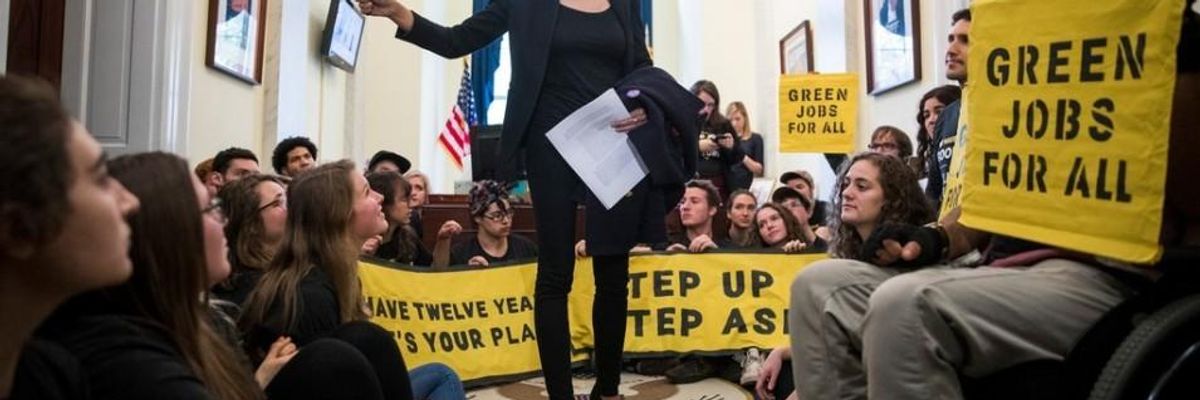
Rep. Alexandria Ocasio-Cortez (D-N.Y.) speaks to Sunrise Movement activists protesting in the offices of Rep. Nancy Pelosi (D-Calif.) in Washington D.C., on Nov. 13, 2018. (Photo: Sarah Silbiger/The New York Times via Redux)
99% of Green New Deal Co-Sponsors Won Their Races This Cycle: Analysis
"Saying progressive policies held Democrats back from expanding their House majority/taking the Senate just doesn't hold water with data available so far."
Shedding more light on a significant electoral trend that progressives have drawn attention to in the aftermath of the 2020 U.S. election, a new analysis by Earther found that of the 93 House co-sponsors of the Green New Deal resolution who ran for reelection this year, only one lost their congressional race.
"Simply put," wrote journalist Brian Kahn in Earther, "the Green New Deal is not a political loser," including for representatives in swing districts.
"Simply put, the Green New Deal is not a political loser."
--Brian Kahn, journalist
Kahn identified four House co-sponsors who represent districts that "range from very slightly Democratic to moderately Republican," according to Cook Political Report's Partisan Voting Index.
Of those four, three--Reps. Mike Levin (D-Calif.), Jahana Hayes (D- Conn.), and Peter DeFazio (D-Ore.)--have already "decisively won their reelection bids," while the fourth, Rep. Tom Suozzi (D- N.Y.), is projected to win handily "once all mail-in ballots are counted."
"This quick-and-dirty analysis," Kahn said, "aligns with other data showing that representatives who have sponsored and voted for progressive policies were not punished by voters."
As Common Dreams reported this weekend, Rep. Alexandria Ocasio-Cortez (D-N.Y.) and others pointed out that every single congressional member who ran for reelection this year as a supporter of Medicare for All won their race.
Ocasio-Cortez hinted that her team would be "running numbers" on the Green New Deal--of which she is the lead House sponsor--next. As Earther's analysis showed, the reelection rate for representatives who co-sponsored the Green New Deal resolution was nearly 100% as well, with 92 out of those 93 congressional members retaining their seat.
"Saying progressive policies held Democrats back from expanding their House majority/taking the Senate just doesn't hold water with data available so far," Kahn noted on Twitter.
As Common Dreams reported last week, the blame game within the Democratic Party began immediately in the wake of its lackluster showing in down-ticket contests, with officials from the right and left flanks of the party pointing fingers at each other.
The New York Times allowed Ocasio-Cortez to make the evidence-backed case for the positive role played by the left in the 2020 election, but for the most part, corporate media outlets over the weekend did their best to cement the right-wing narrative that progressive policy ideas are to blame for the party's underwhelming performance in down-ballot races.
So-called moderate Republicans like former Ohio Gov. John Kasich and Sen. Mitt Romney of Utah, as well as moderate Democrats like South Carolina Congressman James Clyburn, were given airtime on CNN to falsely claim Americans don't back egalitarian policy proposals.
These assaults continue despite recent polling, including surveys commissioned by Fox News, that indicates the majoritarian popularity of left-wing policy ideas eschewed by Democrats and Republicans alike, including an expanded role for the government in the provision of healthcare and the creation of green jobs in energy and infrastructure.
In Georgia, for instance, where Democrats have a chance to secure a Senate majority if they win both runoff races, voters prefer a universal public option to the Affordable Care Act.
Since voting ended last week, however, numerous corporate-friendly politicians have advocated for shifting the nation's political center of gravity rightward, despite the fact that politicians who supported popular redistributive policies, such as Medicare for All and the Green New Deal, were reelected at higher rates than ostensibly centrist Democrats, including in swing districts.
"The people who actually back progressive policies came through the election largely unscathed and, in many cases, fared better than their more conservative Democratic counterparts in swing districts," Kahn wrote.
"For all the complaining about progressive policies sinking Democrats' chances of expanding their hold on the House and overtaking the Senate," he added, "the data available so far just is not there."
John Nichols, The Nation's national affairs correspondent and author of The "S" Word: A Short History of An American Tradition... Socialism, tweeted that "the Democratic Party's problem is not Alexandria Ocasio-Cortez."
"The Democratic Party's problem," he continued, "is that it keeps trying to marginalize the people who build energy and excitement about fighting for the future, like... Alexandria Ocasio-Cortez."
We are at a crossroads
This country and this world are at a monumental crossroads. In a few short weeks, US voters will have an opportunity to beat back the forces of fascism and confront the billionaires who are rigging the economy, our media system, and our democracy, making it increasingly impossible for ordinary people to get by. We’re not just talking about the election. We’re talking about what must be done once these fascist elements are vanquished from power. We need a bolder set of solutions than what either major party has so far been willing to offer and a working-class movement ready to fight like hell for it. Trump didn't emerge from nowhere. The conditions that fueled MAGA authoritarianism were created by decades of radical neoliberal economic policies and a corrupt political system dominated by corporate interests. They slashed taxes on the super-rich, promising that the benefits would trickle down. They said giveaways to the corporate titans would make life more affordable for the rest of us. It was all bullshit. And when a bitter, betrayed populace searches for someone to blame, right-wing demagogues have little trouble finding scapegoats. People know when they're being lied to, but you won't hear any of this from the corporate media. Only independent journalism—powered and funded by people who believe in building a better world—can deliver truly trustworthy daily news. Our Fall Campaign is underway, and we need your help. To power our newsroom through the rest of the year, we need to raise $125,000 by midnight on October 31. So if you share our vision, please contribute whatever you can to sustain our work. |
Shedding more light on a significant electoral trend that progressives have drawn attention to in the aftermath of the 2020 U.S. election, a new analysis by Earther found that of the 93 House co-sponsors of the Green New Deal resolution who ran for reelection this year, only one lost their congressional race.
"Simply put," wrote journalist Brian Kahn in Earther, "the Green New Deal is not a political loser," including for representatives in swing districts.
"Simply put, the Green New Deal is not a political loser."
--Brian Kahn, journalist
Kahn identified four House co-sponsors who represent districts that "range from very slightly Democratic to moderately Republican," according to Cook Political Report's Partisan Voting Index.
Of those four, three--Reps. Mike Levin (D-Calif.), Jahana Hayes (D- Conn.), and Peter DeFazio (D-Ore.)--have already "decisively won their reelection bids," while the fourth, Rep. Tom Suozzi (D- N.Y.), is projected to win handily "once all mail-in ballots are counted."
"This quick-and-dirty analysis," Kahn said, "aligns with other data showing that representatives who have sponsored and voted for progressive policies were not punished by voters."
As Common Dreams reported this weekend, Rep. Alexandria Ocasio-Cortez (D-N.Y.) and others pointed out that every single congressional member who ran for reelection this year as a supporter of Medicare for All won their race.
Ocasio-Cortez hinted that her team would be "running numbers" on the Green New Deal--of which she is the lead House sponsor--next. As Earther's analysis showed, the reelection rate for representatives who co-sponsored the Green New Deal resolution was nearly 100% as well, with 92 out of those 93 congressional members retaining their seat.
"Saying progressive policies held Democrats back from expanding their House majority/taking the Senate just doesn't hold water with data available so far," Kahn noted on Twitter.
As Common Dreams reported last week, the blame game within the Democratic Party began immediately in the wake of its lackluster showing in down-ticket contests, with officials from the right and left flanks of the party pointing fingers at each other.
The New York Times allowed Ocasio-Cortez to make the evidence-backed case for the positive role played by the left in the 2020 election, but for the most part, corporate media outlets over the weekend did their best to cement the right-wing narrative that progressive policy ideas are to blame for the party's underwhelming performance in down-ballot races.
So-called moderate Republicans like former Ohio Gov. John Kasich and Sen. Mitt Romney of Utah, as well as moderate Democrats like South Carolina Congressman James Clyburn, were given airtime on CNN to falsely claim Americans don't back egalitarian policy proposals.
These assaults continue despite recent polling, including surveys commissioned by Fox News, that indicates the majoritarian popularity of left-wing policy ideas eschewed by Democrats and Republicans alike, including an expanded role for the government in the provision of healthcare and the creation of green jobs in energy and infrastructure.
In Georgia, for instance, where Democrats have a chance to secure a Senate majority if they win both runoff races, voters prefer a universal public option to the Affordable Care Act.
Since voting ended last week, however, numerous corporate-friendly politicians have advocated for shifting the nation's political center of gravity rightward, despite the fact that politicians who supported popular redistributive policies, such as Medicare for All and the Green New Deal, were reelected at higher rates than ostensibly centrist Democrats, including in swing districts.
"The people who actually back progressive policies came through the election largely unscathed and, in many cases, fared better than their more conservative Democratic counterparts in swing districts," Kahn wrote.
"For all the complaining about progressive policies sinking Democrats' chances of expanding their hold on the House and overtaking the Senate," he added, "the data available so far just is not there."
John Nichols, The Nation's national affairs correspondent and author of The "S" Word: A Short History of An American Tradition... Socialism, tweeted that "the Democratic Party's problem is not Alexandria Ocasio-Cortez."
"The Democratic Party's problem," he continued, "is that it keeps trying to marginalize the people who build energy and excitement about fighting for the future, like... Alexandria Ocasio-Cortez."
Shedding more light on a significant electoral trend that progressives have drawn attention to in the aftermath of the 2020 U.S. election, a new analysis by Earther found that of the 93 House co-sponsors of the Green New Deal resolution who ran for reelection this year, only one lost their congressional race.
"Simply put," wrote journalist Brian Kahn in Earther, "the Green New Deal is not a political loser," including for representatives in swing districts.
"Simply put, the Green New Deal is not a political loser."
--Brian Kahn, journalist
Kahn identified four House co-sponsors who represent districts that "range from very slightly Democratic to moderately Republican," according to Cook Political Report's Partisan Voting Index.
Of those four, three--Reps. Mike Levin (D-Calif.), Jahana Hayes (D- Conn.), and Peter DeFazio (D-Ore.)--have already "decisively won their reelection bids," while the fourth, Rep. Tom Suozzi (D- N.Y.), is projected to win handily "once all mail-in ballots are counted."
"This quick-and-dirty analysis," Kahn said, "aligns with other data showing that representatives who have sponsored and voted for progressive policies were not punished by voters."
As Common Dreams reported this weekend, Rep. Alexandria Ocasio-Cortez (D-N.Y.) and others pointed out that every single congressional member who ran for reelection this year as a supporter of Medicare for All won their race.
Ocasio-Cortez hinted that her team would be "running numbers" on the Green New Deal--of which she is the lead House sponsor--next. As Earther's analysis showed, the reelection rate for representatives who co-sponsored the Green New Deal resolution was nearly 100% as well, with 92 out of those 93 congressional members retaining their seat.
"Saying progressive policies held Democrats back from expanding their House majority/taking the Senate just doesn't hold water with data available so far," Kahn noted on Twitter.
As Common Dreams reported last week, the blame game within the Democratic Party began immediately in the wake of its lackluster showing in down-ticket contests, with officials from the right and left flanks of the party pointing fingers at each other.
The New York Times allowed Ocasio-Cortez to make the evidence-backed case for the positive role played by the left in the 2020 election, but for the most part, corporate media outlets over the weekend did their best to cement the right-wing narrative that progressive policy ideas are to blame for the party's underwhelming performance in down-ballot races.
So-called moderate Republicans like former Ohio Gov. John Kasich and Sen. Mitt Romney of Utah, as well as moderate Democrats like South Carolina Congressman James Clyburn, were given airtime on CNN to falsely claim Americans don't back egalitarian policy proposals.
These assaults continue despite recent polling, including surveys commissioned by Fox News, that indicates the majoritarian popularity of left-wing policy ideas eschewed by Democrats and Republicans alike, including an expanded role for the government in the provision of healthcare and the creation of green jobs in energy and infrastructure.
In Georgia, for instance, where Democrats have a chance to secure a Senate majority if they win both runoff races, voters prefer a universal public option to the Affordable Care Act.
Since voting ended last week, however, numerous corporate-friendly politicians have advocated for shifting the nation's political center of gravity rightward, despite the fact that politicians who supported popular redistributive policies, such as Medicare for All and the Green New Deal, were reelected at higher rates than ostensibly centrist Democrats, including in swing districts.
"The people who actually back progressive policies came through the election largely unscathed and, in many cases, fared better than their more conservative Democratic counterparts in swing districts," Kahn wrote.
"For all the complaining about progressive policies sinking Democrats' chances of expanding their hold on the House and overtaking the Senate," he added, "the data available so far just is not there."
John Nichols, The Nation's national affairs correspondent and author of The "S" Word: A Short History of An American Tradition... Socialism, tweeted that "the Democratic Party's problem is not Alexandria Ocasio-Cortez."
"The Democratic Party's problem," he continued, "is that it keeps trying to marginalize the people who build energy and excitement about fighting for the future, like... Alexandria Ocasio-Cortez."