SUBSCRIBE TO OUR FREE NEWSLETTER
Daily news & progressive opinion—funded by the people, not the corporations—delivered straight to your inbox.
5
#000000
#FFFFFF
To donate by check, phone, or other method, see our More Ways to Give page.
Daily news & progressive opinion—funded by the people, not the corporations—delivered straight to your inbox.
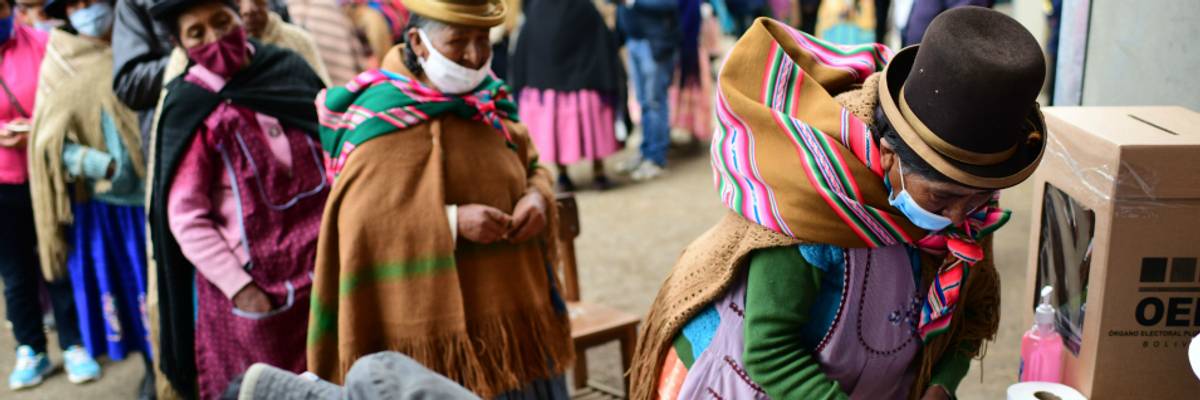
An indigenous woman signs after casting her vote at a polling station in Huarina, Bolivia, on October 18, 2020 during the country's general election. (Photo: Ronaldo Schemidt/AFP via Getty Images)
Following a "violent right-wing coup" last year that led to the ouster of President Evo Morales, the people of Bolivia headed to polling stations in large numbers on Sunday for long-delayed national elections that could see the Movement Towards Socialism (MAS) party retake hold of the government.
In the run-off style elections, a candidate needs more than 50% during a first round vote--or 40% of the vote with at least a 10-point edge over the next candidate--to be declared a winner. If that threshold is not met, a runoff will be held at the end of November.
According to the Guardian:
Polls suggest the MAS candidate, Morales's UK-educated former finance minister Luis Arce, has the edge over his main challenger, a centrist journalist and former president called Carlos Mesa.
"They [MAS] are in the driver's seat and if they can mobilize voters this weekend--and they are the only party with the capacity to do that--they could do very well," said Eduardo Gamarra, a Bolivia expert at Florida International University.
Gamarra thought a second round--which 67-year-old Mesa would probably win--remained the more likely prospect. If no candidate secures an outright majority, or 40% of the votes with 10% breathing space, a run-off will be held on 29 November. The third major candidate is Luis Fernando Camacho of the new rightwing Creemos ("We believe") alliance. Anez withdrew her candidacy last month saying she did not want to split the conservative vote.
Long lines of voters could be seen in MAS strongholds Sunday and after Arce cast his ballot near La Paz, he said: "We hope that the whole process will be peaceful."
The elections arrive with bitter memories of the roll played by the U.S.-backed Organization of American States (OAS) when it bolstered and gave legitimacy to claims from right-wing forces within the country that the 2019 elections, which Morales and his party won, were fraudulent.
Mark Weisbrot, co-director of the Center for Economic and Policy Research (CEPR) in Washington D.C., warned Friday that the OAS remains poised to created mischief again as it aligns itself with the "care taker" Bolivian government of Jeanine Anez, which seized power after Morales was forced to flee the country last year.
"The OAS played a leading role in creating the conditions for the military overthrow of Bolivia's democratic government, following last year's elections in Bolivia," Weisbrot said in a statement. "It quickly cast doubt on the preliminary results that showed Evo Morales with a first-round victory with a false statement about the day after the election, and it repeated this falsehood in multiple releases. As the New York Times has reported, the OAS' 'flawed' analysis 'fueled a chain of events that changed the South American nation's history.' This included the military coup of November 10."
As CEPR noted in its statement, the OAS could still play a possible role in undermining the voice of Bolivians in Sunday's election:
On September 30, OAS Secretary General Luis Almagro met with the de facto interior minister of Bolivia, Arturo Murillo, at the OAS's Washington, DC headquarters. Following the meeting, Almagro tweeted that Murillo had "conveyed his concern about the possibility of a new fraud" in Bolivia's October 18 elections. Almagro agreed to "strengthen" the observation mission the OAS will have on the ground for the vote. Despite Almagro's rhetoric about possible MAS fraud, numerous polls show MAS candidate Luis Arce in first place--and close to the margin necessary to avoid a second-round run-off election.
On Sunday, Morales--who remains in exile in Argentina--tweeted support for his people and called for the legitimate results to be respected both in Bolivia and abroad.
"Elections must always be a democratic party in which we meet again beyond differences," the ousted leader tweeted (translation from Spanish). "Our diversity is the richness of our identity and is the source of our unity."
Morales called on his people not to fall prey to provocations, saying the "great lesson that we must never forget is that violence only generates violence and that with it we all lose."
"It is very important that each and every one of us calmly wait for each and every vote to be counted," Morales said, and he further called on the nation's "Armed Forces and the Bolivian Police to faithfully fulfill their very important institutional and constitutional role" as the results come in.
Dear Common Dreams reader, It’s been nearly 30 years since I co-founded Common Dreams with my late wife, Lina Newhouser. We had the radical notion that journalism should serve the public good, not corporate profits. It was clear to us from the outset what it would take to build such a project. No paid advertisements. No corporate sponsors. No millionaire publisher telling us what to think or do. Many people said we wouldn't last a year, but we proved those doubters wrong. Together with a tremendous team of journalists and dedicated staff, we built an independent media outlet free from the constraints of profits and corporate control. Our mission has always been simple: To inform. To inspire. To ignite change for the common good. Building Common Dreams was not easy. Our survival was never guaranteed. When you take on the most powerful forces—Wall Street greed, fossil fuel industry destruction, Big Tech lobbyists, and uber-rich oligarchs who have spent billions upon billions rigging the economy and democracy in their favor—the only bulwark you have is supporters who believe in your work. But here’s the urgent message from me today. It's never been this bad out there. And it's never been this hard to keep us going. At the very moment Common Dreams is most needed, the threats we face are intensifying. We need your support now more than ever. We don't accept corporate advertising and never will. We don't have a paywall because we don't think people should be blocked from critical news based on their ability to pay. Everything we do is funded by the donations of readers like you. When everyone does the little they can afford, we are strong. But if that support retreats or dries up, so do we. Will you donate now to make sure Common Dreams not only survives but thrives? —Craig Brown, Co-founder |
Following a "violent right-wing coup" last year that led to the ouster of President Evo Morales, the people of Bolivia headed to polling stations in large numbers on Sunday for long-delayed national elections that could see the Movement Towards Socialism (MAS) party retake hold of the government.
In the run-off style elections, a candidate needs more than 50% during a first round vote--or 40% of the vote with at least a 10-point edge over the next candidate--to be declared a winner. If that threshold is not met, a runoff will be held at the end of November.
According to the Guardian:
Polls suggest the MAS candidate, Morales's UK-educated former finance minister Luis Arce, has the edge over his main challenger, a centrist journalist and former president called Carlos Mesa.
"They [MAS] are in the driver's seat and if they can mobilize voters this weekend--and they are the only party with the capacity to do that--they could do very well," said Eduardo Gamarra, a Bolivia expert at Florida International University.
Gamarra thought a second round--which 67-year-old Mesa would probably win--remained the more likely prospect. If no candidate secures an outright majority, or 40% of the votes with 10% breathing space, a run-off will be held on 29 November. The third major candidate is Luis Fernando Camacho of the new rightwing Creemos ("We believe") alliance. Anez withdrew her candidacy last month saying she did not want to split the conservative vote.
Long lines of voters could be seen in MAS strongholds Sunday and after Arce cast his ballot near La Paz, he said: "We hope that the whole process will be peaceful."
The elections arrive with bitter memories of the roll played by the U.S.-backed Organization of American States (OAS) when it bolstered and gave legitimacy to claims from right-wing forces within the country that the 2019 elections, which Morales and his party won, were fraudulent.
Mark Weisbrot, co-director of the Center for Economic and Policy Research (CEPR) in Washington D.C., warned Friday that the OAS remains poised to created mischief again as it aligns itself with the "care taker" Bolivian government of Jeanine Anez, which seized power after Morales was forced to flee the country last year.
"The OAS played a leading role in creating the conditions for the military overthrow of Bolivia's democratic government, following last year's elections in Bolivia," Weisbrot said in a statement. "It quickly cast doubt on the preliminary results that showed Evo Morales with a first-round victory with a false statement about the day after the election, and it repeated this falsehood in multiple releases. As the New York Times has reported, the OAS' 'flawed' analysis 'fueled a chain of events that changed the South American nation's history.' This included the military coup of November 10."
As CEPR noted in its statement, the OAS could still play a possible role in undermining the voice of Bolivians in Sunday's election:
On September 30, OAS Secretary General Luis Almagro met with the de facto interior minister of Bolivia, Arturo Murillo, at the OAS's Washington, DC headquarters. Following the meeting, Almagro tweeted that Murillo had "conveyed his concern about the possibility of a new fraud" in Bolivia's October 18 elections. Almagro agreed to "strengthen" the observation mission the OAS will have on the ground for the vote. Despite Almagro's rhetoric about possible MAS fraud, numerous polls show MAS candidate Luis Arce in first place--and close to the margin necessary to avoid a second-round run-off election.
On Sunday, Morales--who remains in exile in Argentina--tweeted support for his people and called for the legitimate results to be respected both in Bolivia and abroad.
"Elections must always be a democratic party in which we meet again beyond differences," the ousted leader tweeted (translation from Spanish). "Our diversity is the richness of our identity and is the source of our unity."
Morales called on his people not to fall prey to provocations, saying the "great lesson that we must never forget is that violence only generates violence and that with it we all lose."
"It is very important that each and every one of us calmly wait for each and every vote to be counted," Morales said, and he further called on the nation's "Armed Forces and the Bolivian Police to faithfully fulfill their very important institutional and constitutional role" as the results come in.
Following a "violent right-wing coup" last year that led to the ouster of President Evo Morales, the people of Bolivia headed to polling stations in large numbers on Sunday for long-delayed national elections that could see the Movement Towards Socialism (MAS) party retake hold of the government.
In the run-off style elections, a candidate needs more than 50% during a first round vote--or 40% of the vote with at least a 10-point edge over the next candidate--to be declared a winner. If that threshold is not met, a runoff will be held at the end of November.
According to the Guardian:
Polls suggest the MAS candidate, Morales's UK-educated former finance minister Luis Arce, has the edge over his main challenger, a centrist journalist and former president called Carlos Mesa.
"They [MAS] are in the driver's seat and if they can mobilize voters this weekend--and they are the only party with the capacity to do that--they could do very well," said Eduardo Gamarra, a Bolivia expert at Florida International University.
Gamarra thought a second round--which 67-year-old Mesa would probably win--remained the more likely prospect. If no candidate secures an outright majority, or 40% of the votes with 10% breathing space, a run-off will be held on 29 November. The third major candidate is Luis Fernando Camacho of the new rightwing Creemos ("We believe") alliance. Anez withdrew her candidacy last month saying she did not want to split the conservative vote.
Long lines of voters could be seen in MAS strongholds Sunday and after Arce cast his ballot near La Paz, he said: "We hope that the whole process will be peaceful."
The elections arrive with bitter memories of the roll played by the U.S.-backed Organization of American States (OAS) when it bolstered and gave legitimacy to claims from right-wing forces within the country that the 2019 elections, which Morales and his party won, were fraudulent.
Mark Weisbrot, co-director of the Center for Economic and Policy Research (CEPR) in Washington D.C., warned Friday that the OAS remains poised to created mischief again as it aligns itself with the "care taker" Bolivian government of Jeanine Anez, which seized power after Morales was forced to flee the country last year.
"The OAS played a leading role in creating the conditions for the military overthrow of Bolivia's democratic government, following last year's elections in Bolivia," Weisbrot said in a statement. "It quickly cast doubt on the preliminary results that showed Evo Morales with a first-round victory with a false statement about the day after the election, and it repeated this falsehood in multiple releases. As the New York Times has reported, the OAS' 'flawed' analysis 'fueled a chain of events that changed the South American nation's history.' This included the military coup of November 10."
As CEPR noted in its statement, the OAS could still play a possible role in undermining the voice of Bolivians in Sunday's election:
On September 30, OAS Secretary General Luis Almagro met with the de facto interior minister of Bolivia, Arturo Murillo, at the OAS's Washington, DC headquarters. Following the meeting, Almagro tweeted that Murillo had "conveyed his concern about the possibility of a new fraud" in Bolivia's October 18 elections. Almagro agreed to "strengthen" the observation mission the OAS will have on the ground for the vote. Despite Almagro's rhetoric about possible MAS fraud, numerous polls show MAS candidate Luis Arce in first place--and close to the margin necessary to avoid a second-round run-off election.
On Sunday, Morales--who remains in exile in Argentina--tweeted support for his people and called for the legitimate results to be respected both in Bolivia and abroad.
"Elections must always be a democratic party in which we meet again beyond differences," the ousted leader tweeted (translation from Spanish). "Our diversity is the richness of our identity and is the source of our unity."
Morales called on his people not to fall prey to provocations, saying the "great lesson that we must never forget is that violence only generates violence and that with it we all lose."
"It is very important that each and every one of us calmly wait for each and every vote to be counted," Morales said, and he further called on the nation's "Armed Forces and the Bolivian Police to faithfully fulfill their very important institutional and constitutional role" as the results come in.