SUBSCRIBE TO OUR FREE NEWSLETTER
Daily news & progressive opinion—funded by the people, not the corporations—delivered straight to your inbox.
5
#000000
#FFFFFF
To donate by check, phone, or other method, see our More Ways to Give page.
Daily news & progressive opinion—funded by the people, not the corporations—delivered straight to your inbox.
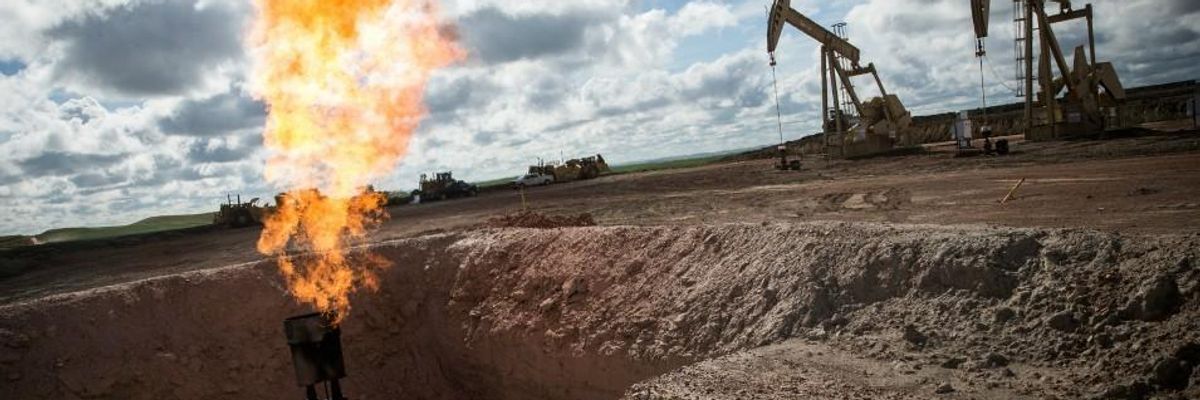
A gas flare is seen at an oil well site on outside Williston, North Dakota. (Photo: Andrew Burton/Getty Images)
A study released Tuesday by a team of scientists from Harvard University found that airborne radiation levels downwind of U.S. fracking sites are significantly elevated compared to background levels, providing further evidence that the drilling practice poses a threat to public health as well as the climate.
Published in the journal Nature Communications, the study detected the largest increases in airborne radiation levels near drilling locations in Pennsylvania and Ohio, states with high concentrations of fracking sites.
"Our results suggest that an increase in [particle radioactivity] due to the extensive [fracking development] may cause adverse health outcomes in nearby communities," warned the study, which found that locations within 12 miles downwind of 100 fracking sites have around 7% higher radiation levels compared to background levels.
The impact of fracking on airborne particle radioactivity "decreases gradually along with an increasing downwind distance" from oil and gas wells, the researchers noted.
Petros Koutrakis, the lead author of the study, told The Guardian that "if you asked me to go and live downwind [of fracking sites], I would not go. People should not go crazy, but I think it's a significant risk that needs to be addressed."
The new study comes as fracking continues to figure prominently in the 2020 presidential race, with President Donald Trump openly celebrating the destructive practice and Democratic nominee Joe Biden vowing not to completely ban it if elected--a stance that has drawn the ire of environmental activists and progressive lawmakers.
"Fracking is bad, actually," Rep. Alexandria Ocasio-Cortez (D-N.Y.) tweeted after Sen. Kamala Harris (D-Calif.), Biden's running mate, said during last week's vice presidential debate that a Biden administration "will not ban fracking."
Dear Common Dreams reader, It’s been nearly 30 years since I co-founded Common Dreams with my late wife, Lina Newhouser. We had the radical notion that journalism should serve the public good, not corporate profits. It was clear to us from the outset what it would take to build such a project. No paid advertisements. No corporate sponsors. No millionaire publisher telling us what to think or do. Many people said we wouldn't last a year, but we proved those doubters wrong. Together with a tremendous team of journalists and dedicated staff, we built an independent media outlet free from the constraints of profits and corporate control. Our mission has always been simple: To inform. To inspire. To ignite change for the common good. Building Common Dreams was not easy. Our survival was never guaranteed. When you take on the most powerful forces—Wall Street greed, fossil fuel industry destruction, Big Tech lobbyists, and uber-rich oligarchs who have spent billions upon billions rigging the economy and democracy in their favor—the only bulwark you have is supporters who believe in your work. But here’s the urgent message from me today. It's never been this bad out there. And it's never been this hard to keep us going. At the very moment Common Dreams is most needed, the threats we face are intensifying. We need your support now more than ever. We don't accept corporate advertising and never will. We don't have a paywall because we don't think people should be blocked from critical news based on their ability to pay. Everything we do is funded by the donations of readers like you. When everyone does the little they can afford, we are strong. But if that support retreats or dries up, so do we. Will you donate now to make sure Common Dreams not only survives but thrives? —Craig Brown, Co-founder |
A study released Tuesday by a team of scientists from Harvard University found that airborne radiation levels downwind of U.S. fracking sites are significantly elevated compared to background levels, providing further evidence that the drilling practice poses a threat to public health as well as the climate.
Published in the journal Nature Communications, the study detected the largest increases in airborne radiation levels near drilling locations in Pennsylvania and Ohio, states with high concentrations of fracking sites.
"Our results suggest that an increase in [particle radioactivity] due to the extensive [fracking development] may cause adverse health outcomes in nearby communities," warned the study, which found that locations within 12 miles downwind of 100 fracking sites have around 7% higher radiation levels compared to background levels.
The impact of fracking on airborne particle radioactivity "decreases gradually along with an increasing downwind distance" from oil and gas wells, the researchers noted.
Petros Koutrakis, the lead author of the study, told The Guardian that "if you asked me to go and live downwind [of fracking sites], I would not go. People should not go crazy, but I think it's a significant risk that needs to be addressed."
The new study comes as fracking continues to figure prominently in the 2020 presidential race, with President Donald Trump openly celebrating the destructive practice and Democratic nominee Joe Biden vowing not to completely ban it if elected--a stance that has drawn the ire of environmental activists and progressive lawmakers.
"Fracking is bad, actually," Rep. Alexandria Ocasio-Cortez (D-N.Y.) tweeted after Sen. Kamala Harris (D-Calif.), Biden's running mate, said during last week's vice presidential debate that a Biden administration "will not ban fracking."
A study released Tuesday by a team of scientists from Harvard University found that airborne radiation levels downwind of U.S. fracking sites are significantly elevated compared to background levels, providing further evidence that the drilling practice poses a threat to public health as well as the climate.
Published in the journal Nature Communications, the study detected the largest increases in airborne radiation levels near drilling locations in Pennsylvania and Ohio, states with high concentrations of fracking sites.
"Our results suggest that an increase in [particle radioactivity] due to the extensive [fracking development] may cause adverse health outcomes in nearby communities," warned the study, which found that locations within 12 miles downwind of 100 fracking sites have around 7% higher radiation levels compared to background levels.
The impact of fracking on airborne particle radioactivity "decreases gradually along with an increasing downwind distance" from oil and gas wells, the researchers noted.
Petros Koutrakis, the lead author of the study, told The Guardian that "if you asked me to go and live downwind [of fracking sites], I would not go. People should not go crazy, but I think it's a significant risk that needs to be addressed."
The new study comes as fracking continues to figure prominently in the 2020 presidential race, with President Donald Trump openly celebrating the destructive practice and Democratic nominee Joe Biden vowing not to completely ban it if elected--a stance that has drawn the ire of environmental activists and progressive lawmakers.
"Fracking is bad, actually," Rep. Alexandria Ocasio-Cortez (D-N.Y.) tweeted after Sen. Kamala Harris (D-Calif.), Biden's running mate, said during last week's vice presidential debate that a Biden administration "will not ban fracking."