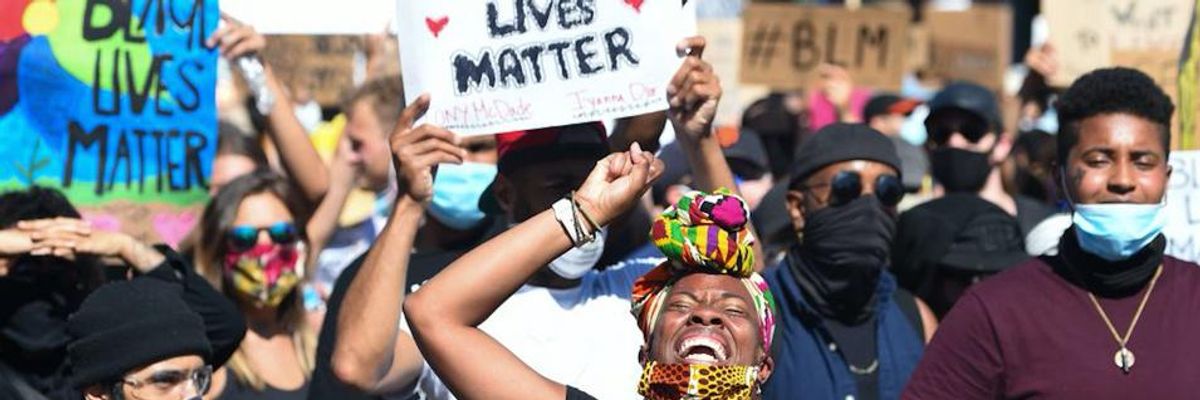
Protesters at a Black youth-led Black Lives Matter demonstration near Dolores Park in San Francisco on June 3, 2020. (Photo: Josh Edelson/AFP/Getty Images)
San Francisco Activists Sue City Over 'Illegal Dragnet Surveillance' of George Floyd, BLM Protests
Such practices by police are "completely at odds with the First Amendment and should never be allowed," said an ACLU lawyer on the case.
A group of activists on Wednesday sued the city of San Francisco over its police department's alleged illegal surveillance of protesters during recent racial justice demonstrations.
The Electronic Frontier Foundation (EFF) and ACLU of Northern California filed the suit (pdf) in San Francisco Superior Court on behalf of local activists Hope Williams, Nathan Sheard, and Nestor Reyes, Black and Latinx activists who organized and participated in Black Lives Matter, Defund SFPD Now, and other protests in the wake of the police killings of George Floyd, Breonna Taylor, and other Black and BIPOC people this year.
"I want the SFPD to stop spying on protestors because we have the right to organize, speak out, and march without fear of police surveillance."
--Hope Williams, lead plaintiff
Last year, San Francisco became the first major city in the nation to ban the use of facial recognition technology by police and other agencies following an 8-1 vote by the city's governing Board of Supervisors.
The lawsuit alleges the city violated its Surveillance Technology Ordinance (pdf), which also restricts police and other city agencies' power to "receive information from non-city-owned surveillance technology."
"San Francisco police have a long and troubling history of targeting Black organizers going back to the 1960s," said EFF staff attorney Saira Hussain in a statement announcing the lawsuit.
"This new surveillance of Black Lives Matter protesters is exactly the kind of harm that the San Francisco supervisors were trying to prevent when they passed a critical Surveillance Technology Ordinance last year," added Hussain. "And still, with all eyes watching, SFPD brazenly decided to break the law."
Matt Cagle, technology and civil liberties attorney for the ACLU of Northern California, said that "in a democracy, people should be able to freely protest without fearing that police are spying and lying in wait."
"Illegal, dragnet surveillance of protests is completely at odds with the First Amendment and should never be allowed," he said.
"That the SFPD flouted the law to spy on activists protesting the abuse and killing of Black people by the police is simply indefensible," Cagle added.
Williams, a community organizer and lead plaintiff in the lawsuit, said in a statement that she "took to the streets to protest police violence and racism and affirm that Black lives matter," and that "it is an affront to our movement for equity and justice that the SFPD responded by secretly spying on us."
Williams said she is suing the city to "defend the rights of protestors and hold the police accountable for breaking the law."
"I want the SFPD to stop spying on protestors because we have the right to organize, speak out, and march without fear of police surveillance," she added.
According to the suit--which calls on the city to enforce the Surveillance Technology Ordinance and for the SFPD to behave lawfully--the San Francisco Police Department tapped into a network of downtown business cameras to conduct mass surveillance of protesters in late May and early June.
EFF said in July that SFPD received live access to hundreds of cameras operated by the Union Square Business Improvement District, a special taxation zone created by the city of San Francisco but run by a private nonprofit group.
SFPD also gained access to a "data dump" of camera footage during the protests. The networked high definition cameras can zoom in on a targeted person's face to capture images that could then be analyzed using facial recognition software in contravention of local law.
Records obtained by EFF showed SFPD repeatedly requested access to footage related to alleged looting and assaults in areas where protests against police violence and racism occured after the police killings of Floyd, Taylor, and other cases around the nation.
According to EFF, "SFPD has gone beyond simply investigating particular incident reports and instead engaged in indiscriminate surveillance of protesters."
We are at a crossroads
This country and this world are at a monumental crossroads. In a few short weeks, US voters will have an opportunity to beat back the forces of fascism and confront the billionaires who are rigging the economy, our media system, and our democracy, making it increasingly impossible for ordinary people to get by. We’re not just talking about the election. We’re talking about what must be done once these fascist elements are vanquished from power. We need a bolder set of solutions than what either major party has so far been willing to offer and a working-class movement ready to fight like hell for it. Trump didn't emerge from nowhere. The conditions that fueled MAGA authoritarianism were created by decades of radical neoliberal economic policies and a corrupt political system dominated by corporate interests. They slashed taxes on the super-rich, promising that the benefits would trickle down. They said giveaways to the corporate titans would make life more affordable for the rest of us. It was all bullshit. And when a bitter, betrayed populace searches for someone to blame, right-wing demagogues have little trouble finding scapegoats. People know when they're being lied to, but you won't hear any of this from the corporate media. Only independent journalism—powered and funded by people who believe in building a better world—can deliver truly trustworthy daily news. Our Fall Campaign is underway, and we need your help. To power our newsroom through the rest of the year, we need to raise $125,000 by midnight on October 31. So if you share our vision, please contribute whatever you can to sustain our work. |
A group of activists on Wednesday sued the city of San Francisco over its police department's alleged illegal surveillance of protesters during recent racial justice demonstrations.
The Electronic Frontier Foundation (EFF) and ACLU of Northern California filed the suit (pdf) in San Francisco Superior Court on behalf of local activists Hope Williams, Nathan Sheard, and Nestor Reyes, Black and Latinx activists who organized and participated in Black Lives Matter, Defund SFPD Now, and other protests in the wake of the police killings of George Floyd, Breonna Taylor, and other Black and BIPOC people this year.
"I want the SFPD to stop spying on protestors because we have the right to organize, speak out, and march without fear of police surveillance."
--Hope Williams, lead plaintiff
Last year, San Francisco became the first major city in the nation to ban the use of facial recognition technology by police and other agencies following an 8-1 vote by the city's governing Board of Supervisors.
The lawsuit alleges the city violated its Surveillance Technology Ordinance (pdf), which also restricts police and other city agencies' power to "receive information from non-city-owned surveillance technology."
"San Francisco police have a long and troubling history of targeting Black organizers going back to the 1960s," said EFF staff attorney Saira Hussain in a statement announcing the lawsuit.
"This new surveillance of Black Lives Matter protesters is exactly the kind of harm that the San Francisco supervisors were trying to prevent when they passed a critical Surveillance Technology Ordinance last year," added Hussain. "And still, with all eyes watching, SFPD brazenly decided to break the law."
Matt Cagle, technology and civil liberties attorney for the ACLU of Northern California, said that "in a democracy, people should be able to freely protest without fearing that police are spying and lying in wait."
"Illegal, dragnet surveillance of protests is completely at odds with the First Amendment and should never be allowed," he said.
"That the SFPD flouted the law to spy on activists protesting the abuse and killing of Black people by the police is simply indefensible," Cagle added.
Williams, a community organizer and lead plaintiff in the lawsuit, said in a statement that she "took to the streets to protest police violence and racism and affirm that Black lives matter," and that "it is an affront to our movement for equity and justice that the SFPD responded by secretly spying on us."
Williams said she is suing the city to "defend the rights of protestors and hold the police accountable for breaking the law."
"I want the SFPD to stop spying on protestors because we have the right to organize, speak out, and march without fear of police surveillance," she added.
According to the suit--which calls on the city to enforce the Surveillance Technology Ordinance and for the SFPD to behave lawfully--the San Francisco Police Department tapped into a network of downtown business cameras to conduct mass surveillance of protesters in late May and early June.
EFF said in July that SFPD received live access to hundreds of cameras operated by the Union Square Business Improvement District, a special taxation zone created by the city of San Francisco but run by a private nonprofit group.
SFPD also gained access to a "data dump" of camera footage during the protests. The networked high definition cameras can zoom in on a targeted person's face to capture images that could then be analyzed using facial recognition software in contravention of local law.
Records obtained by EFF showed SFPD repeatedly requested access to footage related to alleged looting and assaults in areas where protests against police violence and racism occured after the police killings of Floyd, Taylor, and other cases around the nation.
According to EFF, "SFPD has gone beyond simply investigating particular incident reports and instead engaged in indiscriminate surveillance of protesters."
A group of activists on Wednesday sued the city of San Francisco over its police department's alleged illegal surveillance of protesters during recent racial justice demonstrations.
The Electronic Frontier Foundation (EFF) and ACLU of Northern California filed the suit (pdf) in San Francisco Superior Court on behalf of local activists Hope Williams, Nathan Sheard, and Nestor Reyes, Black and Latinx activists who organized and participated in Black Lives Matter, Defund SFPD Now, and other protests in the wake of the police killings of George Floyd, Breonna Taylor, and other Black and BIPOC people this year.
"I want the SFPD to stop spying on protestors because we have the right to organize, speak out, and march without fear of police surveillance."
--Hope Williams, lead plaintiff
Last year, San Francisco became the first major city in the nation to ban the use of facial recognition technology by police and other agencies following an 8-1 vote by the city's governing Board of Supervisors.
The lawsuit alleges the city violated its Surveillance Technology Ordinance (pdf), which also restricts police and other city agencies' power to "receive information from non-city-owned surveillance technology."
"San Francisco police have a long and troubling history of targeting Black organizers going back to the 1960s," said EFF staff attorney Saira Hussain in a statement announcing the lawsuit.
"This new surveillance of Black Lives Matter protesters is exactly the kind of harm that the San Francisco supervisors were trying to prevent when they passed a critical Surveillance Technology Ordinance last year," added Hussain. "And still, with all eyes watching, SFPD brazenly decided to break the law."
Matt Cagle, technology and civil liberties attorney for the ACLU of Northern California, said that "in a democracy, people should be able to freely protest without fearing that police are spying and lying in wait."
"Illegal, dragnet surveillance of protests is completely at odds with the First Amendment and should never be allowed," he said.
"That the SFPD flouted the law to spy on activists protesting the abuse and killing of Black people by the police is simply indefensible," Cagle added.
Williams, a community organizer and lead plaintiff in the lawsuit, said in a statement that she "took to the streets to protest police violence and racism and affirm that Black lives matter," and that "it is an affront to our movement for equity and justice that the SFPD responded by secretly spying on us."
Williams said she is suing the city to "defend the rights of protestors and hold the police accountable for breaking the law."
"I want the SFPD to stop spying on protestors because we have the right to organize, speak out, and march without fear of police surveillance," she added.
According to the suit--which calls on the city to enforce the Surveillance Technology Ordinance and for the SFPD to behave lawfully--the San Francisco Police Department tapped into a network of downtown business cameras to conduct mass surveillance of protesters in late May and early June.
EFF said in July that SFPD received live access to hundreds of cameras operated by the Union Square Business Improvement District, a special taxation zone created by the city of San Francisco but run by a private nonprofit group.
SFPD also gained access to a "data dump" of camera footage during the protests. The networked high definition cameras can zoom in on a targeted person's face to capture images that could then be analyzed using facial recognition software in contravention of local law.
Records obtained by EFF showed SFPD repeatedly requested access to footage related to alleged looting and assaults in areas where protests against police violence and racism occured after the police killings of Floyd, Taylor, and other cases around the nation.
According to EFF, "SFPD has gone beyond simply investigating particular incident reports and instead engaged in indiscriminate surveillance of protesters."