

SUBSCRIBE TO OUR FREE NEWSLETTER
Daily news & progressive opinion—funded by the people, not the corporations—delivered straight to your inbox.
5
#000000
#FFFFFF
To donate by check, phone, or other method, see our More Ways to Give page.
Daily news & progressive opinion—funded by the people, not the corporations—delivered straight to your inbox.
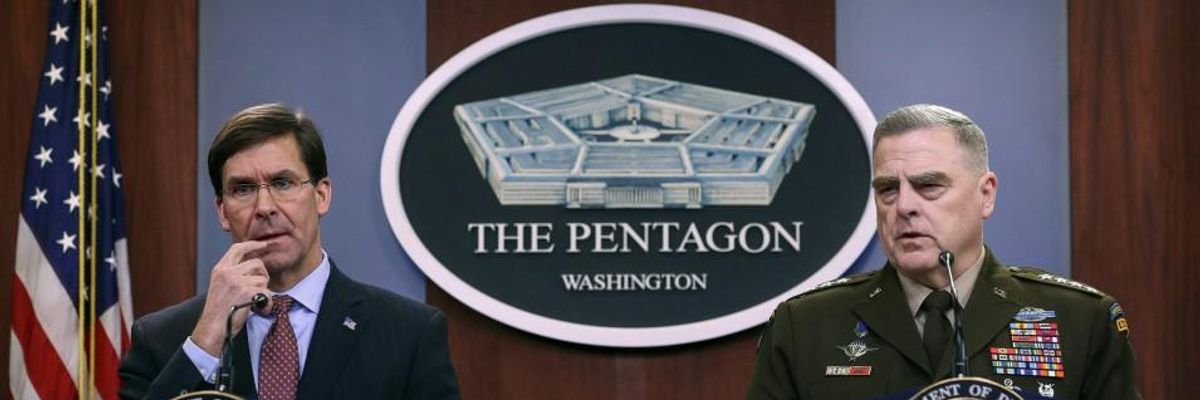
Secretary of Defense Mark Esper and Chairman of the Joint Chiefs of Staff Army Gen. Mark Milley hold an end of year press conference at the Pentagon on December 20, 2019 in Arlington, Virginia. (Photo: Drew Angerer/Getty Images)
Instead of adhering to congressional intent by building up the nation's inadequate supply of N95 masks and other equipment to combat the Covid-19 crisis, the Pentagon has funneled hundreds of millions of dollars in appropriated taxpayer funds to private defense contractors for drone technology, jet engine parts, Army uniform material, body armor, and other purposes not directly related to the pandemic.
As the Washington Post reported Tuesday morning, the Department of Defense--headed by former Raytheon lobbyist Mark Esper--"began reshaping how it would award the money" just weeks after Congress in March approved a $1 billion fund under the Defense Production Act to help the nation "prevent, prepare for, and respond to coronavirus."
"The Trump administration has done little to limit the defense firms from accessing multiple bailout funds at once and is not requiring the companies to refrain from layoffs as a condition of receiving the awards," the Post noted. "Some defense contractors were given the Pentagon money even though they had already dipped into another pot of bailout funds, the Paycheck Protection Program."
As the U.S. still faces major shortages of testing supplies and N95 masks six months into the pandemic, the Post reported that the Pentagon has used congressionally approved funds to dish out $183 million to Rolls-Royce and other companies to help "maintain the shipbuilding industry," tens of millions for "drone and space surveillance technology," and $80 million to "a Kansas aircraft parts business."
A subsidiary of Rolls-Royce also received $22 million from the Pentagon "to upgrade a Mississippi plant," according to the Post.
Mandy Smithberger, a weapons industry analyst at the Project on Government Oversight, told the Post, "This is part and parcel of whether we have budget priorities that actually serve our public safety or whether we have a government that is captured by special interests."
The Pentagon's misuse of taxpayer funds aimed at addressing the Covid-19 pandemic has drawn a rebuke from the Democrat-controlled House Appropriations Committee, which characterized the Defense Department's rewards to defense contractors as a clear violation of congressional intent.
"While the Department plans to execute a portion of that funding for personal protective equipment (PPE) as intended by Congress, most of the funds will be used to address the impact of Covid-19 on the [defense industrial base], which was not the original intent of the funds," the committee said in a July report (pdf).
Pentagon officials insisted to the Post that the funds were allocated appropriately, citing the need to "protect key defense capabilities from the consequences of Covid," but Slate's Elliot Hannon argued the Defense Department's generous taxpayer-funded gifts to private corporations amount to little more than "a colossal backdoor bailout for the defense industry."
Pointing to the Pentagon's handouts to Rolls-Royce and other major companies, Hannon wrote, "That doesn't exactly sound like PPE."
Correction: A previous version of this article mischaracterized Rolls-Royce.
Dear Common Dreams reader, It’s been nearly 30 years since I co-founded Common Dreams with my late wife, Lina Newhouser. We had the radical notion that journalism should serve the public good, not corporate profits. It was clear to us from the outset what it would take to build such a project. No paid advertisements. No corporate sponsors. No millionaire publisher telling us what to think or do. Many people said we wouldn't last a year, but we proved those doubters wrong. Together with a tremendous team of journalists and dedicated staff, we built an independent media outlet free from the constraints of profits and corporate control. Our mission has always been simple: To inform. To inspire. To ignite change for the common good. Building Common Dreams was not easy. Our survival was never guaranteed. When you take on the most powerful forces—Wall Street greed, fossil fuel industry destruction, Big Tech lobbyists, and uber-rich oligarchs who have spent billions upon billions rigging the economy and democracy in their favor—the only bulwark you have is supporters who believe in your work. But here’s the urgent message from me today. It's never been this bad out there. And it's never been this hard to keep us going. At the very moment Common Dreams is most needed, the threats we face are intensifying. We need your support now more than ever. We don't accept corporate advertising and never will. We don't have a paywall because we don't think people should be blocked from critical news based on their ability to pay. Everything we do is funded by the donations of readers like you. When everyone does the little they can afford, we are strong. But if that support retreats or dries up, so do we. Will you donate now to make sure Common Dreams not only survives but thrives? —Craig Brown, Co-founder |
Instead of adhering to congressional intent by building up the nation's inadequate supply of N95 masks and other equipment to combat the Covid-19 crisis, the Pentagon has funneled hundreds of millions of dollars in appropriated taxpayer funds to private defense contractors for drone technology, jet engine parts, Army uniform material, body armor, and other purposes not directly related to the pandemic.
As the Washington Post reported Tuesday morning, the Department of Defense--headed by former Raytheon lobbyist Mark Esper--"began reshaping how it would award the money" just weeks after Congress in March approved a $1 billion fund under the Defense Production Act to help the nation "prevent, prepare for, and respond to coronavirus."
"The Trump administration has done little to limit the defense firms from accessing multiple bailout funds at once and is not requiring the companies to refrain from layoffs as a condition of receiving the awards," the Post noted. "Some defense contractors were given the Pentagon money even though they had already dipped into another pot of bailout funds, the Paycheck Protection Program."
As the U.S. still faces major shortages of testing supplies and N95 masks six months into the pandemic, the Post reported that the Pentagon has used congressionally approved funds to dish out $183 million to Rolls-Royce and other companies to help "maintain the shipbuilding industry," tens of millions for "drone and space surveillance technology," and $80 million to "a Kansas aircraft parts business."
A subsidiary of Rolls-Royce also received $22 million from the Pentagon "to upgrade a Mississippi plant," according to the Post.
Mandy Smithberger, a weapons industry analyst at the Project on Government Oversight, told the Post, "This is part and parcel of whether we have budget priorities that actually serve our public safety or whether we have a government that is captured by special interests."
The Pentagon's misuse of taxpayer funds aimed at addressing the Covid-19 pandemic has drawn a rebuke from the Democrat-controlled House Appropriations Committee, which characterized the Defense Department's rewards to defense contractors as a clear violation of congressional intent.
"While the Department plans to execute a portion of that funding for personal protective equipment (PPE) as intended by Congress, most of the funds will be used to address the impact of Covid-19 on the [defense industrial base], which was not the original intent of the funds," the committee said in a July report (pdf).
Pentagon officials insisted to the Post that the funds were allocated appropriately, citing the need to "protect key defense capabilities from the consequences of Covid," but Slate's Elliot Hannon argued the Defense Department's generous taxpayer-funded gifts to private corporations amount to little more than "a colossal backdoor bailout for the defense industry."
Pointing to the Pentagon's handouts to Rolls-Royce and other major companies, Hannon wrote, "That doesn't exactly sound like PPE."
Correction: A previous version of this article mischaracterized Rolls-Royce.
Instead of adhering to congressional intent by building up the nation's inadequate supply of N95 masks and other equipment to combat the Covid-19 crisis, the Pentagon has funneled hundreds of millions of dollars in appropriated taxpayer funds to private defense contractors for drone technology, jet engine parts, Army uniform material, body armor, and other purposes not directly related to the pandemic.
As the Washington Post reported Tuesday morning, the Department of Defense--headed by former Raytheon lobbyist Mark Esper--"began reshaping how it would award the money" just weeks after Congress in March approved a $1 billion fund under the Defense Production Act to help the nation "prevent, prepare for, and respond to coronavirus."
"The Trump administration has done little to limit the defense firms from accessing multiple bailout funds at once and is not requiring the companies to refrain from layoffs as a condition of receiving the awards," the Post noted. "Some defense contractors were given the Pentagon money even though they had already dipped into another pot of bailout funds, the Paycheck Protection Program."
As the U.S. still faces major shortages of testing supplies and N95 masks six months into the pandemic, the Post reported that the Pentagon has used congressionally approved funds to dish out $183 million to Rolls-Royce and other companies to help "maintain the shipbuilding industry," tens of millions for "drone and space surveillance technology," and $80 million to "a Kansas aircraft parts business."
A subsidiary of Rolls-Royce also received $22 million from the Pentagon "to upgrade a Mississippi plant," according to the Post.
Mandy Smithberger, a weapons industry analyst at the Project on Government Oversight, told the Post, "This is part and parcel of whether we have budget priorities that actually serve our public safety or whether we have a government that is captured by special interests."
The Pentagon's misuse of taxpayer funds aimed at addressing the Covid-19 pandemic has drawn a rebuke from the Democrat-controlled House Appropriations Committee, which characterized the Defense Department's rewards to defense contractors as a clear violation of congressional intent.
"While the Department plans to execute a portion of that funding for personal protective equipment (PPE) as intended by Congress, most of the funds will be used to address the impact of Covid-19 on the [defense industrial base], which was not the original intent of the funds," the committee said in a July report (pdf).
Pentagon officials insisted to the Post that the funds were allocated appropriately, citing the need to "protect key defense capabilities from the consequences of Covid," but Slate's Elliot Hannon argued the Defense Department's generous taxpayer-funded gifts to private corporations amount to little more than "a colossal backdoor bailout for the defense industry."
Pointing to the Pentagon's handouts to Rolls-Royce and other major companies, Hannon wrote, "That doesn't exactly sound like PPE."
Correction: A previous version of this article mischaracterized Rolls-Royce.

