SUBSCRIBE TO OUR FREE NEWSLETTER
Daily news & progressive opinion—funded by the people, not the corporations—delivered straight to your inbox.
5
#000000
#FFFFFF
To donate by check, phone, or other method, see our More Ways to Give page.
Daily news & progressive opinion—funded by the people, not the corporations—delivered straight to your inbox.
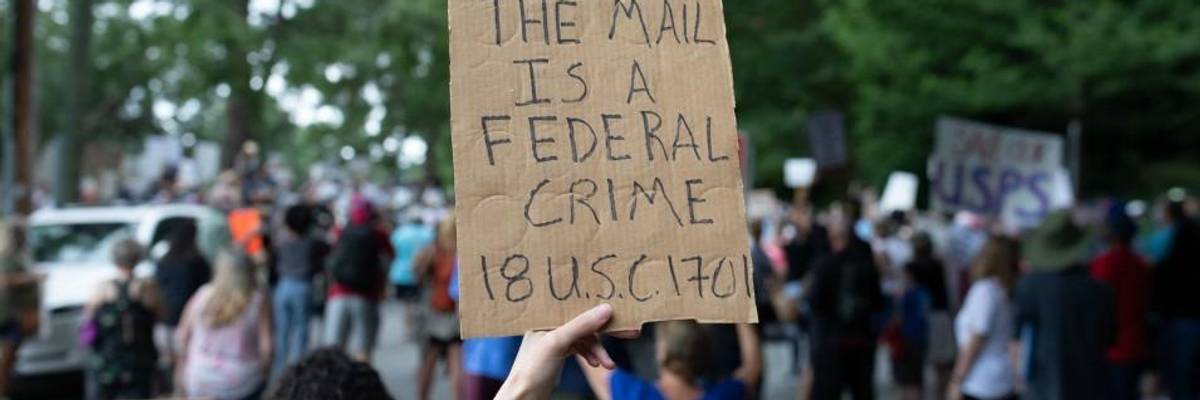
A group of protestors hold a demonstration in front of Postmaster General Louis DeJoy's home in Greensboro, North Carolina on August 16, 2020. (Photo: Logan Cyrus/AFP via Getty Images)
A federal judge late Thursday issued a nationwide injunction temporarily blocking and reversing dramatic changes to mail operations imposed in recent months by Postmaster General Louis DeJoy, slamming the policies as a "politically motivated attack" on the U.S. Postal Service that--if allowed to stand--would disenfranchise voters in November.
"Although not necessarily apparent on the surface, at the heart of DeJoy's and the Postal Service's actions is voter disenfranchisement," wrote Judge Stanley Bastian of the U.S. District Court for the Eastern District of Washington in a 13-page ruling (pdf), largely granting a request by 14 states for a court order halting the postmaster general's sweeping changes.
Bastian said that based on President Donald Trump's repeated and ongoing attacks on mail-in voting, it is "easy to conclude" that DeJoy's changes are part of "an intentional effort" by the White House to "disrupt and challenge the legitimacy of upcoming local, state, and federal elections, especially given that 72% of the decommissioned high-speed mail sorting machines... were located in counties where Hillary Clinton received the most votes in 2016."
The judge's ruling requires the USPS to immediately stop instructing postal workers to leave mail behind in order to leave for their trips at set times, continue treating all election mail as First Class mail, and return or reconnect any sorting machines deemed essential for efficient processing of election mail.
Washington state Attorney General Bob Ferguson, who led the coalition of states in suing the Postal Service, celebrated the ruling as a major victory that "protects a critical institution for our country."
In a statement to the Washington Post, USPS spokesman Dave Partenheimer said the agency is "exploring our legal options" following the nationwide injunction.
"There should be no doubt that the Postal Service is ready and committed to handle whatever volume of election mail it receives," said Partenheimer. "Our number one priority is to deliver election mail on-time."
Pointing to statistics showing that "there has been a drastic decrease in delivery rates," Bastian dismissed the USPS leadership's "remarkable position that nothing has changed in the Postal Service's approach to election mail from past years."
An investigation led by Sen. Gary Peters (D-Mich.), the top Democrat on the Senate Homeland Security and Governmental Affairs Committee, found that "on-time mail delivery fell abruptly following Postmaster General DeJoy's July 2020 directives ordering operational changes to mail service and delivery."
"By the second week of August 2020, on-time delivery of First Class mail nationwide had fallen nearly 10 percentage points compared to the week preceding the changes," reads a report (pdf) Peters released this week. "This means approximately 85 million more deliveries were late in a single week, compared to what the late deliveries would have been that week under on-time delivery rates before the changes."
In a statement late Thursday, Peters applauded Bastian's ruling as further confirmation that "Postmaster General DeJoy's changes were directly responsible for slowing down the mail for seniors, veterans, small businesses, and other Americans."
"While today's ruling is a welcome development," said Peters, "I will continue to work to push Mr. DeJoy to ensure the Postal Service returns to providing reliable, on-time delivery and pass my legislation that would reverse changes to the Postal Service during the pandemic and provide necessary funding for the Postal Service during this crisis."
Dear Common Dreams reader, It’s been nearly 30 years since I co-founded Common Dreams with my late wife, Lina Newhouser. We had the radical notion that journalism should serve the public good, not corporate profits. It was clear to us from the outset what it would take to build such a project. No paid advertisements. No corporate sponsors. No millionaire publisher telling us what to think or do. Many people said we wouldn't last a year, but we proved those doubters wrong. Together with a tremendous team of journalists and dedicated staff, we built an independent media outlet free from the constraints of profits and corporate control. Our mission has always been simple: To inform. To inspire. To ignite change for the common good. Building Common Dreams was not easy. Our survival was never guaranteed. When you take on the most powerful forces—Wall Street greed, fossil fuel industry destruction, Big Tech lobbyists, and uber-rich oligarchs who have spent billions upon billions rigging the economy and democracy in their favor—the only bulwark you have is supporters who believe in your work. But here’s the urgent message from me today. It's never been this bad out there. And it's never been this hard to keep us going. At the very moment Common Dreams is most needed, the threats we face are intensifying. We need your support now more than ever. We don't accept corporate advertising and never will. We don't have a paywall because we don't think people should be blocked from critical news based on their ability to pay. Everything we do is funded by the donations of readers like you. When everyone does the little they can afford, we are strong. But if that support retreats or dries up, so do we. Will you donate now to make sure Common Dreams not only survives but thrives? —Craig Brown, Co-founder |
A federal judge late Thursday issued a nationwide injunction temporarily blocking and reversing dramatic changes to mail operations imposed in recent months by Postmaster General Louis DeJoy, slamming the policies as a "politically motivated attack" on the U.S. Postal Service that--if allowed to stand--would disenfranchise voters in November.
"Although not necessarily apparent on the surface, at the heart of DeJoy's and the Postal Service's actions is voter disenfranchisement," wrote Judge Stanley Bastian of the U.S. District Court for the Eastern District of Washington in a 13-page ruling (pdf), largely granting a request by 14 states for a court order halting the postmaster general's sweeping changes.
Bastian said that based on President Donald Trump's repeated and ongoing attacks on mail-in voting, it is "easy to conclude" that DeJoy's changes are part of "an intentional effort" by the White House to "disrupt and challenge the legitimacy of upcoming local, state, and federal elections, especially given that 72% of the decommissioned high-speed mail sorting machines... were located in counties where Hillary Clinton received the most votes in 2016."
The judge's ruling requires the USPS to immediately stop instructing postal workers to leave mail behind in order to leave for their trips at set times, continue treating all election mail as First Class mail, and return or reconnect any sorting machines deemed essential for efficient processing of election mail.
Washington state Attorney General Bob Ferguson, who led the coalition of states in suing the Postal Service, celebrated the ruling as a major victory that "protects a critical institution for our country."
In a statement to the Washington Post, USPS spokesman Dave Partenheimer said the agency is "exploring our legal options" following the nationwide injunction.
"There should be no doubt that the Postal Service is ready and committed to handle whatever volume of election mail it receives," said Partenheimer. "Our number one priority is to deliver election mail on-time."
Pointing to statistics showing that "there has been a drastic decrease in delivery rates," Bastian dismissed the USPS leadership's "remarkable position that nothing has changed in the Postal Service's approach to election mail from past years."
An investigation led by Sen. Gary Peters (D-Mich.), the top Democrat on the Senate Homeland Security and Governmental Affairs Committee, found that "on-time mail delivery fell abruptly following Postmaster General DeJoy's July 2020 directives ordering operational changes to mail service and delivery."
"By the second week of August 2020, on-time delivery of First Class mail nationwide had fallen nearly 10 percentage points compared to the week preceding the changes," reads a report (pdf) Peters released this week. "This means approximately 85 million more deliveries were late in a single week, compared to what the late deliveries would have been that week under on-time delivery rates before the changes."
In a statement late Thursday, Peters applauded Bastian's ruling as further confirmation that "Postmaster General DeJoy's changes were directly responsible for slowing down the mail for seniors, veterans, small businesses, and other Americans."
"While today's ruling is a welcome development," said Peters, "I will continue to work to push Mr. DeJoy to ensure the Postal Service returns to providing reliable, on-time delivery and pass my legislation that would reverse changes to the Postal Service during the pandemic and provide necessary funding for the Postal Service during this crisis."
A federal judge late Thursday issued a nationwide injunction temporarily blocking and reversing dramatic changes to mail operations imposed in recent months by Postmaster General Louis DeJoy, slamming the policies as a "politically motivated attack" on the U.S. Postal Service that--if allowed to stand--would disenfranchise voters in November.
"Although not necessarily apparent on the surface, at the heart of DeJoy's and the Postal Service's actions is voter disenfranchisement," wrote Judge Stanley Bastian of the U.S. District Court for the Eastern District of Washington in a 13-page ruling (pdf), largely granting a request by 14 states for a court order halting the postmaster general's sweeping changes.
Bastian said that based on President Donald Trump's repeated and ongoing attacks on mail-in voting, it is "easy to conclude" that DeJoy's changes are part of "an intentional effort" by the White House to "disrupt and challenge the legitimacy of upcoming local, state, and federal elections, especially given that 72% of the decommissioned high-speed mail sorting machines... were located in counties where Hillary Clinton received the most votes in 2016."
The judge's ruling requires the USPS to immediately stop instructing postal workers to leave mail behind in order to leave for their trips at set times, continue treating all election mail as First Class mail, and return or reconnect any sorting machines deemed essential for efficient processing of election mail.
Washington state Attorney General Bob Ferguson, who led the coalition of states in suing the Postal Service, celebrated the ruling as a major victory that "protects a critical institution for our country."
In a statement to the Washington Post, USPS spokesman Dave Partenheimer said the agency is "exploring our legal options" following the nationwide injunction.
"There should be no doubt that the Postal Service is ready and committed to handle whatever volume of election mail it receives," said Partenheimer. "Our number one priority is to deliver election mail on-time."
Pointing to statistics showing that "there has been a drastic decrease in delivery rates," Bastian dismissed the USPS leadership's "remarkable position that nothing has changed in the Postal Service's approach to election mail from past years."
An investigation led by Sen. Gary Peters (D-Mich.), the top Democrat on the Senate Homeland Security and Governmental Affairs Committee, found that "on-time mail delivery fell abruptly following Postmaster General DeJoy's July 2020 directives ordering operational changes to mail service and delivery."
"By the second week of August 2020, on-time delivery of First Class mail nationwide had fallen nearly 10 percentage points compared to the week preceding the changes," reads a report (pdf) Peters released this week. "This means approximately 85 million more deliveries were late in a single week, compared to what the late deliveries would have been that week under on-time delivery rates before the changes."
In a statement late Thursday, Peters applauded Bastian's ruling as further confirmation that "Postmaster General DeJoy's changes were directly responsible for slowing down the mail for seniors, veterans, small businesses, and other Americans."
"While today's ruling is a welcome development," said Peters, "I will continue to work to push Mr. DeJoy to ensure the Postal Service returns to providing reliable, on-time delivery and pass my legislation that would reverse changes to the Postal Service during the pandemic and provide necessary funding for the Postal Service during this crisis."