SUBSCRIBE TO OUR FREE NEWSLETTER
Daily news & progressive opinion—funded by the people, not the corporations—delivered straight to your inbox.
5
#000000
#FFFFFF
To donate by check, phone, or other method, see our More Ways to Give page.
Daily news & progressive opinion—funded by the people, not the corporations—delivered straight to your inbox.
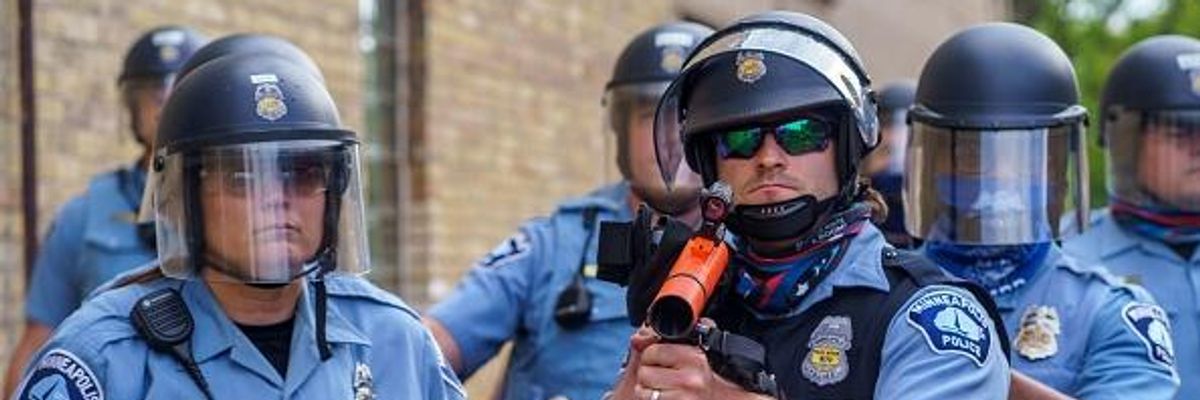
A police officer aims a projectile weapon at protesters who gathered in a call for justice for George Floyd following his death, outside the 3rd Police Precinct on May 27, 2020 in Minneapolis, Minnesota. (Photo: Kerem Yucel/AFP via Getty Images)
"My skull was showing." "My jaw looked like it got hit by a car." "I thought it was a brick."
These and other similar statements can be found in a report published Monday by the Nobel Peace Prize-winning organization Physicians for Human Rights (PHR), which found that at least 115 people suffered serious injuries after law enforcement officers illegally shot them above the clavicle with so-called "less-lethal" projectiles during this summer's protests against police brutality and racial injustice.
In an effort to document the scope of kinetic impact projectile (KIP) use and the resulting injuries, PHR used open-source investigative methods to aggregate publicly available data on injuries sustained to the head, face, or neck due to the use of KIPs at protests from May 26 to July 27.
The product of that effort is a highly detailed interactive visualization titled "Shot in the Head." Though the data are national, the accompanying web page focuses on Los Angeles; Austin, Texas; and Portland, Oregon.
Even though the majority of protesters remained peaceful during demonstrations in June and July of 2020, at some events police used crowd-control weapons, sometimes called "less-lethal" weapons. While tear gas, pepper spray, stun grenades, and acoustic weapons "have all been extensively employed," PHR explains, the group focuses its study on the widespread use of KIPs--commonly referred to as "rubber bullets" but encompassing a wide variety of projectiles fired directly at people during crowd-control operations worldwide.
Although PHR says its count "is almost certainly an underestimation," the new study is the most comprehensive review of head injuries caused by KIPs to date, finding twice as many victims as USA Today and Kaiser Health News identified in July.
PHR argues that "the classification of KIPs as 'less-lethal' contradicts extensive research illustrating that these weapons can cause serious injuries, permanent disabilities, and death." The potentially lethal nature of KIPs "depends greatly on the way it is used" and increases when these weapons are fired at close range or otherwise misused.
PHR cites the U.N. Guidance on Less Lethal Weapons in Law Enforcement (pdf), which explains the known risks of KIP use:
"Shooting civilians in the head with KIPs," PHR writes, "violates widely accepted use of force principles, which forbid targeting of the head and neck and emphasize proportional response to actual threats faced by law enforcement."
For example, the LAPD's guidelines on the use of force state that "less-lethal force options are only permissible when an officer reasonably believes that a suspect or subject is violently resisting arrest or poses and immediate threat of violence or physical harm" and "shall not be used for a suspect or subject who is passively resisting or merely failing to comply with commands" [emphasis in original].
Nonetheless, one protester at a Los Angeles demonstration, C.J. Montano, was shot in the head with a rubber bullet by police officers standing on a roof while his hands were raised in the air, according to PHR. He suffered a traumatic brain injury and bleeding in the brain, which necessitated his taking anti-seizure medication and using a cane to walk.
The analysis states "no evidence has been presented that any of the civilians who were shot in the head by the LAPD on May 30 were behaving in a manner that warranted the use of lethal force as outlined in these LAPD rules governing use of force."
PHR also documents the use of KIPs on May 31 in Austin, Texas, where six demonstrators were shot in the head with "bean bag" rounds.
Victims, some of whom weren't "even around a bunch of chaos," suffered injuries, such as broken jaws, that require reconstructive surgery. The New England Journal of Medicine devoted attention to the injuries caused by "bean bag" rounds, which can penetrate the skull.
KIPs can also cause severe eye injuries and have been condemned by the American Academy of Ophthalmology, whose clinical spokesperson Dr. George Williams told USA Today: "I can't imagine a more effective way to destroy an eyeball than these so-called kinetic impact technologies. ... Frankly, you're better off being stabbed in the eye with something sharp that creates a clean, plain wound."
As in Los Angeles, KIP use in Austin violated the police department's policy, according to PHR, and the group also reports that "no publicly available evidence has been presented that suggests any of the civilians shot in the head in Austin were engaged in conduct that presented a threat of serious injury or death to officers or others."
The report also highlights wanton and illegitimate use of KIPs by law enforcement officials in Portland, where several individuals were shot in the head.
Even when KIPs are "launched or fired from afar," PHR notes, "these weapons are often inaccurate and can strike vulnerable body parts, causing unintended injuries to bystanders."
Furthermore, according to the group, "the use of multi-projectile rounds" violates international standards, which state that "multiple projectiles fired at the same time are inaccurate and, in general, their use cannot comply with the principles of necessity and proportionality," which is why PHR "considers that KIPs are not an appropriate weapon for crowd management and specifically for dispersal purposes."
In addition to causing bodily harm, the "dangerous and often indiscriminate... deployments of KIPs also violate First Amendment protections of free speech and assembly," PHR writes. The group cites the ACLU and a National Lawyers Guild report (pdf) to highlight the "chilling effect" of police violence on the exercising of fundamental constitutional rights.
In conclusion, PHR states:
Piecemeal, post-hoc changes to individual law enforcement, while important, are inadequate to address what is clearly a national phenomenon regarding the misuse of crowd-control weapons. The incidents and injuries identified in this open-source review demand national action on regulation, education, and training on the use of force and accountability around all impact projectiles... We must ban the use of KIPs in crowd-control situations due both to the life-threatening injuries they can cause and their potential to violate freedom of expression and assembly.
"It seems systematic," Dr. Rohini Haar--an emergency physician in Oakland, California who led the analysis--told USA Today. "It seems like there needs to be a reckoning with the use of force in protests."
Dear Common Dreams reader, It’s been nearly 30 years since I co-founded Common Dreams with my late wife, Lina Newhouser. We had the radical notion that journalism should serve the public good, not corporate profits. It was clear to us from the outset what it would take to build such a project. No paid advertisements. No corporate sponsors. No millionaire publisher telling us what to think or do. Many people said we wouldn't last a year, but we proved those doubters wrong. Together with a tremendous team of journalists and dedicated staff, we built an independent media outlet free from the constraints of profits and corporate control. Our mission has always been simple: To inform. To inspire. To ignite change for the common good. Building Common Dreams was not easy. Our survival was never guaranteed. When you take on the most powerful forces—Wall Street greed, fossil fuel industry destruction, Big Tech lobbyists, and uber-rich oligarchs who have spent billions upon billions rigging the economy and democracy in their favor—the only bulwark you have is supporters who believe in your work. But here’s the urgent message from me today. It's never been this bad out there. And it's never been this hard to keep us going. At the very moment Common Dreams is most needed, the threats we face are intensifying. We need your support now more than ever. We don't accept corporate advertising and never will. We don't have a paywall because we don't think people should be blocked from critical news based on their ability to pay. Everything we do is funded by the donations of readers like you. When everyone does the little they can afford, we are strong. But if that support retreats or dries up, so do we. Will you donate now to make sure Common Dreams not only survives but thrives? —Craig Brown, Co-founder |
"My skull was showing." "My jaw looked like it got hit by a car." "I thought it was a brick."
These and other similar statements can be found in a report published Monday by the Nobel Peace Prize-winning organization Physicians for Human Rights (PHR), which found that at least 115 people suffered serious injuries after law enforcement officers illegally shot them above the clavicle with so-called "less-lethal" projectiles during this summer's protests against police brutality and racial injustice.
In an effort to document the scope of kinetic impact projectile (KIP) use and the resulting injuries, PHR used open-source investigative methods to aggregate publicly available data on injuries sustained to the head, face, or neck due to the use of KIPs at protests from May 26 to July 27.
The product of that effort is a highly detailed interactive visualization titled "Shot in the Head." Though the data are national, the accompanying web page focuses on Los Angeles; Austin, Texas; and Portland, Oregon.
Even though the majority of protesters remained peaceful during demonstrations in June and July of 2020, at some events police used crowd-control weapons, sometimes called "less-lethal" weapons. While tear gas, pepper spray, stun grenades, and acoustic weapons "have all been extensively employed," PHR explains, the group focuses its study on the widespread use of KIPs--commonly referred to as "rubber bullets" but encompassing a wide variety of projectiles fired directly at people during crowd-control operations worldwide.
Although PHR says its count "is almost certainly an underestimation," the new study is the most comprehensive review of head injuries caused by KIPs to date, finding twice as many victims as USA Today and Kaiser Health News identified in July.
PHR argues that "the classification of KIPs as 'less-lethal' contradicts extensive research illustrating that these weapons can cause serious injuries, permanent disabilities, and death." The potentially lethal nature of KIPs "depends greatly on the way it is used" and increases when these weapons are fired at close range or otherwise misused.
PHR cites the U.N. Guidance on Less Lethal Weapons in Law Enforcement (pdf), which explains the known risks of KIP use:
"Shooting civilians in the head with KIPs," PHR writes, "violates widely accepted use of force principles, which forbid targeting of the head and neck and emphasize proportional response to actual threats faced by law enforcement."
For example, the LAPD's guidelines on the use of force state that "less-lethal force options are only permissible when an officer reasonably believes that a suspect or subject is violently resisting arrest or poses and immediate threat of violence or physical harm" and "shall not be used for a suspect or subject who is passively resisting or merely failing to comply with commands" [emphasis in original].
Nonetheless, one protester at a Los Angeles demonstration, C.J. Montano, was shot in the head with a rubber bullet by police officers standing on a roof while his hands were raised in the air, according to PHR. He suffered a traumatic brain injury and bleeding in the brain, which necessitated his taking anti-seizure medication and using a cane to walk.
The analysis states "no evidence has been presented that any of the civilians who were shot in the head by the LAPD on May 30 were behaving in a manner that warranted the use of lethal force as outlined in these LAPD rules governing use of force."
PHR also documents the use of KIPs on May 31 in Austin, Texas, where six demonstrators were shot in the head with "bean bag" rounds.
Victims, some of whom weren't "even around a bunch of chaos," suffered injuries, such as broken jaws, that require reconstructive surgery. The New England Journal of Medicine devoted attention to the injuries caused by "bean bag" rounds, which can penetrate the skull.
KIPs can also cause severe eye injuries and have been condemned by the American Academy of Ophthalmology, whose clinical spokesperson Dr. George Williams told USA Today: "I can't imagine a more effective way to destroy an eyeball than these so-called kinetic impact technologies. ... Frankly, you're better off being stabbed in the eye with something sharp that creates a clean, plain wound."
As in Los Angeles, KIP use in Austin violated the police department's policy, according to PHR, and the group also reports that "no publicly available evidence has been presented that suggests any of the civilians shot in the head in Austin were engaged in conduct that presented a threat of serious injury or death to officers or others."
The report also highlights wanton and illegitimate use of KIPs by law enforcement officials in Portland, where several individuals were shot in the head.
Even when KIPs are "launched or fired from afar," PHR notes, "these weapons are often inaccurate and can strike vulnerable body parts, causing unintended injuries to bystanders."
Furthermore, according to the group, "the use of multi-projectile rounds" violates international standards, which state that "multiple projectiles fired at the same time are inaccurate and, in general, their use cannot comply with the principles of necessity and proportionality," which is why PHR "considers that KIPs are not an appropriate weapon for crowd management and specifically for dispersal purposes."
In addition to causing bodily harm, the "dangerous and often indiscriminate... deployments of KIPs also violate First Amendment protections of free speech and assembly," PHR writes. The group cites the ACLU and a National Lawyers Guild report (pdf) to highlight the "chilling effect" of police violence on the exercising of fundamental constitutional rights.
In conclusion, PHR states:
Piecemeal, post-hoc changes to individual law enforcement, while important, are inadequate to address what is clearly a national phenomenon regarding the misuse of crowd-control weapons. The incidents and injuries identified in this open-source review demand national action on regulation, education, and training on the use of force and accountability around all impact projectiles... We must ban the use of KIPs in crowd-control situations due both to the life-threatening injuries they can cause and their potential to violate freedom of expression and assembly.
"It seems systematic," Dr. Rohini Haar--an emergency physician in Oakland, California who led the analysis--told USA Today. "It seems like there needs to be a reckoning with the use of force in protests."
"My skull was showing." "My jaw looked like it got hit by a car." "I thought it was a brick."
These and other similar statements can be found in a report published Monday by the Nobel Peace Prize-winning organization Physicians for Human Rights (PHR), which found that at least 115 people suffered serious injuries after law enforcement officers illegally shot them above the clavicle with so-called "less-lethal" projectiles during this summer's protests against police brutality and racial injustice.
In an effort to document the scope of kinetic impact projectile (KIP) use and the resulting injuries, PHR used open-source investigative methods to aggregate publicly available data on injuries sustained to the head, face, or neck due to the use of KIPs at protests from May 26 to July 27.
The product of that effort is a highly detailed interactive visualization titled "Shot in the Head." Though the data are national, the accompanying web page focuses on Los Angeles; Austin, Texas; and Portland, Oregon.
Even though the majority of protesters remained peaceful during demonstrations in June and July of 2020, at some events police used crowd-control weapons, sometimes called "less-lethal" weapons. While tear gas, pepper spray, stun grenades, and acoustic weapons "have all been extensively employed," PHR explains, the group focuses its study on the widespread use of KIPs--commonly referred to as "rubber bullets" but encompassing a wide variety of projectiles fired directly at people during crowd-control operations worldwide.
Although PHR says its count "is almost certainly an underestimation," the new study is the most comprehensive review of head injuries caused by KIPs to date, finding twice as many victims as USA Today and Kaiser Health News identified in July.
PHR argues that "the classification of KIPs as 'less-lethal' contradicts extensive research illustrating that these weapons can cause serious injuries, permanent disabilities, and death." The potentially lethal nature of KIPs "depends greatly on the way it is used" and increases when these weapons are fired at close range or otherwise misused.
PHR cites the U.N. Guidance on Less Lethal Weapons in Law Enforcement (pdf), which explains the known risks of KIP use:
"Shooting civilians in the head with KIPs," PHR writes, "violates widely accepted use of force principles, which forbid targeting of the head and neck and emphasize proportional response to actual threats faced by law enforcement."
For example, the LAPD's guidelines on the use of force state that "less-lethal force options are only permissible when an officer reasonably believes that a suspect or subject is violently resisting arrest or poses and immediate threat of violence or physical harm" and "shall not be used for a suspect or subject who is passively resisting or merely failing to comply with commands" [emphasis in original].
Nonetheless, one protester at a Los Angeles demonstration, C.J. Montano, was shot in the head with a rubber bullet by police officers standing on a roof while his hands were raised in the air, according to PHR. He suffered a traumatic brain injury and bleeding in the brain, which necessitated his taking anti-seizure medication and using a cane to walk.
The analysis states "no evidence has been presented that any of the civilians who were shot in the head by the LAPD on May 30 were behaving in a manner that warranted the use of lethal force as outlined in these LAPD rules governing use of force."
PHR also documents the use of KIPs on May 31 in Austin, Texas, where six demonstrators were shot in the head with "bean bag" rounds.
Victims, some of whom weren't "even around a bunch of chaos," suffered injuries, such as broken jaws, that require reconstructive surgery. The New England Journal of Medicine devoted attention to the injuries caused by "bean bag" rounds, which can penetrate the skull.
KIPs can also cause severe eye injuries and have been condemned by the American Academy of Ophthalmology, whose clinical spokesperson Dr. George Williams told USA Today: "I can't imagine a more effective way to destroy an eyeball than these so-called kinetic impact technologies. ... Frankly, you're better off being stabbed in the eye with something sharp that creates a clean, plain wound."
As in Los Angeles, KIP use in Austin violated the police department's policy, according to PHR, and the group also reports that "no publicly available evidence has been presented that suggests any of the civilians shot in the head in Austin were engaged in conduct that presented a threat of serious injury or death to officers or others."
The report also highlights wanton and illegitimate use of KIPs by law enforcement officials in Portland, where several individuals were shot in the head.
Even when KIPs are "launched or fired from afar," PHR notes, "these weapons are often inaccurate and can strike vulnerable body parts, causing unintended injuries to bystanders."
Furthermore, according to the group, "the use of multi-projectile rounds" violates international standards, which state that "multiple projectiles fired at the same time are inaccurate and, in general, their use cannot comply with the principles of necessity and proportionality," which is why PHR "considers that KIPs are not an appropriate weapon for crowd management and specifically for dispersal purposes."
In addition to causing bodily harm, the "dangerous and often indiscriminate... deployments of KIPs also violate First Amendment protections of free speech and assembly," PHR writes. The group cites the ACLU and a National Lawyers Guild report (pdf) to highlight the "chilling effect" of police violence on the exercising of fundamental constitutional rights.
In conclusion, PHR states:
Piecemeal, post-hoc changes to individual law enforcement, while important, are inadequate to address what is clearly a national phenomenon regarding the misuse of crowd-control weapons. The incidents and injuries identified in this open-source review demand national action on regulation, education, and training on the use of force and accountability around all impact projectiles... We must ban the use of KIPs in crowd-control situations due both to the life-threatening injuries they can cause and their potential to violate freedom of expression and assembly.
"It seems systematic," Dr. Rohini Haar--an emergency physician in Oakland, California who led the analysis--told USA Today. "It seems like there needs to be a reckoning with the use of force in protests."