SUBSCRIBE TO OUR FREE NEWSLETTER
Daily news & progressive opinion—funded by the people, not the corporations—delivered straight to your inbox.
5
#000000
#FFFFFF
To donate by check, phone, or other method, see our More Ways to Give page.
Daily news & progressive opinion—funded by the people, not the corporations—delivered straight to your inbox.
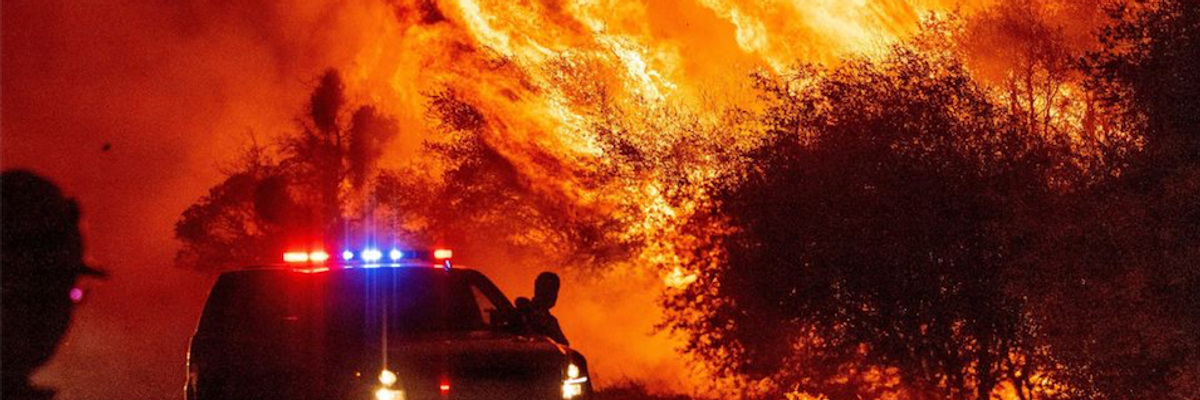
A law enforcement officer watches flames leap into the air as wildfires continued to spread near Oroville, California on September 9, 2020. (Photo: Josh Edelson/AFP/Getty Images)
A new report and visualizations from the Union of Concerned Scientists shows how climate change is fueling more intense and an increasing number of wildfires across the western United States, concluding that better forest management and climate action are the best tools to help limit future fire risks.
"Every year, millions of acres of land are consumed by fire in the United States," the group says in a report published earlier this week. "By raising temperatures, melting snow sooner, and drying soils and forests, climate change is fueling the problem."
"Since 2015, the United States has experienced, on average, roughly 100 more large wildfires every year than the year before," the UCS report continues. "This changes region by region, and year to year, but generally we're seeing more wildfires, more acres burned, and longer, more intense fire seasons."
The report highlights the human and economic costs of worsening wildfires, noting that "between 2014 and 2018 the federal government spent an average of $2.4 billion fighting fires every year." That's more than twice as much as was spent on firefighting two decades earlier.
Then there's the climate cost. "As the forests burn, they release carbon dioxide and other global warming gases, worsening climate change," according to UCS. "As wildfires burn more land, emissions go up."
While fires have always been a part of the natural landscape, "warmer temperatures increase the likelihood that fires will burn more intensely [and] also cause snow to melt sooner, and lead to drier soils, forests, and plants, which act as kindling."
"Increased droughts, unusual rain patterns, and insect outbreaks that lead to large stands of dead trees are also connected with climate change--and they all make wildfires more likely," the report continues.
Ironically, the report says that fire suppression efforts are contributing to worsening wildfires.
"Forests historically evolved with frequent, low-intensity fires that removed underbrush, debris, and fallen timber," it states. "This allowed for larger trees and made massive fires much less common."
"But for the past century, almost all fires have been suppressed, even small ones," it adds. "This has allowed forests to maintain denser growth and more potential fuel, leading to larger and more intense wildfires."
The report says that while "ecologically sound fire management could help limit fire risks" in the near term, "in the long term, climate action is the best tool we have."
"When we reduce global warming emissions, we slow the growth of climate risks, including wildfire," the report concludes. "Until then, summers will continue getting hotter, forests will get drier, and more and more people will face the threat of wildfire."
The UCS report comes amid worsening wildfires not only in North America, but around the world. In the western U.S., entire towns in Oregon have been destroyed by the ferocious conflagrations, and the death toll from California fires--some of the biggest of which are burning completely out of control--rose to at least seven on Thursday, a day after smoke from the infernos turned skies an apocalyptic shade of orange in the San Francisco Bay Area.
Dear Common Dreams reader, It’s been nearly 30 years since I co-founded Common Dreams with my late wife, Lina Newhouser. We had the radical notion that journalism should serve the public good, not corporate profits. It was clear to us from the outset what it would take to build such a project. No paid advertisements. No corporate sponsors. No millionaire publisher telling us what to think or do. Many people said we wouldn't last a year, but we proved those doubters wrong. Together with a tremendous team of journalists and dedicated staff, we built an independent media outlet free from the constraints of profits and corporate control. Our mission has always been simple: To inform. To inspire. To ignite change for the common good. Building Common Dreams was not easy. Our survival was never guaranteed. When you take on the most powerful forces—Wall Street greed, fossil fuel industry destruction, Big Tech lobbyists, and uber-rich oligarchs who have spent billions upon billions rigging the economy and democracy in their favor—the only bulwark you have is supporters who believe in your work. But here’s the urgent message from me today. It's never been this bad out there. And it's never been this hard to keep us going. At the very moment Common Dreams is most needed, the threats we face are intensifying. We need your support now more than ever. We don't accept corporate advertising and never will. We don't have a paywall because we don't think people should be blocked from critical news based on their ability to pay. Everything we do is funded by the donations of readers like you. When everyone does the little they can afford, we are strong. But if that support retreats or dries up, so do we. Will you donate now to make sure Common Dreams not only survives but thrives? —Craig Brown, Co-founder |
A new report and visualizations from the Union of Concerned Scientists shows how climate change is fueling more intense and an increasing number of wildfires across the western United States, concluding that better forest management and climate action are the best tools to help limit future fire risks.
"Every year, millions of acres of land are consumed by fire in the United States," the group says in a report published earlier this week. "By raising temperatures, melting snow sooner, and drying soils and forests, climate change is fueling the problem."
"Since 2015, the United States has experienced, on average, roughly 100 more large wildfires every year than the year before," the UCS report continues. "This changes region by region, and year to year, but generally we're seeing more wildfires, more acres burned, and longer, more intense fire seasons."
The report highlights the human and economic costs of worsening wildfires, noting that "between 2014 and 2018 the federal government spent an average of $2.4 billion fighting fires every year." That's more than twice as much as was spent on firefighting two decades earlier.
Then there's the climate cost. "As the forests burn, they release carbon dioxide and other global warming gases, worsening climate change," according to UCS. "As wildfires burn more land, emissions go up."
While fires have always been a part of the natural landscape, "warmer temperatures increase the likelihood that fires will burn more intensely [and] also cause snow to melt sooner, and lead to drier soils, forests, and plants, which act as kindling."
"Increased droughts, unusual rain patterns, and insect outbreaks that lead to large stands of dead trees are also connected with climate change--and they all make wildfires more likely," the report continues.
Ironically, the report says that fire suppression efforts are contributing to worsening wildfires.
"Forests historically evolved with frequent, low-intensity fires that removed underbrush, debris, and fallen timber," it states. "This allowed for larger trees and made massive fires much less common."
"But for the past century, almost all fires have been suppressed, even small ones," it adds. "This has allowed forests to maintain denser growth and more potential fuel, leading to larger and more intense wildfires."
The report says that while "ecologically sound fire management could help limit fire risks" in the near term, "in the long term, climate action is the best tool we have."
"When we reduce global warming emissions, we slow the growth of climate risks, including wildfire," the report concludes. "Until then, summers will continue getting hotter, forests will get drier, and more and more people will face the threat of wildfire."
The UCS report comes amid worsening wildfires not only in North America, but around the world. In the western U.S., entire towns in Oregon have been destroyed by the ferocious conflagrations, and the death toll from California fires--some of the biggest of which are burning completely out of control--rose to at least seven on Thursday, a day after smoke from the infernos turned skies an apocalyptic shade of orange in the San Francisco Bay Area.
A new report and visualizations from the Union of Concerned Scientists shows how climate change is fueling more intense and an increasing number of wildfires across the western United States, concluding that better forest management and climate action are the best tools to help limit future fire risks.
"Every year, millions of acres of land are consumed by fire in the United States," the group says in a report published earlier this week. "By raising temperatures, melting snow sooner, and drying soils and forests, climate change is fueling the problem."
"Since 2015, the United States has experienced, on average, roughly 100 more large wildfires every year than the year before," the UCS report continues. "This changes region by region, and year to year, but generally we're seeing more wildfires, more acres burned, and longer, more intense fire seasons."
The report highlights the human and economic costs of worsening wildfires, noting that "between 2014 and 2018 the federal government spent an average of $2.4 billion fighting fires every year." That's more than twice as much as was spent on firefighting two decades earlier.
Then there's the climate cost. "As the forests burn, they release carbon dioxide and other global warming gases, worsening climate change," according to UCS. "As wildfires burn more land, emissions go up."
While fires have always been a part of the natural landscape, "warmer temperatures increase the likelihood that fires will burn more intensely [and] also cause snow to melt sooner, and lead to drier soils, forests, and plants, which act as kindling."
"Increased droughts, unusual rain patterns, and insect outbreaks that lead to large stands of dead trees are also connected with climate change--and they all make wildfires more likely," the report continues.
Ironically, the report says that fire suppression efforts are contributing to worsening wildfires.
"Forests historically evolved with frequent, low-intensity fires that removed underbrush, debris, and fallen timber," it states. "This allowed for larger trees and made massive fires much less common."
"But for the past century, almost all fires have been suppressed, even small ones," it adds. "This has allowed forests to maintain denser growth and more potential fuel, leading to larger and more intense wildfires."
The report says that while "ecologically sound fire management could help limit fire risks" in the near term, "in the long term, climate action is the best tool we have."
"When we reduce global warming emissions, we slow the growth of climate risks, including wildfire," the report concludes. "Until then, summers will continue getting hotter, forests will get drier, and more and more people will face the threat of wildfire."
The UCS report comes amid worsening wildfires not only in North America, but around the world. In the western U.S., entire towns in Oregon have been destroyed by the ferocious conflagrations, and the death toll from California fires--some of the biggest of which are burning completely out of control--rose to at least seven on Thursday, a day after smoke from the infernos turned skies an apocalyptic shade of orange in the San Francisco Bay Area.