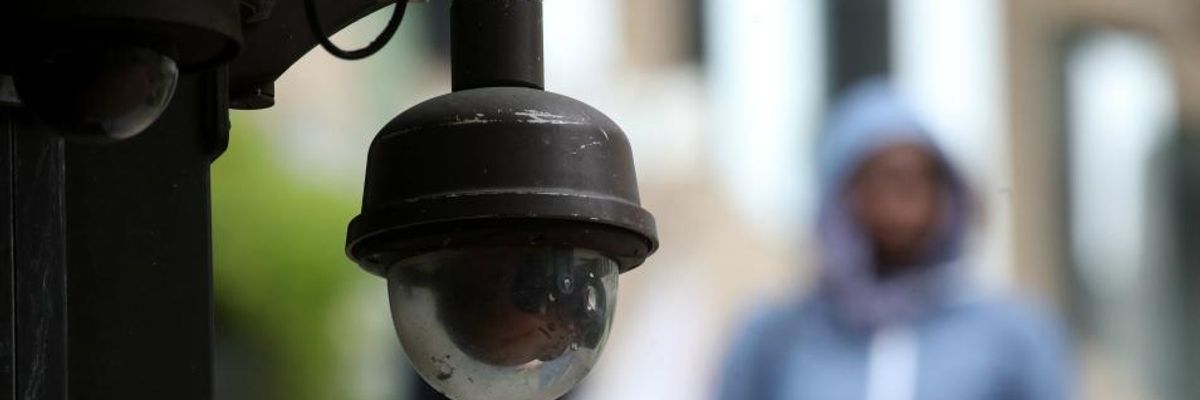
A video surveillance camera hangs from the side of a building on May 14, 2019 in San Francisco. (Photo: Justin Sullivan/Getty Images)
'Every City Council Should Follow Suit': Portland, Oregon Becomes First US City to Ban Corporate Use of Facial Recognition Surveillance
"An enormous victory for the global movement to ban facial recognition and end racist surveillance."
In a historic move that privacy advocates said must be replicated nationwide, the Portland, Oregon city council on Wednesday unanimously approved a sweeping ban on the use of facial recognition surveillance by public agencies as well as private businesses "in places of public accommodation."
Though other major cities across the U.S. have enacted bans on law enforcement use of the notoriously error-prone technology, Portland on Wednesday became the first American city to ban the use of invasive facial recognition surveillance by private corporations. The city's public ban (pdf) took effect immediately and the private ban (pdf) is set to take effect on January 1, 2021.
"This is an exciting opportunity to set a national example by protecting the right of privacy of our community members, especially our most vulnerable and over-policed members."
--Jo Ann Hardesty, Portland City Council Commissioner
Jann Carson, interim executive director of the ACLU of Oregon, said in a statement late Wednesday that "with today's vote, the community made clear we hold the real power in this city."
"We hope the passage of this landmark legislation in Portland will spur efforts to enact statewide legislation that protects Oregonians, across our state, from the broad range of ways that our biometric information is collected, stored, sold, and used without our permission," said Carson.
Fight for the Future deputy director Evan Greer tweeted that "every city council should follow suit" by enacting their own bans on corporate use of facial recognition technology, which she described as "just as dangerous and discriminatory as government and law enforcement use."
Greer noted that the new ban on use of facial recognition technology by private businesses "means stores can't use it on their customers, or on people walking by. It's a huge deal."
The Portland ordinances were led by Portland's Democratic Mayor Ted Wheeler and City Council Commissioner Jo Ann Hardesty, who celebrated the measures as "the nation's most comprehensive facial recognition technology ban."
"This is an exciting opportunity to set a national example by protecting the right of privacy of our community members, especially our most vulnerable and over-policed members," Hardesty wrote in a series of tweets Wednesday. "I refuse to sit back and watch our right to privacy and our civil rights be stripped away so that corporations can make more money."
We are at a crossroads
This country and this world are at a monumental crossroads. In a few short weeks, US voters will have an opportunity to beat back the forces of fascism and confront the billionaires who are rigging the economy, our media system, and our democracy, making it increasingly impossible for ordinary people to get by. We’re not just talking about the election. We’re talking about what must be done once these fascist elements are vanquished from power. We need a bolder set of solutions than what either major party has so far been willing to offer and a working-class movement ready to fight like hell for it. Trump didn't emerge from nowhere. The conditions that fueled MAGA authoritarianism were created by decades of radical neoliberal economic policies and a corrupt political system dominated by corporate interests. They slashed taxes on the super-rich, promising that the benefits would trickle down. They said giveaways to the corporate titans would make life more affordable for the rest of us. It was all bullshit. And when a bitter, betrayed populace searches for someone to blame, right-wing demagogues have little trouble finding scapegoats. People know when they're being lied to, but you won't hear any of this from the corporate media. Only independent journalism—powered and funded by people who believe in building a better world—can deliver truly trustworthy daily news. Our Fall Campaign is underway, and we need your help. To power our newsroom through the rest of the year, we need to raise $125,000 by midnight on October 31. So if you share our vision, please contribute whatever you can to sustain our work. |
In a historic move that privacy advocates said must be replicated nationwide, the Portland, Oregon city council on Wednesday unanimously approved a sweeping ban on the use of facial recognition surveillance by public agencies as well as private businesses "in places of public accommodation."
Though other major cities across the U.S. have enacted bans on law enforcement use of the notoriously error-prone technology, Portland on Wednesday became the first American city to ban the use of invasive facial recognition surveillance by private corporations. The city's public ban (pdf) took effect immediately and the private ban (pdf) is set to take effect on January 1, 2021.
"This is an exciting opportunity to set a national example by protecting the right of privacy of our community members, especially our most vulnerable and over-policed members."
--Jo Ann Hardesty, Portland City Council Commissioner
Jann Carson, interim executive director of the ACLU of Oregon, said in a statement late Wednesday that "with today's vote, the community made clear we hold the real power in this city."
"We hope the passage of this landmark legislation in Portland will spur efforts to enact statewide legislation that protects Oregonians, across our state, from the broad range of ways that our biometric information is collected, stored, sold, and used without our permission," said Carson.
Fight for the Future deputy director Evan Greer tweeted that "every city council should follow suit" by enacting their own bans on corporate use of facial recognition technology, which she described as "just as dangerous and discriminatory as government and law enforcement use."
Greer noted that the new ban on use of facial recognition technology by private businesses "means stores can't use it on their customers, or on people walking by. It's a huge deal."
The Portland ordinances were led by Portland's Democratic Mayor Ted Wheeler and City Council Commissioner Jo Ann Hardesty, who celebrated the measures as "the nation's most comprehensive facial recognition technology ban."
"This is an exciting opportunity to set a national example by protecting the right of privacy of our community members, especially our most vulnerable and over-policed members," Hardesty wrote in a series of tweets Wednesday. "I refuse to sit back and watch our right to privacy and our civil rights be stripped away so that corporations can make more money."
In a historic move that privacy advocates said must be replicated nationwide, the Portland, Oregon city council on Wednesday unanimously approved a sweeping ban on the use of facial recognition surveillance by public agencies as well as private businesses "in places of public accommodation."
Though other major cities across the U.S. have enacted bans on law enforcement use of the notoriously error-prone technology, Portland on Wednesday became the first American city to ban the use of invasive facial recognition surveillance by private corporations. The city's public ban (pdf) took effect immediately and the private ban (pdf) is set to take effect on January 1, 2021.
"This is an exciting opportunity to set a national example by protecting the right of privacy of our community members, especially our most vulnerable and over-policed members."
--Jo Ann Hardesty, Portland City Council Commissioner
Jann Carson, interim executive director of the ACLU of Oregon, said in a statement late Wednesday that "with today's vote, the community made clear we hold the real power in this city."
"We hope the passage of this landmark legislation in Portland will spur efforts to enact statewide legislation that protects Oregonians, across our state, from the broad range of ways that our biometric information is collected, stored, sold, and used without our permission," said Carson.
Fight for the Future deputy director Evan Greer tweeted that "every city council should follow suit" by enacting their own bans on corporate use of facial recognition technology, which she described as "just as dangerous and discriminatory as government and law enforcement use."
Greer noted that the new ban on use of facial recognition technology by private businesses "means stores can't use it on their customers, or on people walking by. It's a huge deal."
The Portland ordinances were led by Portland's Democratic Mayor Ted Wheeler and City Council Commissioner Jo Ann Hardesty, who celebrated the measures as "the nation's most comprehensive facial recognition technology ban."
"This is an exciting opportunity to set a national example by protecting the right of privacy of our community members, especially our most vulnerable and over-policed members," Hardesty wrote in a series of tweets Wednesday. "I refuse to sit back and watch our right to privacy and our civil rights be stripped away so that corporations can make more money."