SUBSCRIBE TO OUR FREE NEWSLETTER
Daily news & progressive opinion—funded by the people, not the corporations—delivered straight to your inbox.
5
#000000
#FFFFFF
To donate by check, phone, or other method, see our More Ways to Give page.
Daily news & progressive opinion—funded by the people, not the corporations—delivered straight to your inbox.
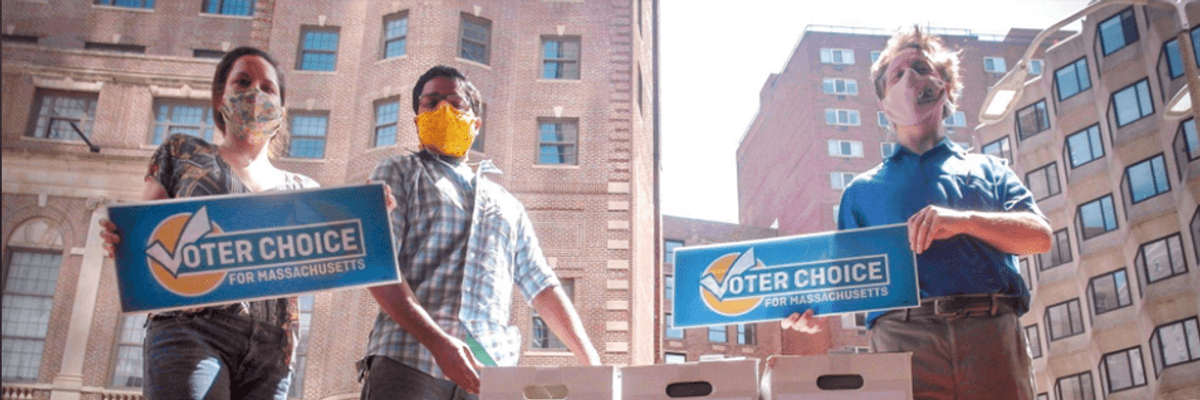
Campaigners with Yes on 2, the ranked choice voting initiative in Massachusetts, pose with boxes of signatures gathered to qualify the referrendum for the general election ballot. Bay State voters will decide whether to adopt RCV on November 3. (Photo: Yeson2/Facebook)
Ranked choice voting advocates are pointing to a crowded congressional primary in Massachusetts as the "poster child" for their cause, which, thanks to a citizen initiative, will be on the ballot in the Bay State in November.
"To me the problem is that democracy isn't creating the results [that reflect the will of the people]," Evan Falchuk, chair of the board for Yes on 2, the ranked choice voting (RCV) ballot initiative campaign in Massachusetts, told Common Dreams Monday. "The biggest structural problem we have is 'first past the post' voting," Falchuk continued. "[Which] means you can win an election with 25% of vote...that's not fair."
The RCV process allows voters to rank candidates in order of preference. Under the system, if no candidate wins the approval of more than half the voters after the first round of tabulation, the candidate with the fewest votes is eliminated. When a voter's first choice is eliminated, their vote is redistributed to the voter's second choice. This process continues until one candidate gets at least 50% of vote.
Referring to a nine-way primary in Massachusetts' 4th congressional district earlier this month in which centrist Democrat and former Republican Jake Auchincloss won with less than 23% of the vote, Falchuk called the race a "poster child" for RCV.
Auchincloss, Falchuk noted, opposes Medicare for All, a policy growing in popularity amidst the Covid-19 pandemic and supported by several of Auchincloss' progressive challengers. "There's just something wrong with that," Falchuk said.
Jess Mermell, one of Achincloss' progressive challengers and a Medicare for All supporter, came in second place in the contest to replace outgoing Rep. Joe Kennedy (D-Mass.), with 21.1% of the vote.
In a video following the election, Mermell said, "If the ranked choice voting campaign needs a new face, give me a call, guys. I've got some time on my hands."
Before and after the primary, critics were quick to blame the progressive slate of challengers for Auchincloss' win, arguing they "spoiled" the opportunity for a more left-leaning candidate to win by remaining in the race and not dropping out instead of throwing their support behind one progressive campaign. Criticism of candidates challenging established party-line ideas is commonplace. Establishment Democrats, for example, continuously paint Sen. Bernie Sanders (I-Vt.) as a spoiler in both his presidential runs.
But, Falchuk said, ranked choice voting is designed to eliminate that "spoiler effect" and promote the democratic process.
"No candidate should feel like they're at risk of splitting the vote," Falchuk said. "Go out there. Run for office. Make a difference."
Ranked choice voting is currently employed in local elections across the country. In Maine, the practice was approved via citizen initiative in 2016 and again in 2018 for use in statewide elections.
"Ranked choice voting is one of the best reforms we can make to preserve and enhance our democracy," said Betsy Sweet, a former U.S. Senate and Maine gubernatorial candidate who helped pass RCV in the Pine Tree state. "As a candidate who has run in a statewide ranked choice system of voting twice it has made a huge difference," Sweet told Common Dreams.
"Most importantly, it dramatically affects who can run, and who believes they can run. It reduces negative campaigning, and it forces candidates to focus on issues," Sweet continued. "It also provides better governance and trust in our legislators because everyone is elected with more than 50% of the vote."
Sweet partnered with fellow candidate Mark Eves during her gubernatorial run in 2018 in a video that showed how ranked choice voting can affect the way campaigns and candidates treat each other and voters.
"People don't like seeing a leader talk about how terrible somebody else is," Falchuk said. Instead, RCV advocates say, voters want to hear from candidates about positive policy changes they plan to enact.
Data collected from elections in which RCV is used, Falchuk said, shows that it makes campaigns more substantive and positive and increases voter turnout "because people feel like they have a voice."
With ranked choice voting, Falchuk continued, candidates are able to have constructive dialogue with voters who support their opponents, a practice candidates in the current system seldom exercise.
Many of the candidates in the race to replace Kennedy, including Auchincloss, came out in support of RCV, Falchuk said. What's more, ranked choice voting has bipartisan support. Progressive leaders including Sen. Ed Markey (D-Mass.) have publicly supported the process, and conservative talk show host Ben Shapiro this week endorsed the idea.
Voters in Massachusetts and Alaska will see statewide initiatives on their November ballots, as will citizens in cities in California, Colorado, and Minnesota.
As the United States grapples with uncertainty ahead of November, Falchuk said ranked choice voting is a logical step in creating more representative campaigns and election results.
"This is one of these no brainers that just makes our democracy better," he said.
Dear Common Dreams reader, It’s been nearly 30 years since I co-founded Common Dreams with my late wife, Lina Newhouser. We had the radical notion that journalism should serve the public good, not corporate profits. It was clear to us from the outset what it would take to build such a project. No paid advertisements. No corporate sponsors. No millionaire publisher telling us what to think or do. Many people said we wouldn't last a year, but we proved those doubters wrong. Together with a tremendous team of journalists and dedicated staff, we built an independent media outlet free from the constraints of profits and corporate control. Our mission has always been simple: To inform. To inspire. To ignite change for the common good. Building Common Dreams was not easy. Our survival was never guaranteed. When you take on the most powerful forces—Wall Street greed, fossil fuel industry destruction, Big Tech lobbyists, and uber-rich oligarchs who have spent billions upon billions rigging the economy and democracy in their favor—the only bulwark you have is supporters who believe in your work. But here’s the urgent message from me today. It's never been this bad out there. And it's never been this hard to keep us going. At the very moment Common Dreams is most needed, the threats we face are intensifying. We need your support now more than ever. We don't accept corporate advertising and never will. We don't have a paywall because we don't think people should be blocked from critical news based on their ability to pay. Everything we do is funded by the donations of readers like you. When everyone does the little they can afford, we are strong. But if that support retreats or dries up, so do we. Will you donate now to make sure Common Dreams not only survives but thrives? —Craig Brown, Co-founder |
Ranked choice voting advocates are pointing to a crowded congressional primary in Massachusetts as the "poster child" for their cause, which, thanks to a citizen initiative, will be on the ballot in the Bay State in November.
"To me the problem is that democracy isn't creating the results [that reflect the will of the people]," Evan Falchuk, chair of the board for Yes on 2, the ranked choice voting (RCV) ballot initiative campaign in Massachusetts, told Common Dreams Monday. "The biggest structural problem we have is 'first past the post' voting," Falchuk continued. "[Which] means you can win an election with 25% of vote...that's not fair."
The RCV process allows voters to rank candidates in order of preference. Under the system, if no candidate wins the approval of more than half the voters after the first round of tabulation, the candidate with the fewest votes is eliminated. When a voter's first choice is eliminated, their vote is redistributed to the voter's second choice. This process continues until one candidate gets at least 50% of vote.
Referring to a nine-way primary in Massachusetts' 4th congressional district earlier this month in which centrist Democrat and former Republican Jake Auchincloss won with less than 23% of the vote, Falchuk called the race a "poster child" for RCV.
Auchincloss, Falchuk noted, opposes Medicare for All, a policy growing in popularity amidst the Covid-19 pandemic and supported by several of Auchincloss' progressive challengers. "There's just something wrong with that," Falchuk said.
Jess Mermell, one of Achincloss' progressive challengers and a Medicare for All supporter, came in second place in the contest to replace outgoing Rep. Joe Kennedy (D-Mass.), with 21.1% of the vote.
In a video following the election, Mermell said, "If the ranked choice voting campaign needs a new face, give me a call, guys. I've got some time on my hands."
Before and after the primary, critics were quick to blame the progressive slate of challengers for Auchincloss' win, arguing they "spoiled" the opportunity for a more left-leaning candidate to win by remaining in the race and not dropping out instead of throwing their support behind one progressive campaign. Criticism of candidates challenging established party-line ideas is commonplace. Establishment Democrats, for example, continuously paint Sen. Bernie Sanders (I-Vt.) as a spoiler in both his presidential runs.
But, Falchuk said, ranked choice voting is designed to eliminate that "spoiler effect" and promote the democratic process.
"No candidate should feel like they're at risk of splitting the vote," Falchuk said. "Go out there. Run for office. Make a difference."
Ranked choice voting is currently employed in local elections across the country. In Maine, the practice was approved via citizen initiative in 2016 and again in 2018 for use in statewide elections.
"Ranked choice voting is one of the best reforms we can make to preserve and enhance our democracy," said Betsy Sweet, a former U.S. Senate and Maine gubernatorial candidate who helped pass RCV in the Pine Tree state. "As a candidate who has run in a statewide ranked choice system of voting twice it has made a huge difference," Sweet told Common Dreams.
"Most importantly, it dramatically affects who can run, and who believes they can run. It reduces negative campaigning, and it forces candidates to focus on issues," Sweet continued. "It also provides better governance and trust in our legislators because everyone is elected with more than 50% of the vote."
Sweet partnered with fellow candidate Mark Eves during her gubernatorial run in 2018 in a video that showed how ranked choice voting can affect the way campaigns and candidates treat each other and voters.
"People don't like seeing a leader talk about how terrible somebody else is," Falchuk said. Instead, RCV advocates say, voters want to hear from candidates about positive policy changes they plan to enact.
Data collected from elections in which RCV is used, Falchuk said, shows that it makes campaigns more substantive and positive and increases voter turnout "because people feel like they have a voice."
With ranked choice voting, Falchuk continued, candidates are able to have constructive dialogue with voters who support their opponents, a practice candidates in the current system seldom exercise.
Many of the candidates in the race to replace Kennedy, including Auchincloss, came out in support of RCV, Falchuk said. What's more, ranked choice voting has bipartisan support. Progressive leaders including Sen. Ed Markey (D-Mass.) have publicly supported the process, and conservative talk show host Ben Shapiro this week endorsed the idea.
Voters in Massachusetts and Alaska will see statewide initiatives on their November ballots, as will citizens in cities in California, Colorado, and Minnesota.
As the United States grapples with uncertainty ahead of November, Falchuk said ranked choice voting is a logical step in creating more representative campaigns and election results.
"This is one of these no brainers that just makes our democracy better," he said.
Ranked choice voting advocates are pointing to a crowded congressional primary in Massachusetts as the "poster child" for their cause, which, thanks to a citizen initiative, will be on the ballot in the Bay State in November.
"To me the problem is that democracy isn't creating the results [that reflect the will of the people]," Evan Falchuk, chair of the board for Yes on 2, the ranked choice voting (RCV) ballot initiative campaign in Massachusetts, told Common Dreams Monday. "The biggest structural problem we have is 'first past the post' voting," Falchuk continued. "[Which] means you can win an election with 25% of vote...that's not fair."
The RCV process allows voters to rank candidates in order of preference. Under the system, if no candidate wins the approval of more than half the voters after the first round of tabulation, the candidate with the fewest votes is eliminated. When a voter's first choice is eliminated, their vote is redistributed to the voter's second choice. This process continues until one candidate gets at least 50% of vote.
Referring to a nine-way primary in Massachusetts' 4th congressional district earlier this month in which centrist Democrat and former Republican Jake Auchincloss won with less than 23% of the vote, Falchuk called the race a "poster child" for RCV.
Auchincloss, Falchuk noted, opposes Medicare for All, a policy growing in popularity amidst the Covid-19 pandemic and supported by several of Auchincloss' progressive challengers. "There's just something wrong with that," Falchuk said.
Jess Mermell, one of Achincloss' progressive challengers and a Medicare for All supporter, came in second place in the contest to replace outgoing Rep. Joe Kennedy (D-Mass.), with 21.1% of the vote.
In a video following the election, Mermell said, "If the ranked choice voting campaign needs a new face, give me a call, guys. I've got some time on my hands."
Before and after the primary, critics were quick to blame the progressive slate of challengers for Auchincloss' win, arguing they "spoiled" the opportunity for a more left-leaning candidate to win by remaining in the race and not dropping out instead of throwing their support behind one progressive campaign. Criticism of candidates challenging established party-line ideas is commonplace. Establishment Democrats, for example, continuously paint Sen. Bernie Sanders (I-Vt.) as a spoiler in both his presidential runs.
But, Falchuk said, ranked choice voting is designed to eliminate that "spoiler effect" and promote the democratic process.
"No candidate should feel like they're at risk of splitting the vote," Falchuk said. "Go out there. Run for office. Make a difference."
Ranked choice voting is currently employed in local elections across the country. In Maine, the practice was approved via citizen initiative in 2016 and again in 2018 for use in statewide elections.
"Ranked choice voting is one of the best reforms we can make to preserve and enhance our democracy," said Betsy Sweet, a former U.S. Senate and Maine gubernatorial candidate who helped pass RCV in the Pine Tree state. "As a candidate who has run in a statewide ranked choice system of voting twice it has made a huge difference," Sweet told Common Dreams.
"Most importantly, it dramatically affects who can run, and who believes they can run. It reduces negative campaigning, and it forces candidates to focus on issues," Sweet continued. "It also provides better governance and trust in our legislators because everyone is elected with more than 50% of the vote."
Sweet partnered with fellow candidate Mark Eves during her gubernatorial run in 2018 in a video that showed how ranked choice voting can affect the way campaigns and candidates treat each other and voters.
"People don't like seeing a leader talk about how terrible somebody else is," Falchuk said. Instead, RCV advocates say, voters want to hear from candidates about positive policy changes they plan to enact.
Data collected from elections in which RCV is used, Falchuk said, shows that it makes campaigns more substantive and positive and increases voter turnout "because people feel like they have a voice."
With ranked choice voting, Falchuk continued, candidates are able to have constructive dialogue with voters who support their opponents, a practice candidates in the current system seldom exercise.
Many of the candidates in the race to replace Kennedy, including Auchincloss, came out in support of RCV, Falchuk said. What's more, ranked choice voting has bipartisan support. Progressive leaders including Sen. Ed Markey (D-Mass.) have publicly supported the process, and conservative talk show host Ben Shapiro this week endorsed the idea.
Voters in Massachusetts and Alaska will see statewide initiatives on their November ballots, as will citizens in cities in California, Colorado, and Minnesota.
As the United States grapples with uncertainty ahead of November, Falchuk said ranked choice voting is a logical step in creating more representative campaigns and election results.
"This is one of these no brainers that just makes our democracy better," he said.