

SUBSCRIBE TO OUR FREE NEWSLETTER
Daily news & progressive opinion—funded by the people, not the corporations—delivered straight to your inbox.
5
#000000
#FFFFFF
To donate by check, phone, or other method, see our More Ways to Give page.
Daily news & progressive opinion—funded by the people, not the corporations—delivered straight to your inbox.
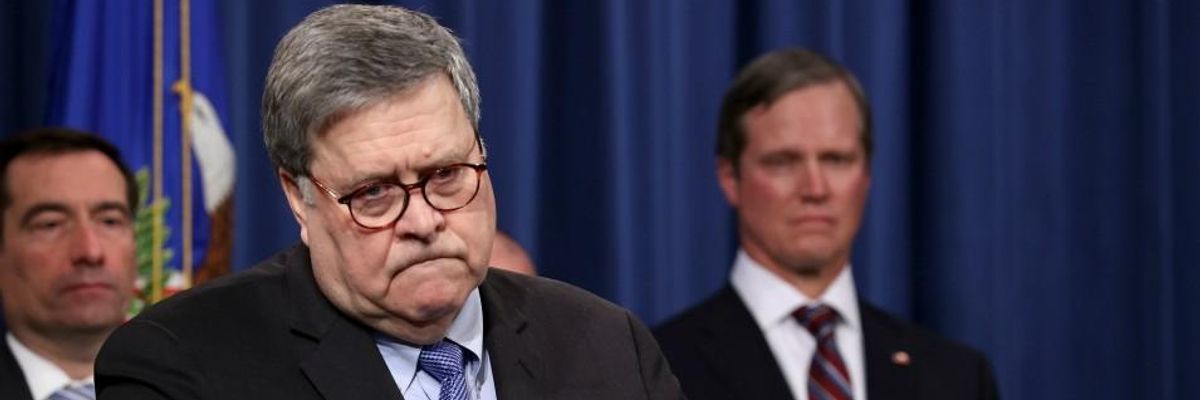
Attorney General William Barr speaks during a press conference on January 13, 2020 in Washington, D.C. (Photo: Win McNamee/Getty Images)
As Attorney General William Barr faced renewed calls for his impeachment after claiming not to know whether it's illegal for a U.S. voter to cast two ballots in a federal election, prosecutors and journalists have caught the nation's top law enforcement officer in a "massive falsehood" about a mail-in ballot fraud case in Texas.
In his interview with CNN earlier this week, Barr told Wolf Blitzer that prosecutors had indicted a man who collected 1,700 blank ballots and used them to cast a specific vote.
"Elections that have been held with mail have found substantial fraud and coercion," Barr said. "For example, we indicted someone in Texas, 1,700 ballots collected...from people who could vote, he made them out and voted for the person he wanted to. Okay?"
Watch: "Let me talk!" AG Bill Barr just clashed with CNN's Wolf Bitzer in a heated segment over mail-in voting: "This is cheap talk to get around the fundamental problem" pic.twitter.com/1PzHm9qN6l
-- TV News HQ (@TVNewsHQ) September 2, 2020
Aside from vastly overstating the prevalence of fraud in vote-by-mail systems which have been used by millions of Americans for decades, Barr appeared to fabricate the facts about the case in Texas, prosecutors who worked on the case told the Washington Post.
"That's not what happened at all," Andy Chatham, who served as assistant district attorney in Dallas County when prosecutors investigated the collection of a small number of blank ballots in 2017, told the newspaper.
"Unfortunately, it speaks volumes to the credibility of Attorney General Barr when he submits half-truths and alternative facts as clear evidence of voter fraud without having so much as even contacted me or the district attorney's office for an understanding of the events that actually occurred."
--Andy Chatham, former Dallas County prosecutor
Barr suggested the Department of Justice prosecuted a federal case of voter fraud, but he appeared to be referring to a local prosecution involving a City Council election.
Authorities uncovered 700 ballots on which voters stated that someone named Jose Rodriguez had helped them to prepare them, but the ballots did not favor a particular candidate and the voters confirmed that the votes were accurate. Chatham said investigators were eventually led to a man named Miguel Hernandez, likely a "low-level player in a possibly larger scheme that never came to fruition," who pleaded guilty to improperly returning a marked ballot.
Hernandez collected a blank ballot from a woman, filled it out, and forged her signature, according to court records.
Prosecutors in the case told the Post that while they initially suspected as many as 1,700 fraudulent ballots, "we did not uncover that, at all... We couldn't find it except that little tiny case."
"Unfortunately, it speaks volumes to the credibility of Attorney General Barr when he submits half-truths and alternative facts as clear evidence of voter fraud without having so much as even contacted me or the district attorney's office for an understanding of the events that actually occurred," Chatham told the Post.
A Justice Department spokesperson said Friday, as news of the prosecutors' objections to Barr's story spread across social media, that the attorney general had received inaccurate information from a staffer.
"Was that staffer a Trump appointee?" asked journalist and activist Isaiah Poole. "Was he disciplined or fired?"
New York Times journalist Charlie Savage pointed out that the incident is far from the first time that Barr has been caught making up details of legal and criminal cases.
"Barr is a shameless liar and most importantly has been one for his entire career," Times columnist Jamelle Bouie tweeted.
Prosecutors also called into question, as a number of academic studies of election fraud have, Barr's claim that elections in which mail-in ballots are primarily used lead to "substantial fraud and coercion."
Colorado, Hawaii, Oregon, Utah, and Washington all use mail-in ballots as their primary method of voting, and President Donald Trump cast a mail-in ballot last month in the Florida primary despite his ongoing claims that voting by mail invites fraud. In 2018, a quarter of all American voters cast ballots via mail.
A study by the Post of five elections held over two years in Colorado, Washington, and Oregon showed that out of 14.6 million votes, officials identified 372 possibly fraudulent votes--a rate of 0.0025%.
Local prosecutors in states that use mail-in voting do not classify fraudulent voters as much of a concern; as Chatham told the Post, fraudulent ballots are "incredibly simple to ferret out" before they have an impact on an election's outcome.
"Not only are there barcodes on the ballot, but the ballot won't be accepted unless it is from a registered voter, whose name and signature are verified by elections officials," Columbia University elections expert Richard Briffault told the Post.
Noah Bookbinder, executive director of Citizens for Responsibility and Ethics in Washington (CREW), tweeted that Barr's credibility was "compromised" well before his latest claim about fraudulent voting.
"Misrepresenting investigations for political purposes further erodes trust in him and the DOJ," Bookbinder wrote.
Dear Common Dreams reader, It’s been nearly 30 years since I co-founded Common Dreams with my late wife, Lina Newhouser. We had the radical notion that journalism should serve the public good, not corporate profits. It was clear to us from the outset what it would take to build such a project. No paid advertisements. No corporate sponsors. No millionaire publisher telling us what to think or do. Many people said we wouldn't last a year, but we proved those doubters wrong. Together with a tremendous team of journalists and dedicated staff, we built an independent media outlet free from the constraints of profits and corporate control. Our mission has always been simple: To inform. To inspire. To ignite change for the common good. Building Common Dreams was not easy. Our survival was never guaranteed. When you take on the most powerful forces—Wall Street greed, fossil fuel industry destruction, Big Tech lobbyists, and uber-rich oligarchs who have spent billions upon billions rigging the economy and democracy in their favor—the only bulwark you have is supporters who believe in your work. But here’s the urgent message from me today. It's never been this bad out there. And it's never been this hard to keep us going. At the very moment Common Dreams is most needed, the threats we face are intensifying. We need your support now more than ever. We don't accept corporate advertising and never will. We don't have a paywall because we don't think people should be blocked from critical news based on their ability to pay. Everything we do is funded by the donations of readers like you. When everyone does the little they can afford, we are strong. But if that support retreats or dries up, so do we. Will you donate now to make sure Common Dreams not only survives but thrives? —Craig Brown, Co-founder |
As Attorney General William Barr faced renewed calls for his impeachment after claiming not to know whether it's illegal for a U.S. voter to cast two ballots in a federal election, prosecutors and journalists have caught the nation's top law enforcement officer in a "massive falsehood" about a mail-in ballot fraud case in Texas.
In his interview with CNN earlier this week, Barr told Wolf Blitzer that prosecutors had indicted a man who collected 1,700 blank ballots and used them to cast a specific vote.
"Elections that have been held with mail have found substantial fraud and coercion," Barr said. "For example, we indicted someone in Texas, 1,700 ballots collected...from people who could vote, he made them out and voted for the person he wanted to. Okay?"
Watch: "Let me talk!" AG Bill Barr just clashed with CNN's Wolf Bitzer in a heated segment over mail-in voting: "This is cheap talk to get around the fundamental problem" pic.twitter.com/1PzHm9qN6l
-- TV News HQ (@TVNewsHQ) September 2, 2020
Aside from vastly overstating the prevalence of fraud in vote-by-mail systems which have been used by millions of Americans for decades, Barr appeared to fabricate the facts about the case in Texas, prosecutors who worked on the case told the Washington Post.
"That's not what happened at all," Andy Chatham, who served as assistant district attorney in Dallas County when prosecutors investigated the collection of a small number of blank ballots in 2017, told the newspaper.
"Unfortunately, it speaks volumes to the credibility of Attorney General Barr when he submits half-truths and alternative facts as clear evidence of voter fraud without having so much as even contacted me or the district attorney's office for an understanding of the events that actually occurred."
--Andy Chatham, former Dallas County prosecutor
Barr suggested the Department of Justice prosecuted a federal case of voter fraud, but he appeared to be referring to a local prosecution involving a City Council election.
Authorities uncovered 700 ballots on which voters stated that someone named Jose Rodriguez had helped them to prepare them, but the ballots did not favor a particular candidate and the voters confirmed that the votes were accurate. Chatham said investigators were eventually led to a man named Miguel Hernandez, likely a "low-level player in a possibly larger scheme that never came to fruition," who pleaded guilty to improperly returning a marked ballot.
Hernandez collected a blank ballot from a woman, filled it out, and forged her signature, according to court records.
Prosecutors in the case told the Post that while they initially suspected as many as 1,700 fraudulent ballots, "we did not uncover that, at all... We couldn't find it except that little tiny case."
"Unfortunately, it speaks volumes to the credibility of Attorney General Barr when he submits half-truths and alternative facts as clear evidence of voter fraud without having so much as even contacted me or the district attorney's office for an understanding of the events that actually occurred," Chatham told the Post.
A Justice Department spokesperson said Friday, as news of the prosecutors' objections to Barr's story spread across social media, that the attorney general had received inaccurate information from a staffer.
"Was that staffer a Trump appointee?" asked journalist and activist Isaiah Poole. "Was he disciplined or fired?"
New York Times journalist Charlie Savage pointed out that the incident is far from the first time that Barr has been caught making up details of legal and criminal cases.
"Barr is a shameless liar and most importantly has been one for his entire career," Times columnist Jamelle Bouie tweeted.
Prosecutors also called into question, as a number of academic studies of election fraud have, Barr's claim that elections in which mail-in ballots are primarily used lead to "substantial fraud and coercion."
Colorado, Hawaii, Oregon, Utah, and Washington all use mail-in ballots as their primary method of voting, and President Donald Trump cast a mail-in ballot last month in the Florida primary despite his ongoing claims that voting by mail invites fraud. In 2018, a quarter of all American voters cast ballots via mail.
A study by the Post of five elections held over two years in Colorado, Washington, and Oregon showed that out of 14.6 million votes, officials identified 372 possibly fraudulent votes--a rate of 0.0025%.
Local prosecutors in states that use mail-in voting do not classify fraudulent voters as much of a concern; as Chatham told the Post, fraudulent ballots are "incredibly simple to ferret out" before they have an impact on an election's outcome.
"Not only are there barcodes on the ballot, but the ballot won't be accepted unless it is from a registered voter, whose name and signature are verified by elections officials," Columbia University elections expert Richard Briffault told the Post.
Noah Bookbinder, executive director of Citizens for Responsibility and Ethics in Washington (CREW), tweeted that Barr's credibility was "compromised" well before his latest claim about fraudulent voting.
"Misrepresenting investigations for political purposes further erodes trust in him and the DOJ," Bookbinder wrote.
As Attorney General William Barr faced renewed calls for his impeachment after claiming not to know whether it's illegal for a U.S. voter to cast two ballots in a federal election, prosecutors and journalists have caught the nation's top law enforcement officer in a "massive falsehood" about a mail-in ballot fraud case in Texas.
In his interview with CNN earlier this week, Barr told Wolf Blitzer that prosecutors had indicted a man who collected 1,700 blank ballots and used them to cast a specific vote.
"Elections that have been held with mail have found substantial fraud and coercion," Barr said. "For example, we indicted someone in Texas, 1,700 ballots collected...from people who could vote, he made them out and voted for the person he wanted to. Okay?"
Watch: "Let me talk!" AG Bill Barr just clashed with CNN's Wolf Bitzer in a heated segment over mail-in voting: "This is cheap talk to get around the fundamental problem" pic.twitter.com/1PzHm9qN6l
-- TV News HQ (@TVNewsHQ) September 2, 2020
Aside from vastly overstating the prevalence of fraud in vote-by-mail systems which have been used by millions of Americans for decades, Barr appeared to fabricate the facts about the case in Texas, prosecutors who worked on the case told the Washington Post.
"That's not what happened at all," Andy Chatham, who served as assistant district attorney in Dallas County when prosecutors investigated the collection of a small number of blank ballots in 2017, told the newspaper.
"Unfortunately, it speaks volumes to the credibility of Attorney General Barr when he submits half-truths and alternative facts as clear evidence of voter fraud without having so much as even contacted me or the district attorney's office for an understanding of the events that actually occurred."
--Andy Chatham, former Dallas County prosecutor
Barr suggested the Department of Justice prosecuted a federal case of voter fraud, but he appeared to be referring to a local prosecution involving a City Council election.
Authorities uncovered 700 ballots on which voters stated that someone named Jose Rodriguez had helped them to prepare them, but the ballots did not favor a particular candidate and the voters confirmed that the votes were accurate. Chatham said investigators were eventually led to a man named Miguel Hernandez, likely a "low-level player in a possibly larger scheme that never came to fruition," who pleaded guilty to improperly returning a marked ballot.
Hernandez collected a blank ballot from a woman, filled it out, and forged her signature, according to court records.
Prosecutors in the case told the Post that while they initially suspected as many as 1,700 fraudulent ballots, "we did not uncover that, at all... We couldn't find it except that little tiny case."
"Unfortunately, it speaks volumes to the credibility of Attorney General Barr when he submits half-truths and alternative facts as clear evidence of voter fraud without having so much as even contacted me or the district attorney's office for an understanding of the events that actually occurred," Chatham told the Post.
A Justice Department spokesperson said Friday, as news of the prosecutors' objections to Barr's story spread across social media, that the attorney general had received inaccurate information from a staffer.
"Was that staffer a Trump appointee?" asked journalist and activist Isaiah Poole. "Was he disciplined or fired?"
New York Times journalist Charlie Savage pointed out that the incident is far from the first time that Barr has been caught making up details of legal and criminal cases.
"Barr is a shameless liar and most importantly has been one for his entire career," Times columnist Jamelle Bouie tweeted.
Prosecutors also called into question, as a number of academic studies of election fraud have, Barr's claim that elections in which mail-in ballots are primarily used lead to "substantial fraud and coercion."
Colorado, Hawaii, Oregon, Utah, and Washington all use mail-in ballots as their primary method of voting, and President Donald Trump cast a mail-in ballot last month in the Florida primary despite his ongoing claims that voting by mail invites fraud. In 2018, a quarter of all American voters cast ballots via mail.
A study by the Post of five elections held over two years in Colorado, Washington, and Oregon showed that out of 14.6 million votes, officials identified 372 possibly fraudulent votes--a rate of 0.0025%.
Local prosecutors in states that use mail-in voting do not classify fraudulent voters as much of a concern; as Chatham told the Post, fraudulent ballots are "incredibly simple to ferret out" before they have an impact on an election's outcome.
"Not only are there barcodes on the ballot, but the ballot won't be accepted unless it is from a registered voter, whose name and signature are verified by elections officials," Columbia University elections expert Richard Briffault told the Post.
Noah Bookbinder, executive director of Citizens for Responsibility and Ethics in Washington (CREW), tweeted that Barr's credibility was "compromised" well before his latest claim about fraudulent voting.
"Misrepresenting investigations for political purposes further erodes trust in him and the DOJ," Bookbinder wrote.

