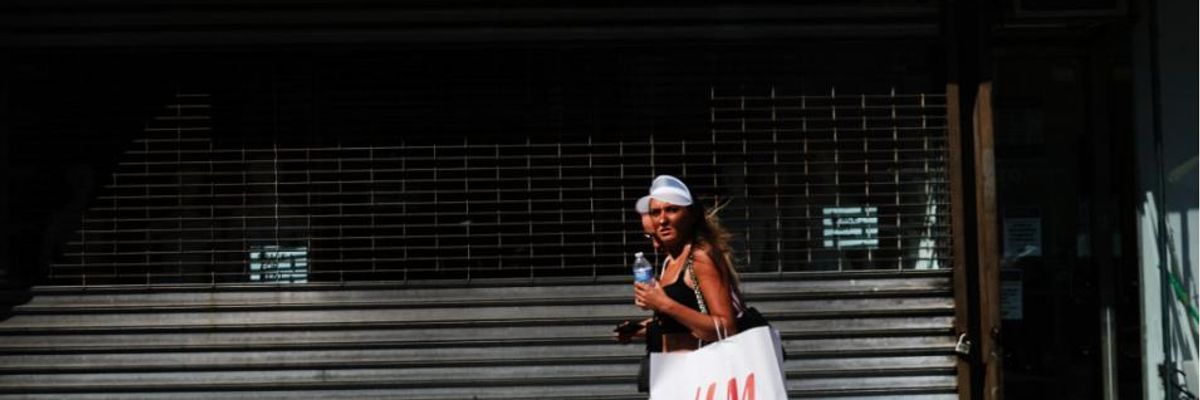
People walk by a closed business on July 21, 2020 in the Brooklyn borough of New York City. (Photo: Spencer Platt/Getty Images)
As Big Box Stores Thrive, 1 in 5 Small Businesses Expect to Close in Next 6 Months Without Urgent Federal Aid
"Many of them still need more financial assistance just to keep their doors open and staff on payroll," the National Federation of Independent Businesses said.
One in five small businesses reported in a survey Monday that they will have to shut their doors permanently if economic conditions--and the federal government's efforts to improve them--don't change in the next six months.
The National Federation of Independent Businesses (NFIB) surveyed 561 small business owners on August 17 and 18 and found that half of the businesses have seen a 25% reduction in sales since the beginning of the pandemic, as consumers have grown less likely to venture into brick-and-mortar stores and are doing much of their shopping online, and have been increasingly likely to cut back on spending amid an unemployment crisis.
According to the survey, one in five respondents reported a 50% drop in sales, and nearly half of them said they would need more government help to stay afloat in the next year. Forty-four percent said if another round of federal small business loans is offered, they would take advantage of the program.
While small businesses struggle, big box stores with deep pockets and wealthy Wall Street investors have seen revenues that Target CEO Brian Cornell called "by virtually any measure, exceptional" last week in a statement to shareholders.
"As many programs have expired with no clear timeline on renewal, there's a growing panic about the future--both for workers and for small-business owners who rely on consumer demand."
--Amanda Ballantyne, Main Street Alliance
With Target reporting online sales in the second quarter of 2020 that were 24% higher than last year at the same time, Cornell applauded "the incredible resilience" of his business.
Walmart saw a 97% increase in online sales over the same period, while Lowes saw an 153% increase. Home Depot reported a 23% surge in business.
According to the NFIB, sales at small business across the country currently stand at negative-28%.
The NFIB survey was taken two weeks after the Paycheck Protection Program (PPP) expired at the end of July. The government program was passed as part of the CARES Act in March and allowed businesses to apply for forgivable loans through banks. Nearly 85% of respondents to the NFIB survey said they had already used up their loans to keep their employees, rent, and other expenses paid.
"Many of them still need more financial assistance just to keep their doors open and staff on payroll," Holly Wade, director of research for the NFIB, said in a statement.
The Trump administration and Congress are considering a second round of PPP loans, but Treasury Secretary Steve Mnuchin said last month that he favored a "revenue test" to ensure loans in the second round of funding only go to businesses that have suffered the biggest losses. In the first round of loans, many of the hardest-hit businesses, like Main Street independent stores and restaurants which had to shut down under public health guidance when the pandemic hit, received less funding than sectors that were able to continue operating.
The crisis faced by small businesses across the country corresponds with concerns that many of the workers who were furloughed in March have now lost their jobs permanently. The Washington Post reported Tuesday that 33% of furloughed employees had been laid off by July, according to data from payroll firm Gusto. The Labor Department said last month that 3.7 million workers had permanently lost their jobs. That number is expected to reach at least 6.2 million and as high as 8.7 million by the end of this year, according to researchers at Harvard University and the Federal Reserve Board.
With more than half of the country's workforce employed by small businesses, jobless claims also spiked just after the PPP expired at the end of July. The Republican-led Senate ended its legislative session and went on its August recess as usual, even as lawmakers failed to reach an agreement to provide more aid to workers and businesses.
"I think that most people expected that Congress would pass another relief package before heading off on recess and now, as many programs have expired with no clear timeline on renewal, there's a growing panic about the future--both for workers and for small-business owners who rely on consumer demand," Amanda Ballantyne, executive director of the Main Street Alliance, told NBC News last week.
"I think we'll see a dramatic rise in small business closure in the third quarter of this year," she added. "Many business owners were holding out from a summer bump in revenue and are now looking at mounting debt in an increasingly unstable economy."
We are at a crossroads
This country and this world are at a monumental crossroads. In a few short weeks, US voters will have an opportunity to beat back the forces of fascism and confront the billionaires who are rigging the economy, our media system, and our democracy, making it increasingly impossible for ordinary people to get by. We’re not just talking about the election. We’re talking about what must be done once these fascist elements are vanquished from power. We need a bolder set of solutions than what either major party has so far been willing to offer and a working-class movement ready to fight like hell for it. Trump didn't emerge from nowhere. The conditions that fueled MAGA authoritarianism were created by decades of radical neoliberal economic policies and a corrupt political system dominated by corporate interests. They slashed taxes on the super-rich, promising that the benefits would trickle down. They said giveaways to the corporate titans would make life more affordable for the rest of us. It was all bullshit. And when a bitter, betrayed populace searches for someone to blame, right-wing demagogues have little trouble finding scapegoats. People know when they're being lied to, but you won't hear any of this from the corporate media. Only independent journalism—powered and funded by people who believe in building a better world—can deliver truly trustworthy daily news. Our Fall Campaign is underway, and we need your help. To power our newsroom through the rest of the year, we need to raise $125,000 by midnight on October 31. So if you share our vision, please contribute whatever you can to sustain our work. |
One in five small businesses reported in a survey Monday that they will have to shut their doors permanently if economic conditions--and the federal government's efforts to improve them--don't change in the next six months.
The National Federation of Independent Businesses (NFIB) surveyed 561 small business owners on August 17 and 18 and found that half of the businesses have seen a 25% reduction in sales since the beginning of the pandemic, as consumers have grown less likely to venture into brick-and-mortar stores and are doing much of their shopping online, and have been increasingly likely to cut back on spending amid an unemployment crisis.
According to the survey, one in five respondents reported a 50% drop in sales, and nearly half of them said they would need more government help to stay afloat in the next year. Forty-four percent said if another round of federal small business loans is offered, they would take advantage of the program.
While small businesses struggle, big box stores with deep pockets and wealthy Wall Street investors have seen revenues that Target CEO Brian Cornell called "by virtually any measure, exceptional" last week in a statement to shareholders.
"As many programs have expired with no clear timeline on renewal, there's a growing panic about the future--both for workers and for small-business owners who rely on consumer demand."
--Amanda Ballantyne, Main Street Alliance
With Target reporting online sales in the second quarter of 2020 that were 24% higher than last year at the same time, Cornell applauded "the incredible resilience" of his business.
Walmart saw a 97% increase in online sales over the same period, while Lowes saw an 153% increase. Home Depot reported a 23% surge in business.
According to the NFIB, sales at small business across the country currently stand at negative-28%.
The NFIB survey was taken two weeks after the Paycheck Protection Program (PPP) expired at the end of July. The government program was passed as part of the CARES Act in March and allowed businesses to apply for forgivable loans through banks. Nearly 85% of respondents to the NFIB survey said they had already used up their loans to keep their employees, rent, and other expenses paid.
"Many of them still need more financial assistance just to keep their doors open and staff on payroll," Holly Wade, director of research for the NFIB, said in a statement.
The Trump administration and Congress are considering a second round of PPP loans, but Treasury Secretary Steve Mnuchin said last month that he favored a "revenue test" to ensure loans in the second round of funding only go to businesses that have suffered the biggest losses. In the first round of loans, many of the hardest-hit businesses, like Main Street independent stores and restaurants which had to shut down under public health guidance when the pandemic hit, received less funding than sectors that were able to continue operating.
The crisis faced by small businesses across the country corresponds with concerns that many of the workers who were furloughed in March have now lost their jobs permanently. The Washington Post reported Tuesday that 33% of furloughed employees had been laid off by July, according to data from payroll firm Gusto. The Labor Department said last month that 3.7 million workers had permanently lost their jobs. That number is expected to reach at least 6.2 million and as high as 8.7 million by the end of this year, according to researchers at Harvard University and the Federal Reserve Board.
With more than half of the country's workforce employed by small businesses, jobless claims also spiked just after the PPP expired at the end of July. The Republican-led Senate ended its legislative session and went on its August recess as usual, even as lawmakers failed to reach an agreement to provide more aid to workers and businesses.
"I think that most people expected that Congress would pass another relief package before heading off on recess and now, as many programs have expired with no clear timeline on renewal, there's a growing panic about the future--both for workers and for small-business owners who rely on consumer demand," Amanda Ballantyne, executive director of the Main Street Alliance, told NBC News last week.
"I think we'll see a dramatic rise in small business closure in the third quarter of this year," she added. "Many business owners were holding out from a summer bump in revenue and are now looking at mounting debt in an increasingly unstable economy."
One in five small businesses reported in a survey Monday that they will have to shut their doors permanently if economic conditions--and the federal government's efforts to improve them--don't change in the next six months.
The National Federation of Independent Businesses (NFIB) surveyed 561 small business owners on August 17 and 18 and found that half of the businesses have seen a 25% reduction in sales since the beginning of the pandemic, as consumers have grown less likely to venture into brick-and-mortar stores and are doing much of their shopping online, and have been increasingly likely to cut back on spending amid an unemployment crisis.
According to the survey, one in five respondents reported a 50% drop in sales, and nearly half of them said they would need more government help to stay afloat in the next year. Forty-four percent said if another round of federal small business loans is offered, they would take advantage of the program.
While small businesses struggle, big box stores with deep pockets and wealthy Wall Street investors have seen revenues that Target CEO Brian Cornell called "by virtually any measure, exceptional" last week in a statement to shareholders.
"As many programs have expired with no clear timeline on renewal, there's a growing panic about the future--both for workers and for small-business owners who rely on consumer demand."
--Amanda Ballantyne, Main Street Alliance
With Target reporting online sales in the second quarter of 2020 that were 24% higher than last year at the same time, Cornell applauded "the incredible resilience" of his business.
Walmart saw a 97% increase in online sales over the same period, while Lowes saw an 153% increase. Home Depot reported a 23% surge in business.
According to the NFIB, sales at small business across the country currently stand at negative-28%.
The NFIB survey was taken two weeks after the Paycheck Protection Program (PPP) expired at the end of July. The government program was passed as part of the CARES Act in March and allowed businesses to apply for forgivable loans through banks. Nearly 85% of respondents to the NFIB survey said they had already used up their loans to keep their employees, rent, and other expenses paid.
"Many of them still need more financial assistance just to keep their doors open and staff on payroll," Holly Wade, director of research for the NFIB, said in a statement.
The Trump administration and Congress are considering a second round of PPP loans, but Treasury Secretary Steve Mnuchin said last month that he favored a "revenue test" to ensure loans in the second round of funding only go to businesses that have suffered the biggest losses. In the first round of loans, many of the hardest-hit businesses, like Main Street independent stores and restaurants which had to shut down under public health guidance when the pandemic hit, received less funding than sectors that were able to continue operating.
The crisis faced by small businesses across the country corresponds with concerns that many of the workers who were furloughed in March have now lost their jobs permanently. The Washington Post reported Tuesday that 33% of furloughed employees had been laid off by July, according to data from payroll firm Gusto. The Labor Department said last month that 3.7 million workers had permanently lost their jobs. That number is expected to reach at least 6.2 million and as high as 8.7 million by the end of this year, according to researchers at Harvard University and the Federal Reserve Board.
With more than half of the country's workforce employed by small businesses, jobless claims also spiked just after the PPP expired at the end of July. The Republican-led Senate ended its legislative session and went on its August recess as usual, even as lawmakers failed to reach an agreement to provide more aid to workers and businesses.
"I think that most people expected that Congress would pass another relief package before heading off on recess and now, as many programs have expired with no clear timeline on renewal, there's a growing panic about the future--both for workers and for small-business owners who rely on consumer demand," Amanda Ballantyne, executive director of the Main Street Alliance, told NBC News last week.
"I think we'll see a dramatic rise in small business closure in the third quarter of this year," she added. "Many business owners were holding out from a summer bump in revenue and are now looking at mounting debt in an increasingly unstable economy."