SUBSCRIBE TO OUR FREE NEWSLETTER
Daily news & progressive opinion—funded by the people, not the corporations—delivered straight to your inbox.
5
#000000
#FFFFFF
To donate by check, phone, or other method, see our More Ways to Give page.
Daily news & progressive opinion—funded by the people, not the corporations—delivered straight to your inbox.
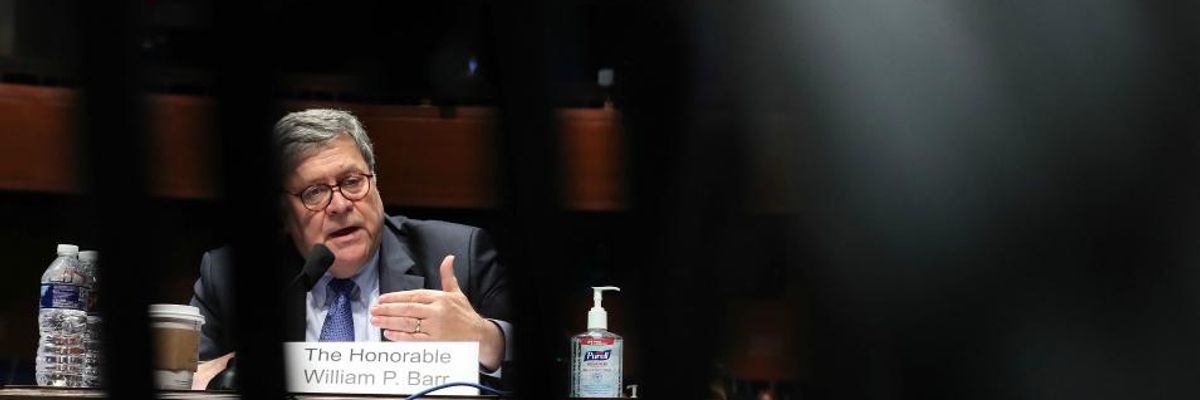
U.S. Attorney General William Barr testifies before the House Judiciary Committee in the Congressional Auditorium at the U.S. Capitol Visitors Center July 28, 2020 in Washington, D.C. (Photo: Chip Somodevilla/Getty Images)
An exchange about government spying powers between Rep. Zoe Lofgren and Attorney General William Barr during a Tuesday House Judiciary Committee hearing prompted calls for an immediate explanation from the Trump administration about the legal basis for using advanced surveillance techniques on protesters nationwide.
Lofgren, a California Democrat, explained in a series of tweets that she asked Barr to detail under what authority the U.S. government can use "intrusive surveillance tools" against protesters. Barr, Lofgren said, declined to give a "real answer."
The congresswoman specifically asked about the potential deployment of cell-site simulators, facial recognition, and sweeping surveillance of internet activity. Barr replied, "I really can't speak to those instances if they've in fact occurred."
After Lofgren clarified that she was seeking an answer about the legal basis of using such tactics, the attorney general said that "most of our cyber activities are conducted by the FBI under their law enforcement powers to detect and prevent crime."
As the congresswoman noted on Twitter, her questioning of Barr came amid a federal crackdown on protests against police brutality toward Black Americans in Portland, Oregon and President Donald Trump's threats to send teams to other major cities:
Demand Progress responded with a statement Tuesday calling on Barr to immediately disclose any legal basis he sees for the federal surveillance of protesters. The advocacy group also put the exchange into the context of Barr's history and broader concerns about government surveillance under the Trump administration.
"Today, Attorney General Barr refused to acknowledge whether the government is conducting dragnet surveillance of internet activity," said Sean Vitka, senior policy counsel at Demand Progress. "He further refused to acknowledge widely reported mass surveillance practices that he may have authorized when sending the [Drug Enforcement Administration] and other agencies after protesters."
"The public needs to know whether Attorney General Barr thinks President Trump can conduct mass surveillance of protesters without congressional authorization," Vitka argued, noting that Barr "has personally authorized lawless, mass surveillance in this country before, and did so by relying on radically aggressive interpretations of executive power, by secretly abusing statutory authority, and by hiding it under the DEA."
The questions Lofgren posed during the hearing were "critically important," explained Vitka.
"It is frighteningly plausible that Attorney General Barr has told the Trump administration it may conduct domestic mass surveillance with effectively no limits, potentially even in the absence of congressional authorization," he said. "The consequences would be staggering and the chilling of free speech is already being felt."
Referencing reports that U.S. government planes flew over Black Lives Matter protests in Washington, D.C. last month and potentially spied on participants, Vitka added that "the planes are in the air. We need these answers now."
The Demand Progress statement highlighted recent examples of other members of Congress demanding answers from the administration about surveillance, particularly considering that the controversial Section 215 of the USA PATRIOT Act expired earlier this year and has not been reauthorized by federal lawmakers.
Sens. Patrick Leahy (D-Vt.) and Mike Lee (R-Utah) sent a letter (pdf) to Barr and Director of National Intelligence John Ratcliffe on July 21 asking them to confirm that federal agencies have terminated surveillance operations authorized under the now-expired FISA provisions and other related questions about the government's spy powers.
Along with highlighting the letter--which requests that Barr and Ratcliffe respond with answers by August 7--the advocacy group pointed out how Patrick Hovakimian, the nominee for general counsel of the Office of the Director of National Intelligence, recently responded (pdf) to a pre-hearing question from Sen. Ron Wyden (D-Ore.).
Wyden asked: "Does the government collect web browsing and internet search history pursuant to Section 215? If so, what are or should be any limitations on such collection or the dissemination and use of such information? Does the government collect web browsing or internet search history pursuant to FISA Pen Register/Trap and Trace authorities?"
Hovakimian responded: "I believe it is important for the IC to use its authorities appropriately against valid intelligence targets. The amendments to Title V of FISA made by Section 215 of the USA PATRIOT Act expired on March 15, 2020 and, to date, have not been reauthorized."
Given those recent exchanges between lawmakers and the administration, Demand Progress declared that "Barr's refusal to answer Rep. Lofgren's questions today adds to concerns that all of this may be occurring in secret without congressional authorization or oversight."
Dear Common Dreams reader, It’s been nearly 30 years since I co-founded Common Dreams with my late wife, Lina Newhouser. We had the radical notion that journalism should serve the public good, not corporate profits. It was clear to us from the outset what it would take to build such a project. No paid advertisements. No corporate sponsors. No millionaire publisher telling us what to think or do. Many people said we wouldn't last a year, but we proved those doubters wrong. Together with a tremendous team of journalists and dedicated staff, we built an independent media outlet free from the constraints of profits and corporate control. Our mission has always been simple: To inform. To inspire. To ignite change for the common good. Building Common Dreams was not easy. Our survival was never guaranteed. When you take on the most powerful forces—Wall Street greed, fossil fuel industry destruction, Big Tech lobbyists, and uber-rich oligarchs who have spent billions upon billions rigging the economy and democracy in their favor—the only bulwark you have is supporters who believe in your work. But here’s the urgent message from me today. It's never been this bad out there. And it's never been this hard to keep us going. At the very moment Common Dreams is most needed, the threats we face are intensifying. We need your support now more than ever. We don't accept corporate advertising and never will. We don't have a paywall because we don't think people should be blocked from critical news based on their ability to pay. Everything we do is funded by the donations of readers like you. When everyone does the little they can afford, we are strong. But if that support retreats or dries up, so do we. Will you donate now to make sure Common Dreams not only survives but thrives? —Craig Brown, Co-founder |
An exchange about government spying powers between Rep. Zoe Lofgren and Attorney General William Barr during a Tuesday House Judiciary Committee hearing prompted calls for an immediate explanation from the Trump administration about the legal basis for using advanced surveillance techniques on protesters nationwide.
Lofgren, a California Democrat, explained in a series of tweets that she asked Barr to detail under what authority the U.S. government can use "intrusive surveillance tools" against protesters. Barr, Lofgren said, declined to give a "real answer."
The congresswoman specifically asked about the potential deployment of cell-site simulators, facial recognition, and sweeping surveillance of internet activity. Barr replied, "I really can't speak to those instances if they've in fact occurred."
After Lofgren clarified that she was seeking an answer about the legal basis of using such tactics, the attorney general said that "most of our cyber activities are conducted by the FBI under their law enforcement powers to detect and prevent crime."
As the congresswoman noted on Twitter, her questioning of Barr came amid a federal crackdown on protests against police brutality toward Black Americans in Portland, Oregon and President Donald Trump's threats to send teams to other major cities:
Demand Progress responded with a statement Tuesday calling on Barr to immediately disclose any legal basis he sees for the federal surveillance of protesters. The advocacy group also put the exchange into the context of Barr's history and broader concerns about government surveillance under the Trump administration.
"Today, Attorney General Barr refused to acknowledge whether the government is conducting dragnet surveillance of internet activity," said Sean Vitka, senior policy counsel at Demand Progress. "He further refused to acknowledge widely reported mass surveillance practices that he may have authorized when sending the [Drug Enforcement Administration] and other agencies after protesters."
"The public needs to know whether Attorney General Barr thinks President Trump can conduct mass surveillance of protesters without congressional authorization," Vitka argued, noting that Barr "has personally authorized lawless, mass surveillance in this country before, and did so by relying on radically aggressive interpretations of executive power, by secretly abusing statutory authority, and by hiding it under the DEA."
The questions Lofgren posed during the hearing were "critically important," explained Vitka.
"It is frighteningly plausible that Attorney General Barr has told the Trump administration it may conduct domestic mass surveillance with effectively no limits, potentially even in the absence of congressional authorization," he said. "The consequences would be staggering and the chilling of free speech is already being felt."
Referencing reports that U.S. government planes flew over Black Lives Matter protests in Washington, D.C. last month and potentially spied on participants, Vitka added that "the planes are in the air. We need these answers now."
The Demand Progress statement highlighted recent examples of other members of Congress demanding answers from the administration about surveillance, particularly considering that the controversial Section 215 of the USA PATRIOT Act expired earlier this year and has not been reauthorized by federal lawmakers.
Sens. Patrick Leahy (D-Vt.) and Mike Lee (R-Utah) sent a letter (pdf) to Barr and Director of National Intelligence John Ratcliffe on July 21 asking them to confirm that federal agencies have terminated surveillance operations authorized under the now-expired FISA provisions and other related questions about the government's spy powers.
Along with highlighting the letter--which requests that Barr and Ratcliffe respond with answers by August 7--the advocacy group pointed out how Patrick Hovakimian, the nominee for general counsel of the Office of the Director of National Intelligence, recently responded (pdf) to a pre-hearing question from Sen. Ron Wyden (D-Ore.).
Wyden asked: "Does the government collect web browsing and internet search history pursuant to Section 215? If so, what are or should be any limitations on such collection or the dissemination and use of such information? Does the government collect web browsing or internet search history pursuant to FISA Pen Register/Trap and Trace authorities?"
Hovakimian responded: "I believe it is important for the IC to use its authorities appropriately against valid intelligence targets. The amendments to Title V of FISA made by Section 215 of the USA PATRIOT Act expired on March 15, 2020 and, to date, have not been reauthorized."
Given those recent exchanges between lawmakers and the administration, Demand Progress declared that "Barr's refusal to answer Rep. Lofgren's questions today adds to concerns that all of this may be occurring in secret without congressional authorization or oversight."
An exchange about government spying powers between Rep. Zoe Lofgren and Attorney General William Barr during a Tuesday House Judiciary Committee hearing prompted calls for an immediate explanation from the Trump administration about the legal basis for using advanced surveillance techniques on protesters nationwide.
Lofgren, a California Democrat, explained in a series of tweets that she asked Barr to detail under what authority the U.S. government can use "intrusive surveillance tools" against protesters. Barr, Lofgren said, declined to give a "real answer."
The congresswoman specifically asked about the potential deployment of cell-site simulators, facial recognition, and sweeping surveillance of internet activity. Barr replied, "I really can't speak to those instances if they've in fact occurred."
After Lofgren clarified that she was seeking an answer about the legal basis of using such tactics, the attorney general said that "most of our cyber activities are conducted by the FBI under their law enforcement powers to detect and prevent crime."
As the congresswoman noted on Twitter, her questioning of Barr came amid a federal crackdown on protests against police brutality toward Black Americans in Portland, Oregon and President Donald Trump's threats to send teams to other major cities:
Demand Progress responded with a statement Tuesday calling on Barr to immediately disclose any legal basis he sees for the federal surveillance of protesters. The advocacy group also put the exchange into the context of Barr's history and broader concerns about government surveillance under the Trump administration.
"Today, Attorney General Barr refused to acknowledge whether the government is conducting dragnet surveillance of internet activity," said Sean Vitka, senior policy counsel at Demand Progress. "He further refused to acknowledge widely reported mass surveillance practices that he may have authorized when sending the [Drug Enforcement Administration] and other agencies after protesters."
"The public needs to know whether Attorney General Barr thinks President Trump can conduct mass surveillance of protesters without congressional authorization," Vitka argued, noting that Barr "has personally authorized lawless, mass surveillance in this country before, and did so by relying on radically aggressive interpretations of executive power, by secretly abusing statutory authority, and by hiding it under the DEA."
The questions Lofgren posed during the hearing were "critically important," explained Vitka.
"It is frighteningly plausible that Attorney General Barr has told the Trump administration it may conduct domestic mass surveillance with effectively no limits, potentially even in the absence of congressional authorization," he said. "The consequences would be staggering and the chilling of free speech is already being felt."
Referencing reports that U.S. government planes flew over Black Lives Matter protests in Washington, D.C. last month and potentially spied on participants, Vitka added that "the planes are in the air. We need these answers now."
The Demand Progress statement highlighted recent examples of other members of Congress demanding answers from the administration about surveillance, particularly considering that the controversial Section 215 of the USA PATRIOT Act expired earlier this year and has not been reauthorized by federal lawmakers.
Sens. Patrick Leahy (D-Vt.) and Mike Lee (R-Utah) sent a letter (pdf) to Barr and Director of National Intelligence John Ratcliffe on July 21 asking them to confirm that federal agencies have terminated surveillance operations authorized under the now-expired FISA provisions and other related questions about the government's spy powers.
Along with highlighting the letter--which requests that Barr and Ratcliffe respond with answers by August 7--the advocacy group pointed out how Patrick Hovakimian, the nominee for general counsel of the Office of the Director of National Intelligence, recently responded (pdf) to a pre-hearing question from Sen. Ron Wyden (D-Ore.).
Wyden asked: "Does the government collect web browsing and internet search history pursuant to Section 215? If so, what are or should be any limitations on such collection or the dissemination and use of such information? Does the government collect web browsing or internet search history pursuant to FISA Pen Register/Trap and Trace authorities?"
Hovakimian responded: "I believe it is important for the IC to use its authorities appropriately against valid intelligence targets. The amendments to Title V of FISA made by Section 215 of the USA PATRIOT Act expired on March 15, 2020 and, to date, have not been reauthorized."
Given those recent exchanges between lawmakers and the administration, Demand Progress declared that "Barr's refusal to answer Rep. Lofgren's questions today adds to concerns that all of this may be occurring in secret without congressional authorization or oversight."