

SUBSCRIBE TO OUR FREE NEWSLETTER
Daily news & progressive opinion—funded by the people, not the corporations—delivered straight to your inbox.
5
#000000
#FFFFFF
To donate by check, phone, or other method, see our More Ways to Give page.
Daily news & progressive opinion—funded by the people, not the corporations—delivered straight to your inbox.
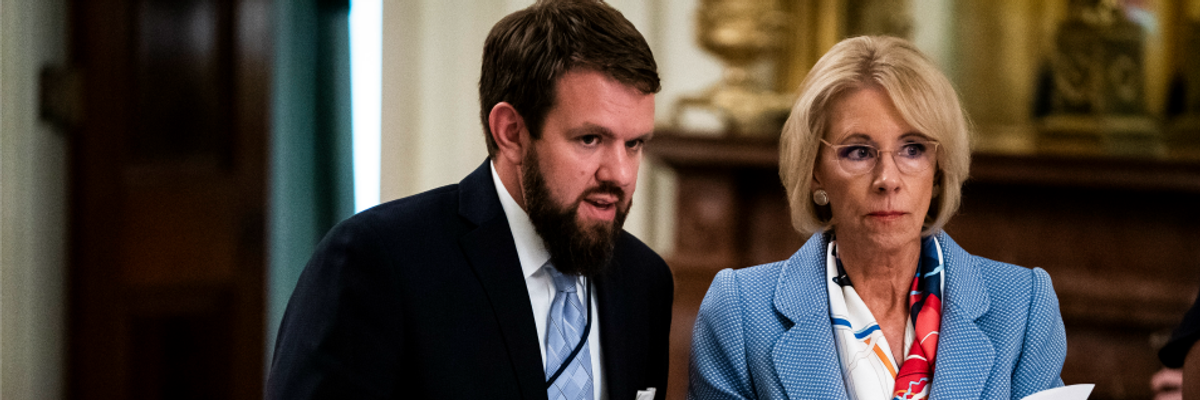
Secretary of Education Betsy DeVos arrives to participate in a roundtable discussion in the East Room at the White House on Tuesday, July 7, 2020 in Washington, D.C. (Photo: Jabin Botsford/The Washington Post via Getty Images)
The Trump administration and Senate Republicans are reportedly considering a plan to pressure U.S. schools to reopen in the fall by attaching conditions or incentives to desperately needed Covid-19 relief funds as educators and parents warn that--in addition to being unpopular--the White House push to send children back to the classroom without an adequate safety strategy is reckless and dangerous.
"Mismanagement of the crisis is now followed by an attempt to bribe schools to ignore the pandemic and act as if everything is normal."
--Barmak Nassirian, American Association of State Colleges and UniversitiesWith school districts across the nation in need of billions of dollars in funding to prepare for potential reopenings, the Washington Post reported Wednesday that "the White House and Republicans are debating whether to take a carrot or a stick approach with the aid."
"Some White House officials are pushing for conditioning the aid on schools reopening partly or fully, but others involved prefer to offer incentives to schools to take steps to reopen," according to the Post. One anonymous Senate GOP aide told the Post that "there are those who would rather incentivize good behavior, and others want to punish bad behavior."
While talks between the Senate and White House over education funding are ongoing and the figures could change, the Post reported that "Republican officials familiar with the negotiations said the bill may include somewhere between $50 billion and $100 billion for elementary and secondary schools, with one person familiar with the talks saying the target was about $70 billion."
Teachers and public health experts have voiced alarm at the Trump administration's aggressive push to reopen schools as states across the U.S. see a surge in Covid-19 infections and hospitalizations, cautioning that sending children back to full in-person classes without adequate precautions in place could endanger students and faculty--a warning the Centers for Disease Control and Prevention has echoed.
The White House's reported effort to attach conditions to education funding that will be necessary for schools to safely reopen comes after President Donald Trump and Education Secretary Betsy DeVos publicly threatened to withhold federal assistance from schools that refuse to resume in-person classes out of fear of spreading Covid-19.
As Common Dreams reported, the American Academy of Pediatrics, the National Education Association, and other groups warned Sunday that "withholding funding from schools that do not open in person full-time would be a misguided approach, putting already financially strapped schools in an impossible position that would threaten the health of students and teachers."
Barmak Nassirian, director of federal relations and policy analysis for the American Association of State Colleges and Universities, tweeted in response to the Post report Wednesday that attaching conditions to school aid could have disastrous consequences.
"Mismanagement of the crisis is now followed by an attempt to bribe schools to ignore the pandemic and act as if everything is normal," Nassirian wrote. "How many students, faculty, and members of the community will die as a result of these theatrics?"
On Wednesday, the National Academies of Sciences, Engineering, and Medicine (NASEM) issued a report outlining its recommendations for reopening schools safely and examining the "considerable" costs associated with implementing necessary preventative measures.
"Federal and state governments should provide significant resources to districts and schools to enable them to implement the suite of measures required to maintain individual and community health and allow schools to remain open," the report said. "Under-resourced districts with aging facilities in poor condition will need additional financial support to bring facilities to basic health and safety standards."
"In addition," the report continued, "State Departments of Education should not penalize schools by withholding state-wide school funding formula monies for student absences during the Covid-19 pandemic."
This country and this world are at a monumental crossroads. US voters have an opportunity to beat back the forces of fascism and confront the billionaires who are rigging the economy, our media system, and our democracy, making it increasingly impossible for ordinary people to get by. We’re not just talking about the election. We’re talking about what must be done once these fascist elements are vanquished from power. We need a bolder set of solutions than what either major party has so far been willing to offer and a working-class movement ready to fight like hell for it. Trump didn't emerge from nowhere. The conditions that fueled MAGA authoritarianism were created by decades of radical neoliberal economic policies and a corrupt political system dominated by corporate interests. They slashed taxes on the super-rich, promising that the benefits would trickle down. They said giveaways to the corporate titans would make life more affordable for the rest of us. It was all bullshit. And when a bitter, betrayed populace searches for someone to blame, right-wing demagogues have little trouble finding scapegoats. People know when they're being lied to, but you won't hear any of this from the corporate media. Only independent journalism—powered and funded by people who believe in building a better world—can deliver truly trustworthy daily news. If you share our vision, please contribute whatever you can to sustain our work. |
The Trump administration and Senate Republicans are reportedly considering a plan to pressure U.S. schools to reopen in the fall by attaching conditions or incentives to desperately needed Covid-19 relief funds as educators and parents warn that--in addition to being unpopular--the White House push to send children back to the classroom without an adequate safety strategy is reckless and dangerous.
"Mismanagement of the crisis is now followed by an attempt to bribe schools to ignore the pandemic and act as if everything is normal."
--Barmak Nassirian, American Association of State Colleges and UniversitiesWith school districts across the nation in need of billions of dollars in funding to prepare for potential reopenings, the Washington Post reported Wednesday that "the White House and Republicans are debating whether to take a carrot or a stick approach with the aid."
"Some White House officials are pushing for conditioning the aid on schools reopening partly or fully, but others involved prefer to offer incentives to schools to take steps to reopen," according to the Post. One anonymous Senate GOP aide told the Post that "there are those who would rather incentivize good behavior, and others want to punish bad behavior."
While talks between the Senate and White House over education funding are ongoing and the figures could change, the Post reported that "Republican officials familiar with the negotiations said the bill may include somewhere between $50 billion and $100 billion for elementary and secondary schools, with one person familiar with the talks saying the target was about $70 billion."
Teachers and public health experts have voiced alarm at the Trump administration's aggressive push to reopen schools as states across the U.S. see a surge in Covid-19 infections and hospitalizations, cautioning that sending children back to full in-person classes without adequate precautions in place could endanger students and faculty--a warning the Centers for Disease Control and Prevention has echoed.
The White House's reported effort to attach conditions to education funding that will be necessary for schools to safely reopen comes after President Donald Trump and Education Secretary Betsy DeVos publicly threatened to withhold federal assistance from schools that refuse to resume in-person classes out of fear of spreading Covid-19.
As Common Dreams reported, the American Academy of Pediatrics, the National Education Association, and other groups warned Sunday that "withholding funding from schools that do not open in person full-time would be a misguided approach, putting already financially strapped schools in an impossible position that would threaten the health of students and teachers."
Barmak Nassirian, director of federal relations and policy analysis for the American Association of State Colleges and Universities, tweeted in response to the Post report Wednesday that attaching conditions to school aid could have disastrous consequences.
"Mismanagement of the crisis is now followed by an attempt to bribe schools to ignore the pandemic and act as if everything is normal," Nassirian wrote. "How many students, faculty, and members of the community will die as a result of these theatrics?"
On Wednesday, the National Academies of Sciences, Engineering, and Medicine (NASEM) issued a report outlining its recommendations for reopening schools safely and examining the "considerable" costs associated with implementing necessary preventative measures.
"Federal and state governments should provide significant resources to districts and schools to enable them to implement the suite of measures required to maintain individual and community health and allow schools to remain open," the report said. "Under-resourced districts with aging facilities in poor condition will need additional financial support to bring facilities to basic health and safety standards."
"In addition," the report continued, "State Departments of Education should not penalize schools by withholding state-wide school funding formula monies for student absences during the Covid-19 pandemic."

