SUBSCRIBE TO OUR FREE NEWSLETTER
Daily news & progressive opinion—funded by the people, not the corporations—delivered straight to your inbox.
5
#000000
#FFFFFF
To donate by check, phone, or other method, see our More Ways to Give page.
Daily news & progressive opinion—funded by the people, not the corporations—delivered straight to your inbox.
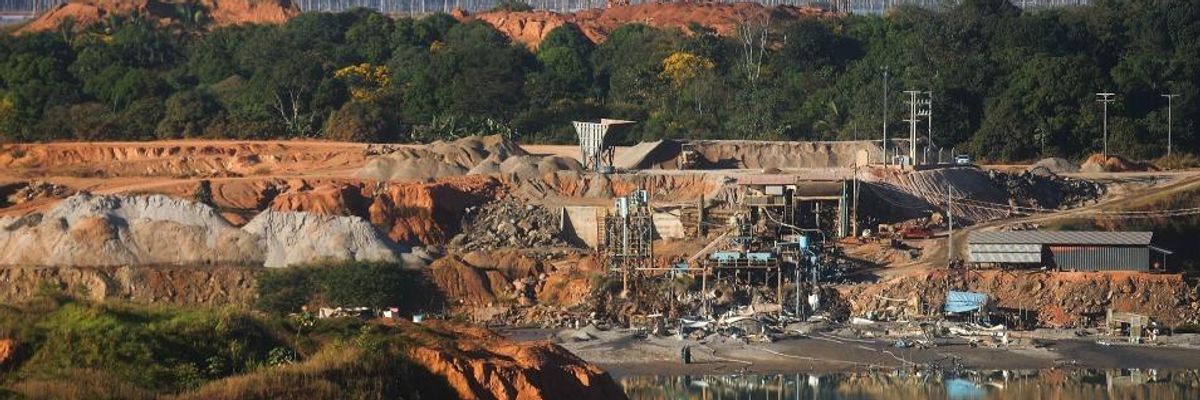
Amazon soil sits in the foreground at the Bom Futuro open air tin mine, one of the largest tin mines in the world, in a deforested section of the Amazon on June 27, 2017 in Bom Futuro, Brazil. (Photo: Mario Tama/Getty Images)
A study released Tuesday by the Oakland Institute details an "unprecedented wave of privatization of natural resources that is underway around the world"--one that is largely being driven by the United States and its allies.
According to the progressive think tank's report (pdf), "Driving Dispossession: The Global Push to Unlock the Economic Potential of Land," governments around the world--particularly in developing countries--are often put under pressure by financial institutions and Western agencies to open up land for so-called "productive use" by miners, agribusiness interests, and other corporate entities intent on exploiting natural resources for profit.
The U.S. in particular, the report says, is a "key player in an unfettered offensive to privatize land around the world."
With deforestation and fossil fuel extraction helping to fuel the climate crisis, governments are being pushed in a direction that's "just the opposite of the drastic shift we need to win the struggle against climate change," Frederic Mousseau, policy director of the Oakland Institute and lead author of the report, said in a statement.
"Most of the land on our planet, especially in the Global South, is public land or land held under customary tenure systems [and] is seen as an obstacle to exploitation and economic growth," Mousseau said.
The Oakland Institute included in its report six case studies in Ukraine, Myanmar, Sri Lanka, Zambia, Papua New Guinea, and Brazil, finding that global land privatization is often directly driven by U.S. interests.
Zambia has been affected by what the Institute calls a recent "surge of American and European startups attempting to apply blockchain technology to land registries," referring to the digital ledger created for Bitcoin.
The Zambian government is partnering with Medici Land Governance (MLG), a blockchain company and subsidiary of the U.S. online retailer Overstock.com, to assist with land registration and titling. According to former Overstock.com CEO Patrick Byrne, the use of blockchain "will help unlock trillions of dollars in global mineral reserves that are inaccessible due to unclear land governance systems."
In Sri Lanka, a U.S. government entity known as the Millenium Challenge Corporation (MCC) approved a five-year compact for the country in 2019, offering the Sri Lankan government $480 million to map and digitize public lands in order to "promote land transactions that could stimulate investment and increase its use as an economic asset."
"The proposed MCC compact would shift control of millions of hectares away from the state towards private interests," the report says, and was proposed by a U.S. entity formed in 2002 by Congress with the stated goal of "reducing poverty through growth."
"In practice, poverty alleviation has taken a back seat to promoting private sector growth," the report continues. "This has translated to countries shifting their policies in adherence to a neoliberal economic framework--including the privatization and commodification of land--in exchange for substantial financial grants."
MCC compacts throughout Africa have "allowed investors to acquire land at bargain prices to facilitate large-scale industrial agriculture at the expense of smallholder farmers," the Oakland Institute added.
The study also points to Brazilian President Jair Bolsonaro's aggressive push to assume control of Indigenous territories in the Amazon Rainforest, appointing a member of one the country's most powerful agribusiness families to head the Ministry of Agriculture. Illegal land invasions and massive fires driven by agriculture and mining interests have threatened Indigenous people while contributing to deforestation and the climate crisis.
As the Institute published the report while the Covid-19 pandemic is upending the global economy, the report points out that "returning to normal is not an option."
Instead, the economic crisis "must be used as a catalyst to address the systematic issues surrounding the rampant overexploitation of natural resources that has driven the climate crisis to its current state."
Rather than erasing local governance and negating individual autonomy, governments must instead build systems that incorporate a diversity of ownership and tenure systems, and focus on a development path that serves the people instead of one that takes the land away from them for corporate profits."
Dear Common Dreams reader, It’s been nearly 30 years since I co-founded Common Dreams with my late wife, Lina Newhouser. We had the radical notion that journalism should serve the public good, not corporate profits. It was clear to us from the outset what it would take to build such a project. No paid advertisements. No corporate sponsors. No millionaire publisher telling us what to think or do. Many people said we wouldn't last a year, but we proved those doubters wrong. Together with a tremendous team of journalists and dedicated staff, we built an independent media outlet free from the constraints of profits and corporate control. Our mission has always been simple: To inform. To inspire. To ignite change for the common good. Building Common Dreams was not easy. Our survival was never guaranteed. When you take on the most powerful forces—Wall Street greed, fossil fuel industry destruction, Big Tech lobbyists, and uber-rich oligarchs who have spent billions upon billions rigging the economy and democracy in their favor—the only bulwark you have is supporters who believe in your work. But here’s the urgent message from me today. It's never been this bad out there. And it's never been this hard to keep us going. At the very moment Common Dreams is most needed, the threats we face are intensifying. We need your support now more than ever. We don't accept corporate advertising and never will. We don't have a paywall because we don't think people should be blocked from critical news based on their ability to pay. Everything we do is funded by the donations of readers like you. When everyone does the little they can afford, we are strong. But if that support retreats or dries up, so do we. Will you donate now to make sure Common Dreams not only survives but thrives? —Craig Brown, Co-founder |
A study released Tuesday by the Oakland Institute details an "unprecedented wave of privatization of natural resources that is underway around the world"--one that is largely being driven by the United States and its allies.
According to the progressive think tank's report (pdf), "Driving Dispossession: The Global Push to Unlock the Economic Potential of Land," governments around the world--particularly in developing countries--are often put under pressure by financial institutions and Western agencies to open up land for so-called "productive use" by miners, agribusiness interests, and other corporate entities intent on exploiting natural resources for profit.
The U.S. in particular, the report says, is a "key player in an unfettered offensive to privatize land around the world."
With deforestation and fossil fuel extraction helping to fuel the climate crisis, governments are being pushed in a direction that's "just the opposite of the drastic shift we need to win the struggle against climate change," Frederic Mousseau, policy director of the Oakland Institute and lead author of the report, said in a statement.
"Most of the land on our planet, especially in the Global South, is public land or land held under customary tenure systems [and] is seen as an obstacle to exploitation and economic growth," Mousseau said.
The Oakland Institute included in its report six case studies in Ukraine, Myanmar, Sri Lanka, Zambia, Papua New Guinea, and Brazil, finding that global land privatization is often directly driven by U.S. interests.
Zambia has been affected by what the Institute calls a recent "surge of American and European startups attempting to apply blockchain technology to land registries," referring to the digital ledger created for Bitcoin.
The Zambian government is partnering with Medici Land Governance (MLG), a blockchain company and subsidiary of the U.S. online retailer Overstock.com, to assist with land registration and titling. According to former Overstock.com CEO Patrick Byrne, the use of blockchain "will help unlock trillions of dollars in global mineral reserves that are inaccessible due to unclear land governance systems."
In Sri Lanka, a U.S. government entity known as the Millenium Challenge Corporation (MCC) approved a five-year compact for the country in 2019, offering the Sri Lankan government $480 million to map and digitize public lands in order to "promote land transactions that could stimulate investment and increase its use as an economic asset."
"The proposed MCC compact would shift control of millions of hectares away from the state towards private interests," the report says, and was proposed by a U.S. entity formed in 2002 by Congress with the stated goal of "reducing poverty through growth."
"In practice, poverty alleviation has taken a back seat to promoting private sector growth," the report continues. "This has translated to countries shifting their policies in adherence to a neoliberal economic framework--including the privatization and commodification of land--in exchange for substantial financial grants."
MCC compacts throughout Africa have "allowed investors to acquire land at bargain prices to facilitate large-scale industrial agriculture at the expense of smallholder farmers," the Oakland Institute added.
The study also points to Brazilian President Jair Bolsonaro's aggressive push to assume control of Indigenous territories in the Amazon Rainforest, appointing a member of one the country's most powerful agribusiness families to head the Ministry of Agriculture. Illegal land invasions and massive fires driven by agriculture and mining interests have threatened Indigenous people while contributing to deforestation and the climate crisis.
As the Institute published the report while the Covid-19 pandemic is upending the global economy, the report points out that "returning to normal is not an option."
Instead, the economic crisis "must be used as a catalyst to address the systematic issues surrounding the rampant overexploitation of natural resources that has driven the climate crisis to its current state."
Rather than erasing local governance and negating individual autonomy, governments must instead build systems that incorporate a diversity of ownership and tenure systems, and focus on a development path that serves the people instead of one that takes the land away from them for corporate profits."
A study released Tuesday by the Oakland Institute details an "unprecedented wave of privatization of natural resources that is underway around the world"--one that is largely being driven by the United States and its allies.
According to the progressive think tank's report (pdf), "Driving Dispossession: The Global Push to Unlock the Economic Potential of Land," governments around the world--particularly in developing countries--are often put under pressure by financial institutions and Western agencies to open up land for so-called "productive use" by miners, agribusiness interests, and other corporate entities intent on exploiting natural resources for profit.
The U.S. in particular, the report says, is a "key player in an unfettered offensive to privatize land around the world."
With deforestation and fossil fuel extraction helping to fuel the climate crisis, governments are being pushed in a direction that's "just the opposite of the drastic shift we need to win the struggle against climate change," Frederic Mousseau, policy director of the Oakland Institute and lead author of the report, said in a statement.
"Most of the land on our planet, especially in the Global South, is public land or land held under customary tenure systems [and] is seen as an obstacle to exploitation and economic growth," Mousseau said.
The Oakland Institute included in its report six case studies in Ukraine, Myanmar, Sri Lanka, Zambia, Papua New Guinea, and Brazil, finding that global land privatization is often directly driven by U.S. interests.
Zambia has been affected by what the Institute calls a recent "surge of American and European startups attempting to apply blockchain technology to land registries," referring to the digital ledger created for Bitcoin.
The Zambian government is partnering with Medici Land Governance (MLG), a blockchain company and subsidiary of the U.S. online retailer Overstock.com, to assist with land registration and titling. According to former Overstock.com CEO Patrick Byrne, the use of blockchain "will help unlock trillions of dollars in global mineral reserves that are inaccessible due to unclear land governance systems."
In Sri Lanka, a U.S. government entity known as the Millenium Challenge Corporation (MCC) approved a five-year compact for the country in 2019, offering the Sri Lankan government $480 million to map and digitize public lands in order to "promote land transactions that could stimulate investment and increase its use as an economic asset."
"The proposed MCC compact would shift control of millions of hectares away from the state towards private interests," the report says, and was proposed by a U.S. entity formed in 2002 by Congress with the stated goal of "reducing poverty through growth."
"In practice, poverty alleviation has taken a back seat to promoting private sector growth," the report continues. "This has translated to countries shifting their policies in adherence to a neoliberal economic framework--including the privatization and commodification of land--in exchange for substantial financial grants."
MCC compacts throughout Africa have "allowed investors to acquire land at bargain prices to facilitate large-scale industrial agriculture at the expense of smallholder farmers," the Oakland Institute added.
The study also points to Brazilian President Jair Bolsonaro's aggressive push to assume control of Indigenous territories in the Amazon Rainforest, appointing a member of one the country's most powerful agribusiness families to head the Ministry of Agriculture. Illegal land invasions and massive fires driven by agriculture and mining interests have threatened Indigenous people while contributing to deforestation and the climate crisis.
As the Institute published the report while the Covid-19 pandemic is upending the global economy, the report points out that "returning to normal is not an option."
Instead, the economic crisis "must be used as a catalyst to address the systematic issues surrounding the rampant overexploitation of natural resources that has driven the climate crisis to its current state."
Rather than erasing local governance and negating individual autonomy, governments must instead build systems that incorporate a diversity of ownership and tenure systems, and focus on a development path that serves the people instead of one that takes the land away from them for corporate profits."