SUBSCRIBE TO OUR FREE NEWSLETTER
Daily news & progressive opinion—funded by the people, not the corporations—delivered straight to your inbox.
5
#000000
#FFFFFF
To donate by check, phone, or other method, see our More Ways to Give page.
Daily news & progressive opinion—funded by the people, not the corporations—delivered straight to your inbox.
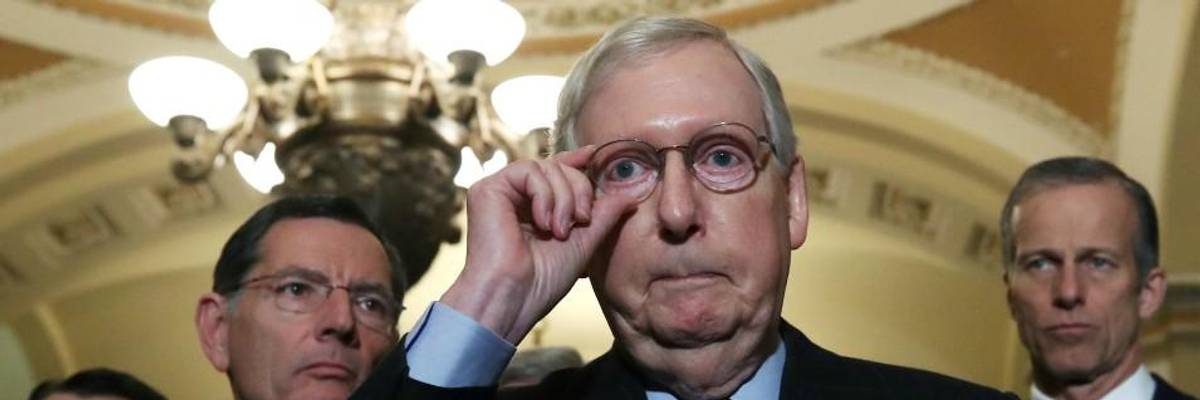
Senate Majority Leader Mitch McConnell (R-Ky.) talks to reporters after attending the weekly Senate Republicans policy luncheon at the U.S. Capitol January 7, 2020 in Washington, D.C. (Photo: Mark Wilson/Getty Images)
Despite an unprecedented and ongoing economic crash in the U.S. spurred by the Covid-19 pandemic, Senate Republicans, led by Majority Leader Mitch McConnell, are refusing to consider further aid and stimulus until July at the earliest--a decision critics warn will result in misery and deprivation for tens of millions of Americans.
"Communities of color can't wait for you to slow walk more coronavirus aid, Senate Majority Leader" Americans For Tax Fairness executive director Frank Clemente tweeted Tuesday.
The economic crisis sparked by the coronavirus outbreak in March has put millions of Americans out of work. The nation's unemployment rate remains in the double-digits, though May's jobs report showed an uptick in employment--albeit one that some economists noted was based in faulty data and underreporting.
Nonetheless, Senate Republicans appear to believe that the economy is a winning issue that they can leverage for political gain in November. That risky move, Democratic consultant Tim Fullerton said, could backfire.
"Hanging their political lives on a jobs report with errors is a hell of a position to take," said Fullerton.
As Politico reported, the refusal to act carries political risk and the delay could be devastating on the country's economy:
If the Senate waits until next month to act, the window gets smaller. After July 3, the Senate is scheduled to go on a two-week recess, return for three weeks and then depart again until September.
Republicans say it's only responsible to wait and see how nearly $3 trillion in total coronavirus spending seeps into the economy. But it's also a gamble: if the economic recovery isn't as strong as they predict, they risk being blamed by voters in November that they and President Donald Trump didn't do enough amid a global pandemic and historic recession.
The confidence of Senate Republicans in the economy struck Senate Minority Leader Chuck Schumer (D-N.Y.) as unfounded and dangerous.
"I fear that the recent bump in the employment number, caused in large part because of the stimulus money we pumped into the economy, will create in Republicans a sense of complacency and the economy will get even worse," said Schumer.
Dear Common Dreams reader, It’s been nearly 30 years since I co-founded Common Dreams with my late wife, Lina Newhouser. We had the radical notion that journalism should serve the public good, not corporate profits. It was clear to us from the outset what it would take to build such a project. No paid advertisements. No corporate sponsors. No millionaire publisher telling us what to think or do. Many people said we wouldn't last a year, but we proved those doubters wrong. Together with a tremendous team of journalists and dedicated staff, we built an independent media outlet free from the constraints of profits and corporate control. Our mission has always been simple: To inform. To inspire. To ignite change for the common good. Building Common Dreams was not easy. Our survival was never guaranteed. When you take on the most powerful forces—Wall Street greed, fossil fuel industry destruction, Big Tech lobbyists, and uber-rich oligarchs who have spent billions upon billions rigging the economy and democracy in their favor—the only bulwark you have is supporters who believe in your work. But here’s the urgent message from me today. It's never been this bad out there. And it's never been this hard to keep us going. At the very moment Common Dreams is most needed, the threats we face are intensifying. We need your support now more than ever. We don't accept corporate advertising and never will. We don't have a paywall because we don't think people should be blocked from critical news based on their ability to pay. Everything we do is funded by the donations of readers like you. When everyone does the little they can afford, we are strong. But if that support retreats or dries up, so do we. Will you donate now to make sure Common Dreams not only survives but thrives? —Craig Brown, Co-founder |
Despite an unprecedented and ongoing economic crash in the U.S. spurred by the Covid-19 pandemic, Senate Republicans, led by Majority Leader Mitch McConnell, are refusing to consider further aid and stimulus until July at the earliest--a decision critics warn will result in misery and deprivation for tens of millions of Americans.
"Communities of color can't wait for you to slow walk more coronavirus aid, Senate Majority Leader" Americans For Tax Fairness executive director Frank Clemente tweeted Tuesday.
The economic crisis sparked by the coronavirus outbreak in March has put millions of Americans out of work. The nation's unemployment rate remains in the double-digits, though May's jobs report showed an uptick in employment--albeit one that some economists noted was based in faulty data and underreporting.
Nonetheless, Senate Republicans appear to believe that the economy is a winning issue that they can leverage for political gain in November. That risky move, Democratic consultant Tim Fullerton said, could backfire.
"Hanging their political lives on a jobs report with errors is a hell of a position to take," said Fullerton.
As Politico reported, the refusal to act carries political risk and the delay could be devastating on the country's economy:
If the Senate waits until next month to act, the window gets smaller. After July 3, the Senate is scheduled to go on a two-week recess, return for three weeks and then depart again until September.
Republicans say it's only responsible to wait and see how nearly $3 trillion in total coronavirus spending seeps into the economy. But it's also a gamble: if the economic recovery isn't as strong as they predict, they risk being blamed by voters in November that they and President Donald Trump didn't do enough amid a global pandemic and historic recession.
The confidence of Senate Republicans in the economy struck Senate Minority Leader Chuck Schumer (D-N.Y.) as unfounded and dangerous.
"I fear that the recent bump in the employment number, caused in large part because of the stimulus money we pumped into the economy, will create in Republicans a sense of complacency and the economy will get even worse," said Schumer.
Despite an unprecedented and ongoing economic crash in the U.S. spurred by the Covid-19 pandemic, Senate Republicans, led by Majority Leader Mitch McConnell, are refusing to consider further aid and stimulus until July at the earliest--a decision critics warn will result in misery and deprivation for tens of millions of Americans.
"Communities of color can't wait for you to slow walk more coronavirus aid, Senate Majority Leader" Americans For Tax Fairness executive director Frank Clemente tweeted Tuesday.
The economic crisis sparked by the coronavirus outbreak in March has put millions of Americans out of work. The nation's unemployment rate remains in the double-digits, though May's jobs report showed an uptick in employment--albeit one that some economists noted was based in faulty data and underreporting.
Nonetheless, Senate Republicans appear to believe that the economy is a winning issue that they can leverage for political gain in November. That risky move, Democratic consultant Tim Fullerton said, could backfire.
"Hanging their political lives on a jobs report with errors is a hell of a position to take," said Fullerton.
As Politico reported, the refusal to act carries political risk and the delay could be devastating on the country's economy:
If the Senate waits until next month to act, the window gets smaller. After July 3, the Senate is scheduled to go on a two-week recess, return for three weeks and then depart again until September.
Republicans say it's only responsible to wait and see how nearly $3 trillion in total coronavirus spending seeps into the economy. But it's also a gamble: if the economic recovery isn't as strong as they predict, they risk being blamed by voters in November that they and President Donald Trump didn't do enough amid a global pandemic and historic recession.
The confidence of Senate Republicans in the economy struck Senate Minority Leader Chuck Schumer (D-N.Y.) as unfounded and dangerous.
"I fear that the recent bump in the employment number, caused in large part because of the stimulus money we pumped into the economy, will create in Republicans a sense of complacency and the economy will get even worse," said Schumer.