SUBSCRIBE TO OUR FREE NEWSLETTER
Daily news & progressive opinion—funded by the people, not the corporations—delivered straight to your inbox.
5
#000000
#FFFFFF
To donate by check, phone, or other method, see our More Ways to Give page.
Daily news & progressive opinion—funded by the people, not the corporations—delivered straight to your inbox.
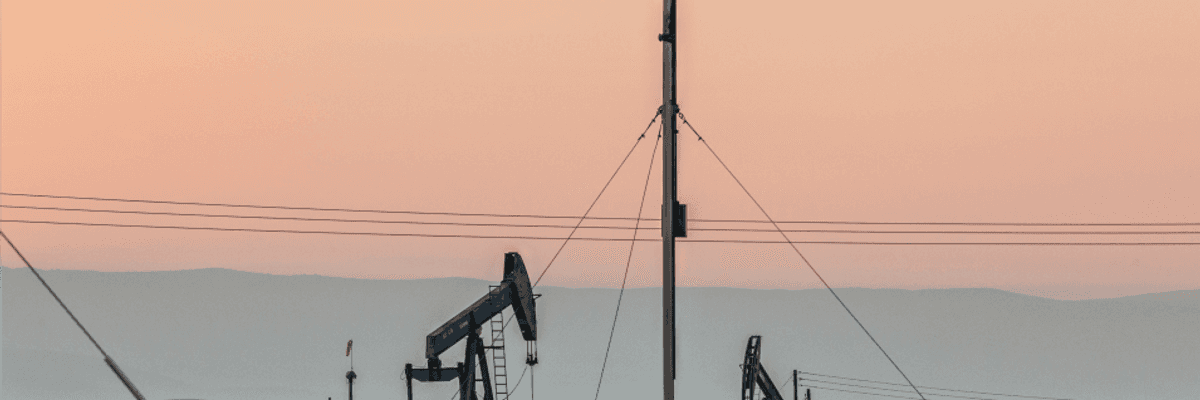
Flares burning off gas at Belridge Oil Field and hydraulic fracking site which is the fourth largest oil field in California. (Photo: Citizens of the Planet/Education Images/Universal Images Group via Getty Images)
President Donald Trump is expected to sign an executive order Thursday waiving environmental regulatory hurdles to infrastructure, energy, and other projects, a move that critics charge is another sign of "authoritarianism" from the White House.
"Allowing the fossil fuel industry to dig, drill, and frack unbounded by NEPA amounts to a targeted strike on people of color and low-income communities most likely to be impacted by these hazardous practices."
--Wenonah Hauter, Food & Water Watch
"This executive order is the latest in string of outlandish authoritarian acts from a president that is quickly spiraling deeper into the realm of anti-democratic, anti-law, anti-Constitution dictatorship," Food & Water Action executive director Wenonah Hauter said in a statement. "This particular action is an egregious attempt to bail out the flailing fossil fuel industry by allowing it to completely bypass benchmark environmental rules at a moment when Trump thinks no one is paying attention."
Trump's order would allow federal agencies to ignore regulations like the National Environmental Policy Act (NEPA) when weighing approval of projects like pipelines, new highways, mines, and other projects. The administration is justifying the move as necessary due to the economic crisis sparked by the ongoing coronavirus pandemic.
It's unclear if Trump has the legal authority to force such a change, Environmental Protection Network member Joel Mintz said in a statement. Minz, a former EPA Enforcement and Supervisory attorney and current law professor at the Nova Southeastern University College of Law, said that NEPA is "a clear directive from Congress to federal agencies that the president cannot ignore or change unilaterally."
More than that, Minz said, it's a generally bad idea.
"This is also very bad public policy," said Minz. "Pipelines and other infrastructure can do great environmental harm. Their impact should be carefully examined, as NEPA requires, before they are allowed to go forward. "
As the Washington Post reported, the order's dubious legality could result in immediate court challenges:
Thomas Jensen, a partner at the firm Perkins Coie, said in an email that any decisions made in response to the executive order could be challenged in court. He noted that the National Environmental Policy Act was enacted 50 years ago partly to prevent arbitrary federal decisions such as building highways through parks and communities of color, and that the current administration cannot simply set aside laws aimed at protecting vulnerable Americans or the environment.
"I will not be surprised to see many observers comparing this move--declaring an emergency to shield agency decisions from the public--to the order to clear Lafayette Square on Monday evening," Jensen said, referring to actions in a Washington park this week. "It's just one more face of authoritarian ideology, with a clear link to issues of race and equality and government accountability."
Rep. Raul Grijalva (D-Ariz.) tweeted that the order "silences Black and brown voices fighting pollution in their own communities" and noted that it came during a nationwide uprising over the death of George Floyd, who was killed by Minneapolis police officers last week.
Susan Jane Brown, the Wildlands Program director for the Western Environmental Law Center, said in a statement that "robust environmental reviews would play an integral part in a just economic recovery following the coronavirus crisis," making the rollback a catastrophe.
"This recent executive action cements the Trump administration's legacy as the most callous and brutal regime in modern times," said Brown.
Food & Water Watch's Hauter agreed.
"Allowing the fossil fuel industry to dig, drill, and frack unbounded by NEPA amounts to a targeted strike on people of color and low-income communities most likely to be impacted by these hazardous practices," she said. "It is a strike on environmental justice, climate stability and a livable planet."
"We are doing all in our power to stop this malicious, authoritarian president," Hauter added, "and we won't stop until he is stopped."
Dear Common Dreams reader, It’s been nearly 30 years since I co-founded Common Dreams with my late wife, Lina Newhouser. We had the radical notion that journalism should serve the public good, not corporate profits. It was clear to us from the outset what it would take to build such a project. No paid advertisements. No corporate sponsors. No millionaire publisher telling us what to think or do. Many people said we wouldn't last a year, but we proved those doubters wrong. Together with a tremendous team of journalists and dedicated staff, we built an independent media outlet free from the constraints of profits and corporate control. Our mission has always been simple: To inform. To inspire. To ignite change for the common good. Building Common Dreams was not easy. Our survival was never guaranteed. When you take on the most powerful forces—Wall Street greed, fossil fuel industry destruction, Big Tech lobbyists, and uber-rich oligarchs who have spent billions upon billions rigging the economy and democracy in their favor—the only bulwark you have is supporters who believe in your work. But here’s the urgent message from me today. It's never been this bad out there. And it's never been this hard to keep us going. At the very moment Common Dreams is most needed, the threats we face are intensifying. We need your support now more than ever. We don't accept corporate advertising and never will. We don't have a paywall because we don't think people should be blocked from critical news based on their ability to pay. Everything we do is funded by the donations of readers like you. When everyone does the little they can afford, we are strong. But if that support retreats or dries up, so do we. Will you donate now to make sure Common Dreams not only survives but thrives? —Craig Brown, Co-founder |
President Donald Trump is expected to sign an executive order Thursday waiving environmental regulatory hurdles to infrastructure, energy, and other projects, a move that critics charge is another sign of "authoritarianism" from the White House.
"Allowing the fossil fuel industry to dig, drill, and frack unbounded by NEPA amounts to a targeted strike on people of color and low-income communities most likely to be impacted by these hazardous practices."
--Wenonah Hauter, Food & Water Watch
"This executive order is the latest in string of outlandish authoritarian acts from a president that is quickly spiraling deeper into the realm of anti-democratic, anti-law, anti-Constitution dictatorship," Food & Water Action executive director Wenonah Hauter said in a statement. "This particular action is an egregious attempt to bail out the flailing fossil fuel industry by allowing it to completely bypass benchmark environmental rules at a moment when Trump thinks no one is paying attention."
Trump's order would allow federal agencies to ignore regulations like the National Environmental Policy Act (NEPA) when weighing approval of projects like pipelines, new highways, mines, and other projects. The administration is justifying the move as necessary due to the economic crisis sparked by the ongoing coronavirus pandemic.
It's unclear if Trump has the legal authority to force such a change, Environmental Protection Network member Joel Mintz said in a statement. Minz, a former EPA Enforcement and Supervisory attorney and current law professor at the Nova Southeastern University College of Law, said that NEPA is "a clear directive from Congress to federal agencies that the president cannot ignore or change unilaterally."
More than that, Minz said, it's a generally bad idea.
"This is also very bad public policy," said Minz. "Pipelines and other infrastructure can do great environmental harm. Their impact should be carefully examined, as NEPA requires, before they are allowed to go forward. "
As the Washington Post reported, the order's dubious legality could result in immediate court challenges:
Thomas Jensen, a partner at the firm Perkins Coie, said in an email that any decisions made in response to the executive order could be challenged in court. He noted that the National Environmental Policy Act was enacted 50 years ago partly to prevent arbitrary federal decisions such as building highways through parks and communities of color, and that the current administration cannot simply set aside laws aimed at protecting vulnerable Americans or the environment.
"I will not be surprised to see many observers comparing this move--declaring an emergency to shield agency decisions from the public--to the order to clear Lafayette Square on Monday evening," Jensen said, referring to actions in a Washington park this week. "It's just one more face of authoritarian ideology, with a clear link to issues of race and equality and government accountability."
Rep. Raul Grijalva (D-Ariz.) tweeted that the order "silences Black and brown voices fighting pollution in their own communities" and noted that it came during a nationwide uprising over the death of George Floyd, who was killed by Minneapolis police officers last week.
Susan Jane Brown, the Wildlands Program director for the Western Environmental Law Center, said in a statement that "robust environmental reviews would play an integral part in a just economic recovery following the coronavirus crisis," making the rollback a catastrophe.
"This recent executive action cements the Trump administration's legacy as the most callous and brutal regime in modern times," said Brown.
Food & Water Watch's Hauter agreed.
"Allowing the fossil fuel industry to dig, drill, and frack unbounded by NEPA amounts to a targeted strike on people of color and low-income communities most likely to be impacted by these hazardous practices," she said. "It is a strike on environmental justice, climate stability and a livable planet."
"We are doing all in our power to stop this malicious, authoritarian president," Hauter added, "and we won't stop until he is stopped."
President Donald Trump is expected to sign an executive order Thursday waiving environmental regulatory hurdles to infrastructure, energy, and other projects, a move that critics charge is another sign of "authoritarianism" from the White House.
"Allowing the fossil fuel industry to dig, drill, and frack unbounded by NEPA amounts to a targeted strike on people of color and low-income communities most likely to be impacted by these hazardous practices."
--Wenonah Hauter, Food & Water Watch
"This executive order is the latest in string of outlandish authoritarian acts from a president that is quickly spiraling deeper into the realm of anti-democratic, anti-law, anti-Constitution dictatorship," Food & Water Action executive director Wenonah Hauter said in a statement. "This particular action is an egregious attempt to bail out the flailing fossil fuel industry by allowing it to completely bypass benchmark environmental rules at a moment when Trump thinks no one is paying attention."
Trump's order would allow federal agencies to ignore regulations like the National Environmental Policy Act (NEPA) when weighing approval of projects like pipelines, new highways, mines, and other projects. The administration is justifying the move as necessary due to the economic crisis sparked by the ongoing coronavirus pandemic.
It's unclear if Trump has the legal authority to force such a change, Environmental Protection Network member Joel Mintz said in a statement. Minz, a former EPA Enforcement and Supervisory attorney and current law professor at the Nova Southeastern University College of Law, said that NEPA is "a clear directive from Congress to federal agencies that the president cannot ignore or change unilaterally."
More than that, Minz said, it's a generally bad idea.
"This is also very bad public policy," said Minz. "Pipelines and other infrastructure can do great environmental harm. Their impact should be carefully examined, as NEPA requires, before they are allowed to go forward. "
As the Washington Post reported, the order's dubious legality could result in immediate court challenges:
Thomas Jensen, a partner at the firm Perkins Coie, said in an email that any decisions made in response to the executive order could be challenged in court. He noted that the National Environmental Policy Act was enacted 50 years ago partly to prevent arbitrary federal decisions such as building highways through parks and communities of color, and that the current administration cannot simply set aside laws aimed at protecting vulnerable Americans or the environment.
"I will not be surprised to see many observers comparing this move--declaring an emergency to shield agency decisions from the public--to the order to clear Lafayette Square on Monday evening," Jensen said, referring to actions in a Washington park this week. "It's just one more face of authoritarian ideology, with a clear link to issues of race and equality and government accountability."
Rep. Raul Grijalva (D-Ariz.) tweeted that the order "silences Black and brown voices fighting pollution in their own communities" and noted that it came during a nationwide uprising over the death of George Floyd, who was killed by Minneapolis police officers last week.
Susan Jane Brown, the Wildlands Program director for the Western Environmental Law Center, said in a statement that "robust environmental reviews would play an integral part in a just economic recovery following the coronavirus crisis," making the rollback a catastrophe.
"This recent executive action cements the Trump administration's legacy as the most callous and brutal regime in modern times," said Brown.
Food & Water Watch's Hauter agreed.
"Allowing the fossil fuel industry to dig, drill, and frack unbounded by NEPA amounts to a targeted strike on people of color and low-income communities most likely to be impacted by these hazardous practices," she said. "It is a strike on environmental justice, climate stability and a livable planet."
"We are doing all in our power to stop this malicious, authoritarian president," Hauter added, "and we won't stop until he is stopped."