SUBSCRIBE TO OUR FREE NEWSLETTER
Daily news & progressive opinion—funded by the people, not the corporations—delivered straight to your inbox.
5
#000000
#FFFFFF
To donate by check, phone, or other method, see our More Ways to Give page.
Daily news & progressive opinion—funded by the people, not the corporations—delivered straight to your inbox.
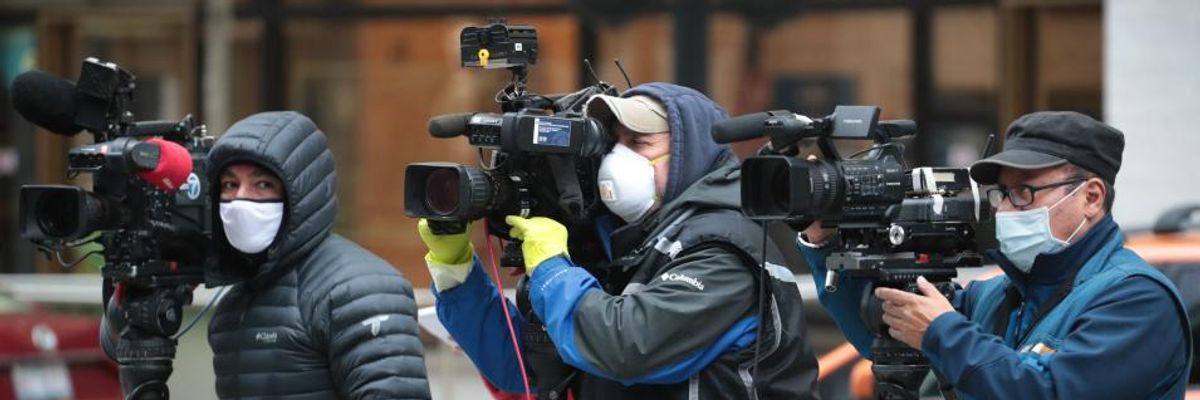
Journalists wearing masks document a protest in Chicago where demonstrators were calling on the Illinois governor to suspend rent and mortgage payments to help those who have lost their income due to the coronavirus on April 30, 2020. (Photo: Scott Olson/Getty Images)
As the coronavirus pandemic continued to devastate local news outlets across the United States--even as some have seen audience and subscription boosts--the group Free Press Action on Monday unveiled a proposal to provide crucial financial relief to newsrooms and reporters while envisioning a more sustainable future for the industry.
The proposal, What a Journalism-Recovery Package Should Look Like During the Covid-19 Crisis (pdf), calls for Congress to allocate direct and indirect subsidies to journalists through the end of 2021 and to substantially increase federal funding for public-media institutions to protect local reporting jobs.
Free Press Action also put forth medium- and long-term policies that "could create a bridge from this emergency period to a future of sustainable journalism that serves and represents local communities, especially Black and Latinx communities that have been disproportionately harmed by the current crisis and poorly served by dominant media."
The policy recommendations come about a month after Free Press Action joined with over 45 groups and scholars to urge federal lawmakers to "include the journalism sector in the congressional assistance packages revitalizing affected industries." In a joint letter (pdf), they emphasized the importance of community-specific news during a pandemic and how the current crisis has affected the media industry.
"Congress must act now to save jobs and ensure crucial economic and health information reaches the people harmed most by this pandemic," Craig Aaron, Free Press president and co-CEO, said in a statement Monday. "To get through this emergency, we need trustworthy news and reporters on the beat. Wishful thinking about new business models or philanthropy won't be enough."
Aaron, co-author of the new recovery package, explained that "our proposed policies focus on directing relief efforts into the hands of local outlets and working journalists--so they can keep people informed during this crisis and its aftermath--and lay the foundation for sustaining community-centered news in the future."
In a series of tweets Monday, Aaron detailed some of the group's recommendations and promised there is more to come:
The proposal says the federal funding for local journalism "should be appropriated separately and in addition to money dedicated to small businesses" in the Coronavirus Aid, Relief, and Economic Security (CARES) Act President Donald Trump signed in late March. The plan also underscores the necessity of "strong guardrails to ensure money is spent locally and directly benefits newsrooms and their communities."
"Free Press Action does not support measures to treat large newspaper or broadcasting chains as small businesses under recovery efforts such as the Paycheck Protection Program," the proposal continues. "Such policies put deeper-pocketed interests in competition with smaller businesses that have much less access to legal and banking resources."
Proposal co-author and Free Press Action research director S. Derek Turner said Monday that "the local-news industry will continue to face massive business headwinds," calling for efforts to bolster local reporting even after the pandemic passes.
"Given the dire nature of the crisis, our proposal prioritizes getting important news and information in front of more people while targeting funds toward news that serves the local audiences that have been hardest hit," he said. "But if we, as a country, value high-quality local news, then bringing lasting relief to news deserts and meeting community-information needs everywhere will require a substantial public investment over a long period of time."
Dear Common Dreams reader, It’s been nearly 30 years since I co-founded Common Dreams with my late wife, Lina Newhouser. We had the radical notion that journalism should serve the public good, not corporate profits. It was clear to us from the outset what it would take to build such a project. No paid advertisements. No corporate sponsors. No millionaire publisher telling us what to think or do. Many people said we wouldn't last a year, but we proved those doubters wrong. Together with a tremendous team of journalists and dedicated staff, we built an independent media outlet free from the constraints of profits and corporate control. Our mission has always been simple: To inform. To inspire. To ignite change for the common good. Building Common Dreams was not easy. Our survival was never guaranteed. When you take on the most powerful forces—Wall Street greed, fossil fuel industry destruction, Big Tech lobbyists, and uber-rich oligarchs who have spent billions upon billions rigging the economy and democracy in their favor—the only bulwark you have is supporters who believe in your work. But here’s the urgent message from me today. It's never been this bad out there. And it's never been this hard to keep us going. At the very moment Common Dreams is most needed, the threats we face are intensifying. We need your support now more than ever. We don't accept corporate advertising and never will. We don't have a paywall because we don't think people should be blocked from critical news based on their ability to pay. Everything we do is funded by the donations of readers like you. When everyone does the little they can afford, we are strong. But if that support retreats or dries up, so do we. Will you donate now to make sure Common Dreams not only survives but thrives? —Craig Brown, Co-founder |
As the coronavirus pandemic continued to devastate local news outlets across the United States--even as some have seen audience and subscription boosts--the group Free Press Action on Monday unveiled a proposal to provide crucial financial relief to newsrooms and reporters while envisioning a more sustainable future for the industry.
The proposal, What a Journalism-Recovery Package Should Look Like During the Covid-19 Crisis (pdf), calls for Congress to allocate direct and indirect subsidies to journalists through the end of 2021 and to substantially increase federal funding for public-media institutions to protect local reporting jobs.
Free Press Action also put forth medium- and long-term policies that "could create a bridge from this emergency period to a future of sustainable journalism that serves and represents local communities, especially Black and Latinx communities that have been disproportionately harmed by the current crisis and poorly served by dominant media."
The policy recommendations come about a month after Free Press Action joined with over 45 groups and scholars to urge federal lawmakers to "include the journalism sector in the congressional assistance packages revitalizing affected industries." In a joint letter (pdf), they emphasized the importance of community-specific news during a pandemic and how the current crisis has affected the media industry.
"Congress must act now to save jobs and ensure crucial economic and health information reaches the people harmed most by this pandemic," Craig Aaron, Free Press president and co-CEO, said in a statement Monday. "To get through this emergency, we need trustworthy news and reporters on the beat. Wishful thinking about new business models or philanthropy won't be enough."
Aaron, co-author of the new recovery package, explained that "our proposed policies focus on directing relief efforts into the hands of local outlets and working journalists--so they can keep people informed during this crisis and its aftermath--and lay the foundation for sustaining community-centered news in the future."
In a series of tweets Monday, Aaron detailed some of the group's recommendations and promised there is more to come:
The proposal says the federal funding for local journalism "should be appropriated separately and in addition to money dedicated to small businesses" in the Coronavirus Aid, Relief, and Economic Security (CARES) Act President Donald Trump signed in late March. The plan also underscores the necessity of "strong guardrails to ensure money is spent locally and directly benefits newsrooms and their communities."
"Free Press Action does not support measures to treat large newspaper or broadcasting chains as small businesses under recovery efforts such as the Paycheck Protection Program," the proposal continues. "Such policies put deeper-pocketed interests in competition with smaller businesses that have much less access to legal and banking resources."
Proposal co-author and Free Press Action research director S. Derek Turner said Monday that "the local-news industry will continue to face massive business headwinds," calling for efforts to bolster local reporting even after the pandemic passes.
"Given the dire nature of the crisis, our proposal prioritizes getting important news and information in front of more people while targeting funds toward news that serves the local audiences that have been hardest hit," he said. "But if we, as a country, value high-quality local news, then bringing lasting relief to news deserts and meeting community-information needs everywhere will require a substantial public investment over a long period of time."
As the coronavirus pandemic continued to devastate local news outlets across the United States--even as some have seen audience and subscription boosts--the group Free Press Action on Monday unveiled a proposal to provide crucial financial relief to newsrooms and reporters while envisioning a more sustainable future for the industry.
The proposal, What a Journalism-Recovery Package Should Look Like During the Covid-19 Crisis (pdf), calls for Congress to allocate direct and indirect subsidies to journalists through the end of 2021 and to substantially increase federal funding for public-media institutions to protect local reporting jobs.
Free Press Action also put forth medium- and long-term policies that "could create a bridge from this emergency period to a future of sustainable journalism that serves and represents local communities, especially Black and Latinx communities that have been disproportionately harmed by the current crisis and poorly served by dominant media."
The policy recommendations come about a month after Free Press Action joined with over 45 groups and scholars to urge federal lawmakers to "include the journalism sector in the congressional assistance packages revitalizing affected industries." In a joint letter (pdf), they emphasized the importance of community-specific news during a pandemic and how the current crisis has affected the media industry.
"Congress must act now to save jobs and ensure crucial economic and health information reaches the people harmed most by this pandemic," Craig Aaron, Free Press president and co-CEO, said in a statement Monday. "To get through this emergency, we need trustworthy news and reporters on the beat. Wishful thinking about new business models or philanthropy won't be enough."
Aaron, co-author of the new recovery package, explained that "our proposed policies focus on directing relief efforts into the hands of local outlets and working journalists--so they can keep people informed during this crisis and its aftermath--and lay the foundation for sustaining community-centered news in the future."
In a series of tweets Monday, Aaron detailed some of the group's recommendations and promised there is more to come:
The proposal says the federal funding for local journalism "should be appropriated separately and in addition to money dedicated to small businesses" in the Coronavirus Aid, Relief, and Economic Security (CARES) Act President Donald Trump signed in late March. The plan also underscores the necessity of "strong guardrails to ensure money is spent locally and directly benefits newsrooms and their communities."
"Free Press Action does not support measures to treat large newspaper or broadcasting chains as small businesses under recovery efforts such as the Paycheck Protection Program," the proposal continues. "Such policies put deeper-pocketed interests in competition with smaller businesses that have much less access to legal and banking resources."
Proposal co-author and Free Press Action research director S. Derek Turner said Monday that "the local-news industry will continue to face massive business headwinds," calling for efforts to bolster local reporting even after the pandemic passes.
"Given the dire nature of the crisis, our proposal prioritizes getting important news and information in front of more people while targeting funds toward news that serves the local audiences that have been hardest hit," he said. "But if we, as a country, value high-quality local news, then bringing lasting relief to news deserts and meeting community-information needs everywhere will require a substantial public investment over a long period of time."