SUBSCRIBE TO OUR FREE NEWSLETTER
Daily news & progressive opinion—funded by the people, not the corporations—delivered straight to your inbox.
5
#000000
#FFFFFF
To donate by check, phone, or other method, see our More Ways to Give page.
Daily news & progressive opinion—funded by the people, not the corporations—delivered straight to your inbox.
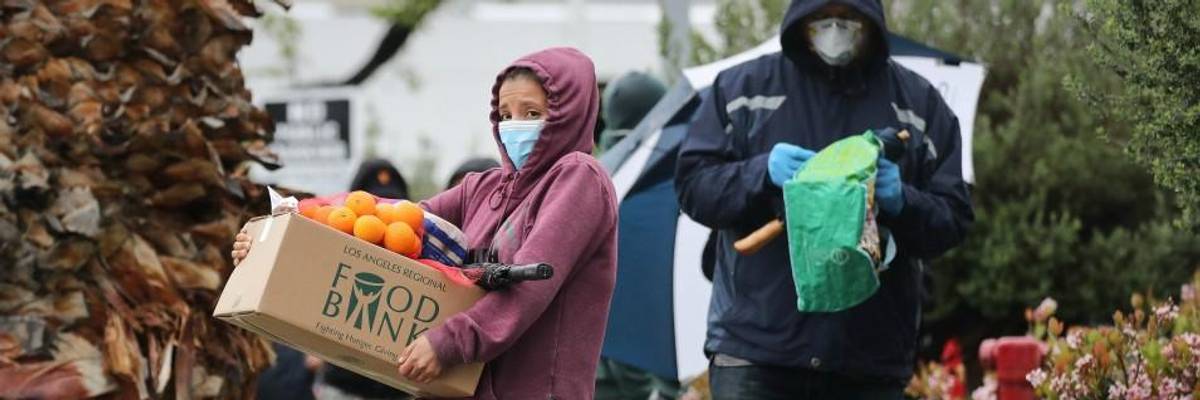
A recipient carries a box of food as others wait in line at a Food Bank distribution for those in need as the coronavirus pandemic continues on April 9, 2020 in Van Nuys, California. (Photo: Mario Tama/Getty Images)
The economic crisis that has come in the wake of the coronavirus outbreak has left nearly a fifth of children in the U.S. without enough food, according to new research from the Hamilton Project, and one in three households in the country food insecure.
"This is alarming," researcher and report author Lauren Bauer told the New York Times Wednesday of her findings. "These are households cutting back on portion sizes, having kids skip meals. The numbers are much higher than I expected."
Bauer, a research fellow on education, children, and the social safety net for the Hamilton Project--an economic policy project of the Brookings Institute--used data from two surveys of mothers on eating habits and food resources. She found rates of food insecurity for polled households and children doubled and quadrupled, respectively, their rates during the Great Recession of 2008-2010.
"Child and household food insecurity are off the charts," Bauer tweeted of her study.
According to Bauer's report:
In the Survey of Mothers with Young Children, 17.4% of mothers with children ages 12 and under reported that since the pandemic started, "the children in my household were not eating enough because we just couldn't afford enough food." Of those mothers, 3.4% reported that it was often the case that their children were not eating enough due to a lack of resources since the coronavirus pandemic began... The incidence of hardship among children as measured by responses to this question has increased 460%.
[...]
The Survey of Mothers with Young Children found that 40.9% of mothers with children ages 12 and under reported household food insecurity since the onset of the COVID-19 pandemic... The share of mothers with children 12 and under reporting that the food that they bought did not last has increased 170%.
As Common Dreams has reported, the coronavirus outbreak has strained food supply chains, led meat processing plants to shut down and massacre animals due to dropping demand from restaurants, and resulted in tons of food rotting with no available means of distribution. Despite the food waste, millions of Americans are going hungry, with food banks stressed past capacity as companies institute mass layoffs while paying out millions to shareholders.
Bauer said that though her findings were dire, the answer to the problem was obvious.
"Luckily, food insecurity is an unusual policy challenge in that it recommends a clear solution," Bauer wrote. "To reduce the number of people, including children, who have insufficient food due to a lack of resources, policymakers can supply the resources."
Dear Common Dreams reader, It’s been nearly 30 years since I co-founded Common Dreams with my late wife, Lina Newhouser. We had the radical notion that journalism should serve the public good, not corporate profits. It was clear to us from the outset what it would take to build such a project. No paid advertisements. No corporate sponsors. No millionaire publisher telling us what to think or do. Many people said we wouldn't last a year, but we proved those doubters wrong. Together with a tremendous team of journalists and dedicated staff, we built an independent media outlet free from the constraints of profits and corporate control. Our mission has always been simple: To inform. To inspire. To ignite change for the common good. Building Common Dreams was not easy. Our survival was never guaranteed. When you take on the most powerful forces—Wall Street greed, fossil fuel industry destruction, Big Tech lobbyists, and uber-rich oligarchs who have spent billions upon billions rigging the economy and democracy in their favor—the only bulwark you have is supporters who believe in your work. But here’s the urgent message from me today. It's never been this bad out there. And it's never been this hard to keep us going. At the very moment Common Dreams is most needed, the threats we face are intensifying. We need your support now more than ever. We don't accept corporate advertising and never will. We don't have a paywall because we don't think people should be blocked from critical news based on their ability to pay. Everything we do is funded by the donations of readers like you. When everyone does the little they can afford, we are strong. But if that support retreats or dries up, so do we. Will you donate now to make sure Common Dreams not only survives but thrives? —Craig Brown, Co-founder |
The economic crisis that has come in the wake of the coronavirus outbreak has left nearly a fifth of children in the U.S. without enough food, according to new research from the Hamilton Project, and one in three households in the country food insecure.
"This is alarming," researcher and report author Lauren Bauer told the New York Times Wednesday of her findings. "These are households cutting back on portion sizes, having kids skip meals. The numbers are much higher than I expected."
Bauer, a research fellow on education, children, and the social safety net for the Hamilton Project--an economic policy project of the Brookings Institute--used data from two surveys of mothers on eating habits and food resources. She found rates of food insecurity for polled households and children doubled and quadrupled, respectively, their rates during the Great Recession of 2008-2010.
"Child and household food insecurity are off the charts," Bauer tweeted of her study.
According to Bauer's report:
In the Survey of Mothers with Young Children, 17.4% of mothers with children ages 12 and under reported that since the pandemic started, "the children in my household were not eating enough because we just couldn't afford enough food." Of those mothers, 3.4% reported that it was often the case that their children were not eating enough due to a lack of resources since the coronavirus pandemic began... The incidence of hardship among children as measured by responses to this question has increased 460%.
[...]
The Survey of Mothers with Young Children found that 40.9% of mothers with children ages 12 and under reported household food insecurity since the onset of the COVID-19 pandemic... The share of mothers with children 12 and under reporting that the food that they bought did not last has increased 170%.
As Common Dreams has reported, the coronavirus outbreak has strained food supply chains, led meat processing plants to shut down and massacre animals due to dropping demand from restaurants, and resulted in tons of food rotting with no available means of distribution. Despite the food waste, millions of Americans are going hungry, with food banks stressed past capacity as companies institute mass layoffs while paying out millions to shareholders.
Bauer said that though her findings were dire, the answer to the problem was obvious.
"Luckily, food insecurity is an unusual policy challenge in that it recommends a clear solution," Bauer wrote. "To reduce the number of people, including children, who have insufficient food due to a lack of resources, policymakers can supply the resources."
The economic crisis that has come in the wake of the coronavirus outbreak has left nearly a fifth of children in the U.S. without enough food, according to new research from the Hamilton Project, and one in three households in the country food insecure.
"This is alarming," researcher and report author Lauren Bauer told the New York Times Wednesday of her findings. "These are households cutting back on portion sizes, having kids skip meals. The numbers are much higher than I expected."
Bauer, a research fellow on education, children, and the social safety net for the Hamilton Project--an economic policy project of the Brookings Institute--used data from two surveys of mothers on eating habits and food resources. She found rates of food insecurity for polled households and children doubled and quadrupled, respectively, their rates during the Great Recession of 2008-2010.
"Child and household food insecurity are off the charts," Bauer tweeted of her study.
According to Bauer's report:
In the Survey of Mothers with Young Children, 17.4% of mothers with children ages 12 and under reported that since the pandemic started, "the children in my household were not eating enough because we just couldn't afford enough food." Of those mothers, 3.4% reported that it was often the case that their children were not eating enough due to a lack of resources since the coronavirus pandemic began... The incidence of hardship among children as measured by responses to this question has increased 460%.
[...]
The Survey of Mothers with Young Children found that 40.9% of mothers with children ages 12 and under reported household food insecurity since the onset of the COVID-19 pandemic... The share of mothers with children 12 and under reporting that the food that they bought did not last has increased 170%.
As Common Dreams has reported, the coronavirus outbreak has strained food supply chains, led meat processing plants to shut down and massacre animals due to dropping demand from restaurants, and resulted in tons of food rotting with no available means of distribution. Despite the food waste, millions of Americans are going hungry, with food banks stressed past capacity as companies institute mass layoffs while paying out millions to shareholders.
Bauer said that though her findings were dire, the answer to the problem was obvious.
"Luckily, food insecurity is an unusual policy challenge in that it recommends a clear solution," Bauer wrote. "To reduce the number of people, including children, who have insufficient food due to a lack of resources, policymakers can supply the resources."