SUBSCRIBE TO OUR FREE NEWSLETTER
Daily news & progressive opinion—funded by the people, not the corporations—delivered straight to your inbox.
5
#000000
#FFFFFF
To donate by check, phone, or other method, see our More Ways to Give page.
Daily news & progressive opinion—funded by the people, not the corporations—delivered straight to your inbox.

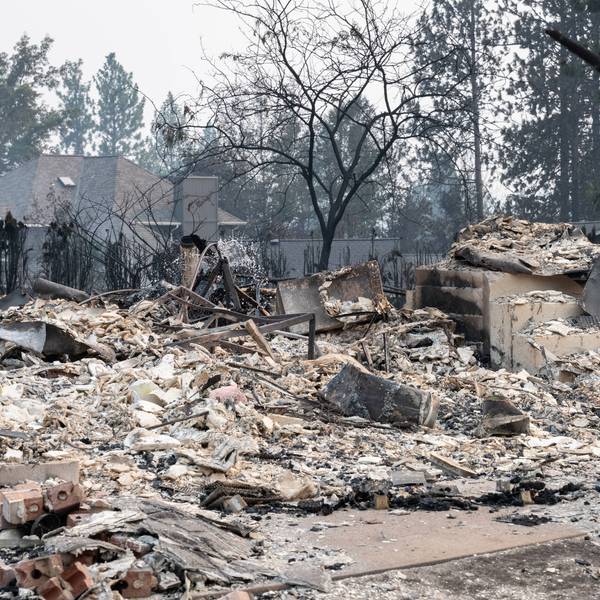
Firefighters sprays water on a back fire while battling the spread of the Maria Fire as it moves quickly towards Santa Paula, California, on Nov. 1, 2019. (Photo: Marcus Yam/Los Angeles Times via Getty Images)
Climate scientists and campaigners reiterated their demands for urgent global action to dramatically reduce planet-heating emissions in response to a new record-breaking reading on Sunday of the concentration of carbon dioxide in the atmosphere from the National Oceanic and Atmospheric Administration.
Experts and activists have long pointed at rapidly rising CO2 concentrations as evidence that the international community must do more to address the climate crisis. The daily average of CO2 levels on May 3 was 418.12 parts per million, according to NOAA's Mauna Loa Observatory, an atmospheric baseline station in Hawaii.
The United Nations Framework Convention on Climate Change secretariat (U.N. Climate Change) highlighted the finding on Twitter Monday and called on countries across the globe to improve their national climate action plans.
Although the next major U.N. climate summit, COP26, is postponed until next year due to the ongoing coronavirus pandemic, countries party to the landmark 2015 Paris climate agreement are still under pressure to unveil their nationally determined contributions (NDCs) sometime this year.
The Covid-19 lockdowns, which persist in many places around the world, have led to declines in fossil fuel emissions and other pollution. In a note on the webpage detailing daily averages, NOAA addresses whether the impacts of the pandemic are affecting the CO2 record:
There have been many inquiries whether we can see in our CO2 measurements at Mauna Loa and elsewhere the slowdown in CO2 emissions from the burning of fossil fuels. That drop in emissions needs to be large enough to stand out from natural CO2 variability caused by how plants and soils respond to seasonal and annual variations of temperature, humidity, soil moisture, etc. These natural variations are large, and so far the "missing" emissions do not stand out.
Here is an example: If emissions are lower by 25%, then we would expect the monthly mean CO2 for March at Mauna Loa to be lowered by about 0.2 ppm, and again in April, etc. Thus, when we compare the average seasonal cycle of many years we would expect a difference to accumulate after a number of months, each missing 0.2 ppm. The International Energy Agency expects global CO2 emissions to drop by 8% this year. Clearly, we cannot see a global effect like that in less than a year. CO2 would continue to increase at almost the same rate, which illustrates that to tackle our global heating emergency aggressive investments need to be made in alternative energy sources.
David N. Thomas, a professor at the School of Ocean Sciences at Bangor University in Wales, shared on Twitter Tuesday an infographic and "sobering" report about the pandemic's expected impact on global CO2 emissions.
That April 30 report from the Breakthrough Institute says that "meaningfully altering atmospheric concentrations of CO2--and meaningfully 'bending the curve' away from high warming outcomes--requires sustained year-over-year emissions reductions rather than temporary drops during economic crises."
Thomas also took to Twitter Monday to acknowledge the new daily average record at the Mauna Loa station. He pointed out that the previous record had been set just two days earlier--418.03 ppm on May 1-- and posited that the May 3 record "unfortunately will be broken several more times this month."
That concern was shared Tuesday by climate activist Greta Thunberg, the 17-year-old Swede who founded the global Fridays for Future movement:
Thunberg noted that the daily average from Sunday is nearly 70 ppm beyond 350 ppm, which experts--including former NASA climatologist James Hansen--have deemed the safe limit. As Hansen has said: "If humanity wishes to preserve a planet similar to that on which civilization developed and to which life on Earth is adapted, paleoclimate evidence and ongoing climate change suggest that CO2 will need to be reduced... to at most 350 ppm."
In a tweet Tuesday, the South Africa-based climate justice group The Collective Movement also noted that safe limit and expectations that CO2 concentrations "are more than likely to increase and unless action is taken."
"We are heading to dangerous levels of CO2 in the atmosphere," the group declared. "Where we are is bad enough. We can't let these levels grow. We need #ClimateAction!"
The record in Hawaii came ahead of a study published in the Proceedings of the National Academy of Sciences that warned if the warming continues at its current rate, up to three billion people could be forced to flee regions of the planet that would become too hot for humans to inhabit by 2070.
Dear Common Dreams reader, It’s been nearly 30 years since I co-founded Common Dreams with my late wife, Lina Newhouser. We had the radical notion that journalism should serve the public good, not corporate profits. It was clear to us from the outset what it would take to build such a project. No paid advertisements. No corporate sponsors. No millionaire publisher telling us what to think or do. Many people said we wouldn't last a year, but we proved those doubters wrong. Together with a tremendous team of journalists and dedicated staff, we built an independent media outlet free from the constraints of profits and corporate control. Our mission has always been simple: To inform. To inspire. To ignite change for the common good. Building Common Dreams was not easy. Our survival was never guaranteed. When you take on the most powerful forces—Wall Street greed, fossil fuel industry destruction, Big Tech lobbyists, and uber-rich oligarchs who have spent billions upon billions rigging the economy and democracy in their favor—the only bulwark you have is supporters who believe in your work. But here’s the urgent message from me today. It's never been this bad out there. And it's never been this hard to keep us going. At the very moment Common Dreams is most needed, the threats we face are intensifying. We need your support now more than ever. We don't accept corporate advertising and never will. We don't have a paywall because we don't think people should be blocked from critical news based on their ability to pay. Everything we do is funded by the donations of readers like you. When everyone does the little they can afford, we are strong. But if that support retreats or dries up, so do we. Will you donate now to make sure Common Dreams not only survives but thrives? —Craig Brown, Co-founder |
Climate scientists and campaigners reiterated their demands for urgent global action to dramatically reduce planet-heating emissions in response to a new record-breaking reading on Sunday of the concentration of carbon dioxide in the atmosphere from the National Oceanic and Atmospheric Administration.
Experts and activists have long pointed at rapidly rising CO2 concentrations as evidence that the international community must do more to address the climate crisis. The daily average of CO2 levels on May 3 was 418.12 parts per million, according to NOAA's Mauna Loa Observatory, an atmospheric baseline station in Hawaii.
The United Nations Framework Convention on Climate Change secretariat (U.N. Climate Change) highlighted the finding on Twitter Monday and called on countries across the globe to improve their national climate action plans.
Although the next major U.N. climate summit, COP26, is postponed until next year due to the ongoing coronavirus pandemic, countries party to the landmark 2015 Paris climate agreement are still under pressure to unveil their nationally determined contributions (NDCs) sometime this year.
The Covid-19 lockdowns, which persist in many places around the world, have led to declines in fossil fuel emissions and other pollution. In a note on the webpage detailing daily averages, NOAA addresses whether the impacts of the pandemic are affecting the CO2 record:
There have been many inquiries whether we can see in our CO2 measurements at Mauna Loa and elsewhere the slowdown in CO2 emissions from the burning of fossil fuels. That drop in emissions needs to be large enough to stand out from natural CO2 variability caused by how plants and soils respond to seasonal and annual variations of temperature, humidity, soil moisture, etc. These natural variations are large, and so far the "missing" emissions do not stand out.
Here is an example: If emissions are lower by 25%, then we would expect the monthly mean CO2 for March at Mauna Loa to be lowered by about 0.2 ppm, and again in April, etc. Thus, when we compare the average seasonal cycle of many years we would expect a difference to accumulate after a number of months, each missing 0.2 ppm. The International Energy Agency expects global CO2 emissions to drop by 8% this year. Clearly, we cannot see a global effect like that in less than a year. CO2 would continue to increase at almost the same rate, which illustrates that to tackle our global heating emergency aggressive investments need to be made in alternative energy sources.
David N. Thomas, a professor at the School of Ocean Sciences at Bangor University in Wales, shared on Twitter Tuesday an infographic and "sobering" report about the pandemic's expected impact on global CO2 emissions.
That April 30 report from the Breakthrough Institute says that "meaningfully altering atmospheric concentrations of CO2--and meaningfully 'bending the curve' away from high warming outcomes--requires sustained year-over-year emissions reductions rather than temporary drops during economic crises."
Thomas also took to Twitter Monday to acknowledge the new daily average record at the Mauna Loa station. He pointed out that the previous record had been set just two days earlier--418.03 ppm on May 1-- and posited that the May 3 record "unfortunately will be broken several more times this month."
That concern was shared Tuesday by climate activist Greta Thunberg, the 17-year-old Swede who founded the global Fridays for Future movement:
Thunberg noted that the daily average from Sunday is nearly 70 ppm beyond 350 ppm, which experts--including former NASA climatologist James Hansen--have deemed the safe limit. As Hansen has said: "If humanity wishes to preserve a planet similar to that on which civilization developed and to which life on Earth is adapted, paleoclimate evidence and ongoing climate change suggest that CO2 will need to be reduced... to at most 350 ppm."
In a tweet Tuesday, the South Africa-based climate justice group The Collective Movement also noted that safe limit and expectations that CO2 concentrations "are more than likely to increase and unless action is taken."
"We are heading to dangerous levels of CO2 in the atmosphere," the group declared. "Where we are is bad enough. We can't let these levels grow. We need #ClimateAction!"
The record in Hawaii came ahead of a study published in the Proceedings of the National Academy of Sciences that warned if the warming continues at its current rate, up to three billion people could be forced to flee regions of the planet that would become too hot for humans to inhabit by 2070.
Climate scientists and campaigners reiterated their demands for urgent global action to dramatically reduce planet-heating emissions in response to a new record-breaking reading on Sunday of the concentration of carbon dioxide in the atmosphere from the National Oceanic and Atmospheric Administration.
Experts and activists have long pointed at rapidly rising CO2 concentrations as evidence that the international community must do more to address the climate crisis. The daily average of CO2 levels on May 3 was 418.12 parts per million, according to NOAA's Mauna Loa Observatory, an atmospheric baseline station in Hawaii.
The United Nations Framework Convention on Climate Change secretariat (U.N. Climate Change) highlighted the finding on Twitter Monday and called on countries across the globe to improve their national climate action plans.
Although the next major U.N. climate summit, COP26, is postponed until next year due to the ongoing coronavirus pandemic, countries party to the landmark 2015 Paris climate agreement are still under pressure to unveil their nationally determined contributions (NDCs) sometime this year.
The Covid-19 lockdowns, which persist in many places around the world, have led to declines in fossil fuel emissions and other pollution. In a note on the webpage detailing daily averages, NOAA addresses whether the impacts of the pandemic are affecting the CO2 record:
There have been many inquiries whether we can see in our CO2 measurements at Mauna Loa and elsewhere the slowdown in CO2 emissions from the burning of fossil fuels. That drop in emissions needs to be large enough to stand out from natural CO2 variability caused by how plants and soils respond to seasonal and annual variations of temperature, humidity, soil moisture, etc. These natural variations are large, and so far the "missing" emissions do not stand out.
Here is an example: If emissions are lower by 25%, then we would expect the monthly mean CO2 for March at Mauna Loa to be lowered by about 0.2 ppm, and again in April, etc. Thus, when we compare the average seasonal cycle of many years we would expect a difference to accumulate after a number of months, each missing 0.2 ppm. The International Energy Agency expects global CO2 emissions to drop by 8% this year. Clearly, we cannot see a global effect like that in less than a year. CO2 would continue to increase at almost the same rate, which illustrates that to tackle our global heating emergency aggressive investments need to be made in alternative energy sources.
David N. Thomas, a professor at the School of Ocean Sciences at Bangor University in Wales, shared on Twitter Tuesday an infographic and "sobering" report about the pandemic's expected impact on global CO2 emissions.
That April 30 report from the Breakthrough Institute says that "meaningfully altering atmospheric concentrations of CO2--and meaningfully 'bending the curve' away from high warming outcomes--requires sustained year-over-year emissions reductions rather than temporary drops during economic crises."
Thomas also took to Twitter Monday to acknowledge the new daily average record at the Mauna Loa station. He pointed out that the previous record had been set just two days earlier--418.03 ppm on May 1-- and posited that the May 3 record "unfortunately will be broken several more times this month."
That concern was shared Tuesday by climate activist Greta Thunberg, the 17-year-old Swede who founded the global Fridays for Future movement:
Thunberg noted that the daily average from Sunday is nearly 70 ppm beyond 350 ppm, which experts--including former NASA climatologist James Hansen--have deemed the safe limit. As Hansen has said: "If humanity wishes to preserve a planet similar to that on which civilization developed and to which life on Earth is adapted, paleoclimate evidence and ongoing climate change suggest that CO2 will need to be reduced... to at most 350 ppm."
In a tweet Tuesday, the South Africa-based climate justice group The Collective Movement also noted that safe limit and expectations that CO2 concentrations "are more than likely to increase and unless action is taken."
"We are heading to dangerous levels of CO2 in the atmosphere," the group declared. "Where we are is bad enough. We can't let these levels grow. We need #ClimateAction!"
The record in Hawaii came ahead of a study published in the Proceedings of the National Academy of Sciences that warned if the warming continues at its current rate, up to three billion people could be forced to flee regions of the planet that would become too hot for humans to inhabit by 2070.