SUBSCRIBE TO OUR FREE NEWSLETTER
Daily news & progressive opinion—funded by the people, not the corporations—delivered straight to your inbox.
5
#000000
#FFFFFF
To donate by check, phone, or other method, see our More Ways to Give page.
Daily news & progressive opinion—funded by the people, not the corporations—delivered straight to your inbox.
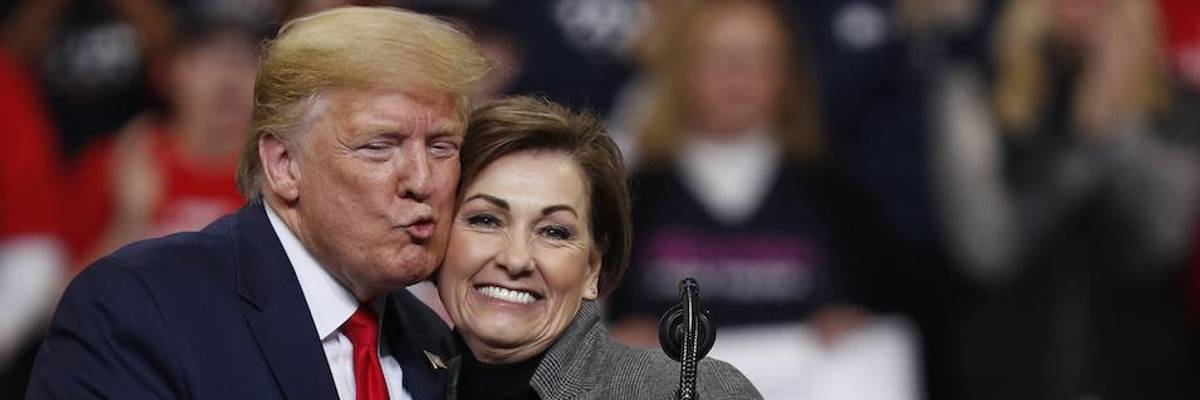
Iowa Governor Kim Reynolds, pictured at a rally with President Donald Trump in January, told Iowans last Friday that if they do not return to work when asked they will lose unemployment benefits. (Photo: Tom Brenner/Getty Images)
If you don't return to work in Texas and Iowa because you fear getting sick from the coronavirus you risk losing unemployment benefits.
That's the directive from the respective states' two Republican governors, who separately issued guidelines to that effect as part of an effort to reopen their economies despite warnings from public health officials.
In Iowa, Gov. Kim Reynolds announced last Friday that anyone in the state refusing to return to work due to concerns over contracting Covid-19, which has as of press time killed over 59,000 Americans, would be considered as a "voluntary quit" from their job and ineligible for unemployment benefits.
"If you're an employer and you offer to bring your employee back to work and they decide not to, that's a voluntary quit," said Reynolds. "Therefore, they would not be eligible for the unemployment money."
In a guidance memo issued Monday, the Iowa Workforce Development agency urged employers to turn in workers who choose to prioritize their personal health and safety over demands they return to work.
"Businesses should report employees who refuse to return to work without good reason or who quit their jobs as soon as possible," the memo declared.
Texas Gov. Greg Abbot on Monday issued an order reopening his state's economy for May 1, meaning Texans who do not return to work could also lose access to unemployment benefits.
"I feel like either I'm going to lose my business and everything I worked for, or I'm going to get sick," restaurant owner Kimberly West told the Texas Tribune of the governor's decision.
In comments to the Tribune, Texas AFL-CIO president Rick Levy said he was angered by the governor's decision.
"It makes me so mad that [the governor's office] talks about, 'If workers aren't feeling good, they should stay home'" said Levy. "That would be a lot easier to do if you had sick-leave benefits, but the state has consistently refused to provide any paid leave at all."
As Slate's Elliot Hannon wrote Wednesday, the treatment of workers is part of Covid-19's unequal impacts on people of differing economic circumstances around the country.
"As has been the case throughout the pandemic so far, those bearing the economic brunt of the virus have been the country's paycheck-to-paycheck class, which is far larger than you'd think," wrote Hannon. "The fervor to reopen--whether it's safe or not--will compel these workers to put themselves between the virus and people sitting on Zoom calls and ordering deliveries online."
Dear Common Dreams reader, It’s been nearly 30 years since I co-founded Common Dreams with my late wife, Lina Newhouser. We had the radical notion that journalism should serve the public good, not corporate profits. It was clear to us from the outset what it would take to build such a project. No paid advertisements. No corporate sponsors. No millionaire publisher telling us what to think or do. Many people said we wouldn't last a year, but we proved those doubters wrong. Together with a tremendous team of journalists and dedicated staff, we built an independent media outlet free from the constraints of profits and corporate control. Our mission has always been simple: To inform. To inspire. To ignite change for the common good. Building Common Dreams was not easy. Our survival was never guaranteed. When you take on the most powerful forces—Wall Street greed, fossil fuel industry destruction, Big Tech lobbyists, and uber-rich oligarchs who have spent billions upon billions rigging the economy and democracy in their favor—the only bulwark you have is supporters who believe in your work. But here’s the urgent message from me today. It's never been this bad out there. And it's never been this hard to keep us going. At the very moment Common Dreams is most needed, the threats we face are intensifying. We need your support now more than ever. We don't accept corporate advertising and never will. We don't have a paywall because we don't think people should be blocked from critical news based on their ability to pay. Everything we do is funded by the donations of readers like you. When everyone does the little they can afford, we are strong. But if that support retreats or dries up, so do we. Will you donate now to make sure Common Dreams not only survives but thrives? —Craig Brown, Co-founder |
If you don't return to work in Texas and Iowa because you fear getting sick from the coronavirus you risk losing unemployment benefits.
That's the directive from the respective states' two Republican governors, who separately issued guidelines to that effect as part of an effort to reopen their economies despite warnings from public health officials.
In Iowa, Gov. Kim Reynolds announced last Friday that anyone in the state refusing to return to work due to concerns over contracting Covid-19, which has as of press time killed over 59,000 Americans, would be considered as a "voluntary quit" from their job and ineligible for unemployment benefits.
"If you're an employer and you offer to bring your employee back to work and they decide not to, that's a voluntary quit," said Reynolds. "Therefore, they would not be eligible for the unemployment money."
In a guidance memo issued Monday, the Iowa Workforce Development agency urged employers to turn in workers who choose to prioritize their personal health and safety over demands they return to work.
"Businesses should report employees who refuse to return to work without good reason or who quit their jobs as soon as possible," the memo declared.
Texas Gov. Greg Abbot on Monday issued an order reopening his state's economy for May 1, meaning Texans who do not return to work could also lose access to unemployment benefits.
"I feel like either I'm going to lose my business and everything I worked for, or I'm going to get sick," restaurant owner Kimberly West told the Texas Tribune of the governor's decision.
In comments to the Tribune, Texas AFL-CIO president Rick Levy said he was angered by the governor's decision.
"It makes me so mad that [the governor's office] talks about, 'If workers aren't feeling good, they should stay home'" said Levy. "That would be a lot easier to do if you had sick-leave benefits, but the state has consistently refused to provide any paid leave at all."
As Slate's Elliot Hannon wrote Wednesday, the treatment of workers is part of Covid-19's unequal impacts on people of differing economic circumstances around the country.
"As has been the case throughout the pandemic so far, those bearing the economic brunt of the virus have been the country's paycheck-to-paycheck class, which is far larger than you'd think," wrote Hannon. "The fervor to reopen--whether it's safe or not--will compel these workers to put themselves between the virus and people sitting on Zoom calls and ordering deliveries online."
If you don't return to work in Texas and Iowa because you fear getting sick from the coronavirus you risk losing unemployment benefits.
That's the directive from the respective states' two Republican governors, who separately issued guidelines to that effect as part of an effort to reopen their economies despite warnings from public health officials.
In Iowa, Gov. Kim Reynolds announced last Friday that anyone in the state refusing to return to work due to concerns over contracting Covid-19, which has as of press time killed over 59,000 Americans, would be considered as a "voluntary quit" from their job and ineligible for unemployment benefits.
"If you're an employer and you offer to bring your employee back to work and they decide not to, that's a voluntary quit," said Reynolds. "Therefore, they would not be eligible for the unemployment money."
In a guidance memo issued Monday, the Iowa Workforce Development agency urged employers to turn in workers who choose to prioritize their personal health and safety over demands they return to work.
"Businesses should report employees who refuse to return to work without good reason or who quit their jobs as soon as possible," the memo declared.
Texas Gov. Greg Abbot on Monday issued an order reopening his state's economy for May 1, meaning Texans who do not return to work could also lose access to unemployment benefits.
"I feel like either I'm going to lose my business and everything I worked for, or I'm going to get sick," restaurant owner Kimberly West told the Texas Tribune of the governor's decision.
In comments to the Tribune, Texas AFL-CIO president Rick Levy said he was angered by the governor's decision.
"It makes me so mad that [the governor's office] talks about, 'If workers aren't feeling good, they should stay home'" said Levy. "That would be a lot easier to do if you had sick-leave benefits, but the state has consistently refused to provide any paid leave at all."
As Slate's Elliot Hannon wrote Wednesday, the treatment of workers is part of Covid-19's unequal impacts on people of differing economic circumstances around the country.
"As has been the case throughout the pandemic so far, those bearing the economic brunt of the virus have been the country's paycheck-to-paycheck class, which is far larger than you'd think," wrote Hannon. "The fervor to reopen--whether it's safe or not--will compel these workers to put themselves between the virus and people sitting on Zoom calls and ordering deliveries online."