SUBSCRIBE TO OUR FREE NEWSLETTER
Daily news & progressive opinion—funded by the people, not the corporations—delivered straight to your inbox.
5
#000000
#FFFFFF
To donate by check, phone, or other method, see our More Ways to Give page.
Daily news & progressive opinion—funded by the people, not the corporations—delivered straight to your inbox.
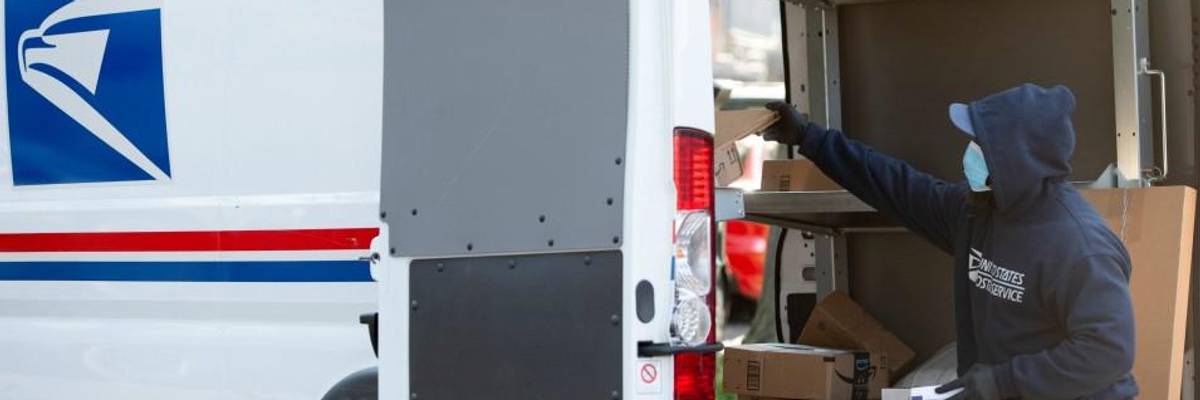
A mailman wearing a mask and gloves loads a postal truck with packages at a United States Postal Service (USPS) post office location in Washington, D.C. on April 16, 2020. (Photo: Saul Loeb/AFP via Getty Images)
With the Senate set to return to Washington, D.C. next week and uncertainty over when the House will also reconvene, calls continued to mount Wednesday for Congress to provide significant relief to the U.S. Postal Service, the popular federal agency that is struggling financially in the midst of the coronavirus pandemic.
In a Wednesday morning interview on Democracy Now!, American Postal Workers Union (APWU) president Mark Dimondstein discussed how the public health crisis has impacted USPS operations, both in terms of revenue and workers. According to the union leader, at least 45 mail clerks and carriers have died from Covid-19.
While Dimondstein noted that a 2006 congressional mandate requiring the USPS to fund retirees' health benefits for several decades has hamstrung the agency, he focused his comments on the current crisis, warning that "the Covid pandemic is having a huge, devastating, dire impact on postal revenue."
Watch:
As Dimondstein explained:
There's no taxpayer dollars that goes into the post office. It runs strictly on the revenue of postal and postal products. And that revenue has to be able to be enough to carry out the mission of what we call the universal service mandate--every address, every person, no matter who we are and where we live, a great small-d democratic right, getting mail, packages, six days a week now, sometimes seven.
And what's happened in this pandemic, and its economic devastation throughout the entire country and world--but what's happened specifically to the Postal Service is the mail has precipitously dropped off. ...The Postal Service will actually run out of money, whether it's this summer, whether it's early fall. The revenue just isn't there, strictly based on Covid.
So, what we've asked--and it's not just the "we" of the postal unions. The postal Board of Governors, which sets policy, which is a majority-Republican board right now, has unanimously asked for robust relief, not a bailout--this is for the people of the country; this doesn't go into any shareholders, any CEOs--but to make up that lost revenue, so the post office can weather this crisis and still, at the same time, serve the people of the country, both in ordinary times and in this time of crisis. So, it's serious. It's real. And again, it's very focused on the Covid pandemic economic impact.
The union leader took aim at President Donald Trump, who on Friday declared that "the Postal Service is a joke," and threatened to block all pandemic-related federal aid unless USPS quadruples its rates for package deliveries. Critics warn doing so could drive business away from the Postal Service and push companies to pass on price increases to customers.
"For a president of the United States to tell the people of this country and the postal workers who are on the frontlines that the postal workers, that the post office, is a joke--something that belongs to everybody in this country, it belongs to the people--that is the absolute insult of insults," Dimondstein told Democracy Now!
Dimondstein added that there are ways that the Postal Service could expand in the future, such as banking and copying services, but "in order to get there, we have to make sure that we have a public Postal Service. And that now is really up for grabs, because, clearly, we have an administration that would like to... sell the public Postal Service off to private corporations, privatize it."
As national radio commentator and author Jim Hightower explained in an op-ed for Creators Wednesday:
The U.S. mail service... is enormously popular and an essential part of our nation's economic and social infrastructure, so Trump can't just blatantly choke off its survival funds. Instead, he's taking the agency hostage, offering to provide a $10 billion "loan" from the Treasury Department--contingent on the public entity agreeing to his draconian demands that it raise postal prices, gut postal unions, and cut postal services.
Trump's provisos are postal poison pills, for they would destroy the agency's morale and service, undermine popular support, and clear the political path for profiteering corporations to seize, privatize, and plunder this public treasure.
Sen. Bernie Sanders (I-Vt.), who last week hosted a virtual town hall with the leaders of the nation's top postal unions to discuss how to save USPS, reiterated his demand to provide support to the agency in a tweet Wednesday morning:
Sanders shared a Washington Post column by Katrina vanden Heuvel of The Nation. In the column Tuesday, vanden Heuvel argued that "the USPS is the quintessential American institution" and members of Congress "must stand up to the White House and deliver the relief the Postal Service needs--not only to survive but also to thrive."
"As Americans across the country are following stay-at-home directives, they are relying on the USPS to deliver their prescription drugs, food, and other essentials," she noted. "Tax refunds and stimulus checks arrive through the mail. So do absentee ballots--this year's presidential election may indeed depend on the Postal Service to facilitate voting by mail."
"As civil rights leaders caution against efforts that would require voters to pay for postage when mailing in ballots, the USPS has restated its previous policy to deliver every ballot, even those with insufficient postage," vanden Heuvel added. "Can you imagine UPS or FedEx doing the same?"
On Democracy Now! Wednesday, Dimondstein noted that "the post office is the most trusted federal agency" and made the case that voting by mail--which is gaining popularity amid the public health crisis--is the best way to secure the 2020 election.
"This pandemic has brought home that if we're going to have true access to the ballot box--or more access to the ballot box, because we really don't have true access now--vote-by-mail is definitely the way to go," he said. "It was before. Now it's very, very clear. And postal workers are ready to continue to serve the people of this country in all sorts of ways, including that defense of our democratic right to vote."
Dear Common Dreams reader, It’s been nearly 30 years since I co-founded Common Dreams with my late wife, Lina Newhouser. We had the radical notion that journalism should serve the public good, not corporate profits. It was clear to us from the outset what it would take to build such a project. No paid advertisements. No corporate sponsors. No millionaire publisher telling us what to think or do. Many people said we wouldn't last a year, but we proved those doubters wrong. Together with a tremendous team of journalists and dedicated staff, we built an independent media outlet free from the constraints of profits and corporate control. Our mission has always been simple: To inform. To inspire. To ignite change for the common good. Building Common Dreams was not easy. Our survival was never guaranteed. When you take on the most powerful forces—Wall Street greed, fossil fuel industry destruction, Big Tech lobbyists, and uber-rich oligarchs who have spent billions upon billions rigging the economy and democracy in their favor—the only bulwark you have is supporters who believe in your work. But here’s the urgent message from me today. It's never been this bad out there. And it's never been this hard to keep us going. At the very moment Common Dreams is most needed, the threats we face are intensifying. We need your support now more than ever. We don't accept corporate advertising and never will. We don't have a paywall because we don't think people should be blocked from critical news based on their ability to pay. Everything we do is funded by the donations of readers like you. When everyone does the little they can afford, we are strong. But if that support retreats or dries up, so do we. Will you donate now to make sure Common Dreams not only survives but thrives? —Craig Brown, Co-founder |
With the Senate set to return to Washington, D.C. next week and uncertainty over when the House will also reconvene, calls continued to mount Wednesday for Congress to provide significant relief to the U.S. Postal Service, the popular federal agency that is struggling financially in the midst of the coronavirus pandemic.
In a Wednesday morning interview on Democracy Now!, American Postal Workers Union (APWU) president Mark Dimondstein discussed how the public health crisis has impacted USPS operations, both in terms of revenue and workers. According to the union leader, at least 45 mail clerks and carriers have died from Covid-19.
While Dimondstein noted that a 2006 congressional mandate requiring the USPS to fund retirees' health benefits for several decades has hamstrung the agency, he focused his comments on the current crisis, warning that "the Covid pandemic is having a huge, devastating, dire impact on postal revenue."
Watch:
As Dimondstein explained:
There's no taxpayer dollars that goes into the post office. It runs strictly on the revenue of postal and postal products. And that revenue has to be able to be enough to carry out the mission of what we call the universal service mandate--every address, every person, no matter who we are and where we live, a great small-d democratic right, getting mail, packages, six days a week now, sometimes seven.
And what's happened in this pandemic, and its economic devastation throughout the entire country and world--but what's happened specifically to the Postal Service is the mail has precipitously dropped off. ...The Postal Service will actually run out of money, whether it's this summer, whether it's early fall. The revenue just isn't there, strictly based on Covid.
So, what we've asked--and it's not just the "we" of the postal unions. The postal Board of Governors, which sets policy, which is a majority-Republican board right now, has unanimously asked for robust relief, not a bailout--this is for the people of the country; this doesn't go into any shareholders, any CEOs--but to make up that lost revenue, so the post office can weather this crisis and still, at the same time, serve the people of the country, both in ordinary times and in this time of crisis. So, it's serious. It's real. And again, it's very focused on the Covid pandemic economic impact.
The union leader took aim at President Donald Trump, who on Friday declared that "the Postal Service is a joke," and threatened to block all pandemic-related federal aid unless USPS quadruples its rates for package deliveries. Critics warn doing so could drive business away from the Postal Service and push companies to pass on price increases to customers.
"For a president of the United States to tell the people of this country and the postal workers who are on the frontlines that the postal workers, that the post office, is a joke--something that belongs to everybody in this country, it belongs to the people--that is the absolute insult of insults," Dimondstein told Democracy Now!
Dimondstein added that there are ways that the Postal Service could expand in the future, such as banking and copying services, but "in order to get there, we have to make sure that we have a public Postal Service. And that now is really up for grabs, because, clearly, we have an administration that would like to... sell the public Postal Service off to private corporations, privatize it."
As national radio commentator and author Jim Hightower explained in an op-ed for Creators Wednesday:
The U.S. mail service... is enormously popular and an essential part of our nation's economic and social infrastructure, so Trump can't just blatantly choke off its survival funds. Instead, he's taking the agency hostage, offering to provide a $10 billion "loan" from the Treasury Department--contingent on the public entity agreeing to his draconian demands that it raise postal prices, gut postal unions, and cut postal services.
Trump's provisos are postal poison pills, for they would destroy the agency's morale and service, undermine popular support, and clear the political path for profiteering corporations to seize, privatize, and plunder this public treasure.
Sen. Bernie Sanders (I-Vt.), who last week hosted a virtual town hall with the leaders of the nation's top postal unions to discuss how to save USPS, reiterated his demand to provide support to the agency in a tweet Wednesday morning:
Sanders shared a Washington Post column by Katrina vanden Heuvel of The Nation. In the column Tuesday, vanden Heuvel argued that "the USPS is the quintessential American institution" and members of Congress "must stand up to the White House and deliver the relief the Postal Service needs--not only to survive but also to thrive."
"As Americans across the country are following stay-at-home directives, they are relying on the USPS to deliver their prescription drugs, food, and other essentials," she noted. "Tax refunds and stimulus checks arrive through the mail. So do absentee ballots--this year's presidential election may indeed depend on the Postal Service to facilitate voting by mail."
"As civil rights leaders caution against efforts that would require voters to pay for postage when mailing in ballots, the USPS has restated its previous policy to deliver every ballot, even those with insufficient postage," vanden Heuvel added. "Can you imagine UPS or FedEx doing the same?"
On Democracy Now! Wednesday, Dimondstein noted that "the post office is the most trusted federal agency" and made the case that voting by mail--which is gaining popularity amid the public health crisis--is the best way to secure the 2020 election.
"This pandemic has brought home that if we're going to have true access to the ballot box--or more access to the ballot box, because we really don't have true access now--vote-by-mail is definitely the way to go," he said. "It was before. Now it's very, very clear. And postal workers are ready to continue to serve the people of this country in all sorts of ways, including that defense of our democratic right to vote."
With the Senate set to return to Washington, D.C. next week and uncertainty over when the House will also reconvene, calls continued to mount Wednesday for Congress to provide significant relief to the U.S. Postal Service, the popular federal agency that is struggling financially in the midst of the coronavirus pandemic.
In a Wednesday morning interview on Democracy Now!, American Postal Workers Union (APWU) president Mark Dimondstein discussed how the public health crisis has impacted USPS operations, both in terms of revenue and workers. According to the union leader, at least 45 mail clerks and carriers have died from Covid-19.
While Dimondstein noted that a 2006 congressional mandate requiring the USPS to fund retirees' health benefits for several decades has hamstrung the agency, he focused his comments on the current crisis, warning that "the Covid pandemic is having a huge, devastating, dire impact on postal revenue."
Watch:
As Dimondstein explained:
There's no taxpayer dollars that goes into the post office. It runs strictly on the revenue of postal and postal products. And that revenue has to be able to be enough to carry out the mission of what we call the universal service mandate--every address, every person, no matter who we are and where we live, a great small-d democratic right, getting mail, packages, six days a week now, sometimes seven.
And what's happened in this pandemic, and its economic devastation throughout the entire country and world--but what's happened specifically to the Postal Service is the mail has precipitously dropped off. ...The Postal Service will actually run out of money, whether it's this summer, whether it's early fall. The revenue just isn't there, strictly based on Covid.
So, what we've asked--and it's not just the "we" of the postal unions. The postal Board of Governors, which sets policy, which is a majority-Republican board right now, has unanimously asked for robust relief, not a bailout--this is for the people of the country; this doesn't go into any shareholders, any CEOs--but to make up that lost revenue, so the post office can weather this crisis and still, at the same time, serve the people of the country, both in ordinary times and in this time of crisis. So, it's serious. It's real. And again, it's very focused on the Covid pandemic economic impact.
The union leader took aim at President Donald Trump, who on Friday declared that "the Postal Service is a joke," and threatened to block all pandemic-related federal aid unless USPS quadruples its rates for package deliveries. Critics warn doing so could drive business away from the Postal Service and push companies to pass on price increases to customers.
"For a president of the United States to tell the people of this country and the postal workers who are on the frontlines that the postal workers, that the post office, is a joke--something that belongs to everybody in this country, it belongs to the people--that is the absolute insult of insults," Dimondstein told Democracy Now!
Dimondstein added that there are ways that the Postal Service could expand in the future, such as banking and copying services, but "in order to get there, we have to make sure that we have a public Postal Service. And that now is really up for grabs, because, clearly, we have an administration that would like to... sell the public Postal Service off to private corporations, privatize it."
As national radio commentator and author Jim Hightower explained in an op-ed for Creators Wednesday:
The U.S. mail service... is enormously popular and an essential part of our nation's economic and social infrastructure, so Trump can't just blatantly choke off its survival funds. Instead, he's taking the agency hostage, offering to provide a $10 billion "loan" from the Treasury Department--contingent on the public entity agreeing to his draconian demands that it raise postal prices, gut postal unions, and cut postal services.
Trump's provisos are postal poison pills, for they would destroy the agency's morale and service, undermine popular support, and clear the political path for profiteering corporations to seize, privatize, and plunder this public treasure.
Sen. Bernie Sanders (I-Vt.), who last week hosted a virtual town hall with the leaders of the nation's top postal unions to discuss how to save USPS, reiterated his demand to provide support to the agency in a tweet Wednesday morning:
Sanders shared a Washington Post column by Katrina vanden Heuvel of The Nation. In the column Tuesday, vanden Heuvel argued that "the USPS is the quintessential American institution" and members of Congress "must stand up to the White House and deliver the relief the Postal Service needs--not only to survive but also to thrive."
"As Americans across the country are following stay-at-home directives, they are relying on the USPS to deliver their prescription drugs, food, and other essentials," she noted. "Tax refunds and stimulus checks arrive through the mail. So do absentee ballots--this year's presidential election may indeed depend on the Postal Service to facilitate voting by mail."
"As civil rights leaders caution against efforts that would require voters to pay for postage when mailing in ballots, the USPS has restated its previous policy to deliver every ballot, even those with insufficient postage," vanden Heuvel added. "Can you imagine UPS or FedEx doing the same?"
On Democracy Now! Wednesday, Dimondstein noted that "the post office is the most trusted federal agency" and made the case that voting by mail--which is gaining popularity amid the public health crisis--is the best way to secure the 2020 election.
"This pandemic has brought home that if we're going to have true access to the ballot box--or more access to the ballot box, because we really don't have true access now--vote-by-mail is definitely the way to go," he said. "It was before. Now it's very, very clear. And postal workers are ready to continue to serve the people of this country in all sorts of ways, including that defense of our democratic right to vote."