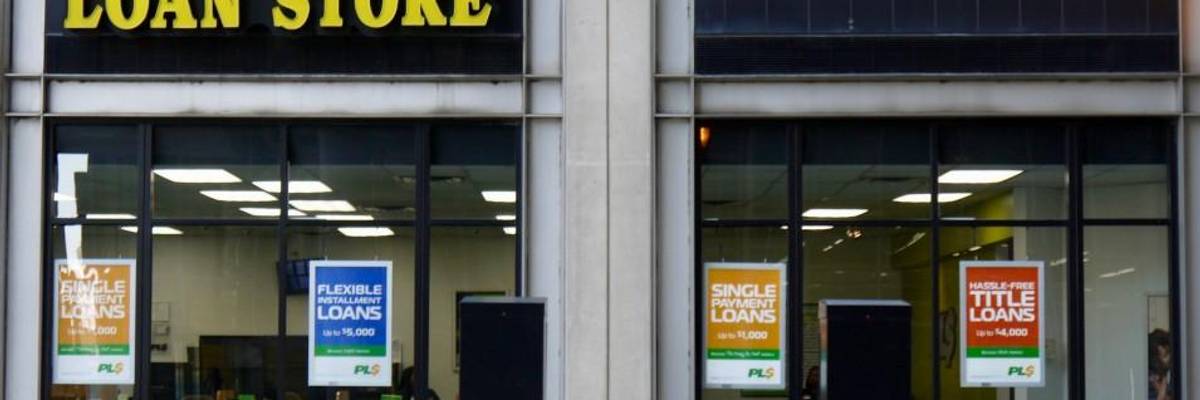
Exterior view of a Payday Loan Store in downtown Chicago, Illinois in 2019. (Photo: Interim Archives/Getty Images)
'Outrageous': Bipartisan Group of Lawmakers Wants to Let Payday Lenders Obtain Small Business Loans
"Payday lenders exploit millions of working families through predatory practices. Congress shouldn't prop them up during this crisis."
A bipartisan group of House lawmakers is pressing the Trump administration to make coronavirus relief loans meant for small businesses available to payday lenders, the financial institutions notorious for preying on desperate borrowers with deceptive advertising and exorbitant interest rates.
In a letter last week to Treasury Secretary Steve Mnuchin and Small Business Administration chief Jovita Carranza, 24 Republicans and four Democrats said "small-size nonbanks" should be eligible for first come, first served Paycheck Protection Program (PPP) loans designed for companies with fewer than 500 employees.
"The companies now asking for government help are the same ones that ruthlessly pursue borrowers when they can't pay their debts."
--Amanda Fischer, Washington Center for Equitable Growth
Politico reported that while "payday lenders weren't explicitly mentioned" in the letter, "a spokesperson for Rep. Blaine Luetkemeyer (R-Mo.), one of the lawmakers who led the letter, confirmed the intent was to include them in the request."
"These businesses have been shut out completely from the PPP, which has forced many of them to lay off their highly trained employees who would have preferred to keep their jobs than seek government unemployment assistance," the lawmakers wrote.
In addition to the two dozen Republicans, the letter was signed by Reps. Henry Cuellar (D-Texas), Collin Peterson (D-Minn.), Alcee Hastings (D-Fla.), and Al Lawson (D-Fla.).
"This is fucking outrageous," Maurice BP-Weeks, co-director of the Action Center on Race and the Economy, tweeted of the letter.
Amanda Fischer, policy director at the Washington Center for Equitable Growth, told Politico that providing small business loans to payday lenders would "supercharge inequality for the low-wage workers suffering the most from this recession."
"The companies now asking for government help are the same ones that ruthlessly pursue borrowers when they can't pay their debts," said Fischer. "Families need better unemployment insurance, additional direct payments, and forbearance on mortgage and rent--not taxpayer-financed predatory loans."
In a tweet last Friday, Fischer suggested sarcastically, "How about we give payday lenders small business loans, but we charge 480% in interest and can garnish their profits for repayment?"
The lawmakers' push to make payday lenders eligible for PPP loans came as millions of small businesses are struggling to apply for and obtain funds from the program.
On Friday, President Donald Trump signed into law a relief package that included $310 billion in additional funding for the PPP, which quickly ran out of money after millions of companies--including many large publicly traded firms--rushed to take part in the program.
Sen. Kirsten Gillibrand (D-N.Y.) expressed opposition to providing relief to payday lenders in a tweet on Sunday.
"Payday lenders exploit millions of working families through predatory practices," said Gillibrand. "Congress shouldn't prop them up during this crisis."
We are at a crossroads
This country and this world are at a monumental crossroads. In a few short weeks, US voters will have an opportunity to beat back the forces of fascism and confront the billionaires who are rigging the economy, our media system, and our democracy, making it increasingly impossible for ordinary people to get by. We’re not just talking about the election. We’re talking about what must be done once these fascist elements are vanquished from power. We need a bolder set of solutions than what either major party has so far been willing to offer and a working-class movement ready to fight like hell for it. Trump didn't emerge from nowhere. The conditions that fueled MAGA authoritarianism were created by decades of radical neoliberal economic policies and a corrupt political system dominated by corporate interests. They slashed taxes on the super-rich, promising that the benefits would trickle down. They said giveaways to the corporate titans would make life more affordable for the rest of us. It was all bullshit. And when a bitter, betrayed populace searches for someone to blame, right-wing demagogues have little trouble finding scapegoats. People know when they're being lied to, but you won't hear any of this from the corporate media. Only independent journalism—powered and funded by people who believe in building a better world—can deliver truly trustworthy daily news. Our Fall Campaign is underway, and we need your help. To power our newsroom through the rest of the year, we need to raise $125,000 by midnight on October 31. So if you share our vision, please contribute whatever you can to sustain our work. |
A bipartisan group of House lawmakers is pressing the Trump administration to make coronavirus relief loans meant for small businesses available to payday lenders, the financial institutions notorious for preying on desperate borrowers with deceptive advertising and exorbitant interest rates.
In a letter last week to Treasury Secretary Steve Mnuchin and Small Business Administration chief Jovita Carranza, 24 Republicans and four Democrats said "small-size nonbanks" should be eligible for first come, first served Paycheck Protection Program (PPP) loans designed for companies with fewer than 500 employees.
"The companies now asking for government help are the same ones that ruthlessly pursue borrowers when they can't pay their debts."
--Amanda Fischer, Washington Center for Equitable Growth
Politico reported that while "payday lenders weren't explicitly mentioned" in the letter, "a spokesperson for Rep. Blaine Luetkemeyer (R-Mo.), one of the lawmakers who led the letter, confirmed the intent was to include them in the request."
"These businesses have been shut out completely from the PPP, which has forced many of them to lay off their highly trained employees who would have preferred to keep their jobs than seek government unemployment assistance," the lawmakers wrote.
In addition to the two dozen Republicans, the letter was signed by Reps. Henry Cuellar (D-Texas), Collin Peterson (D-Minn.), Alcee Hastings (D-Fla.), and Al Lawson (D-Fla.).
"This is fucking outrageous," Maurice BP-Weeks, co-director of the Action Center on Race and the Economy, tweeted of the letter.
Amanda Fischer, policy director at the Washington Center for Equitable Growth, told Politico that providing small business loans to payday lenders would "supercharge inequality for the low-wage workers suffering the most from this recession."
"The companies now asking for government help are the same ones that ruthlessly pursue borrowers when they can't pay their debts," said Fischer. "Families need better unemployment insurance, additional direct payments, and forbearance on mortgage and rent--not taxpayer-financed predatory loans."
In a tweet last Friday, Fischer suggested sarcastically, "How about we give payday lenders small business loans, but we charge 480% in interest and can garnish their profits for repayment?"
The lawmakers' push to make payday lenders eligible for PPP loans came as millions of small businesses are struggling to apply for and obtain funds from the program.
On Friday, President Donald Trump signed into law a relief package that included $310 billion in additional funding for the PPP, which quickly ran out of money after millions of companies--including many large publicly traded firms--rushed to take part in the program.
Sen. Kirsten Gillibrand (D-N.Y.) expressed opposition to providing relief to payday lenders in a tweet on Sunday.
"Payday lenders exploit millions of working families through predatory practices," said Gillibrand. "Congress shouldn't prop them up during this crisis."
A bipartisan group of House lawmakers is pressing the Trump administration to make coronavirus relief loans meant for small businesses available to payday lenders, the financial institutions notorious for preying on desperate borrowers with deceptive advertising and exorbitant interest rates.
In a letter last week to Treasury Secretary Steve Mnuchin and Small Business Administration chief Jovita Carranza, 24 Republicans and four Democrats said "small-size nonbanks" should be eligible for first come, first served Paycheck Protection Program (PPP) loans designed for companies with fewer than 500 employees.
"The companies now asking for government help are the same ones that ruthlessly pursue borrowers when they can't pay their debts."
--Amanda Fischer, Washington Center for Equitable Growth
Politico reported that while "payday lenders weren't explicitly mentioned" in the letter, "a spokesperson for Rep. Blaine Luetkemeyer (R-Mo.), one of the lawmakers who led the letter, confirmed the intent was to include them in the request."
"These businesses have been shut out completely from the PPP, which has forced many of them to lay off their highly trained employees who would have preferred to keep their jobs than seek government unemployment assistance," the lawmakers wrote.
In addition to the two dozen Republicans, the letter was signed by Reps. Henry Cuellar (D-Texas), Collin Peterson (D-Minn.), Alcee Hastings (D-Fla.), and Al Lawson (D-Fla.).
"This is fucking outrageous," Maurice BP-Weeks, co-director of the Action Center on Race and the Economy, tweeted of the letter.
Amanda Fischer, policy director at the Washington Center for Equitable Growth, told Politico that providing small business loans to payday lenders would "supercharge inequality for the low-wage workers suffering the most from this recession."
"The companies now asking for government help are the same ones that ruthlessly pursue borrowers when they can't pay their debts," said Fischer. "Families need better unemployment insurance, additional direct payments, and forbearance on mortgage and rent--not taxpayer-financed predatory loans."
In a tweet last Friday, Fischer suggested sarcastically, "How about we give payday lenders small business loans, but we charge 480% in interest and can garnish their profits for repayment?"
The lawmakers' push to make payday lenders eligible for PPP loans came as millions of small businesses are struggling to apply for and obtain funds from the program.
On Friday, President Donald Trump signed into law a relief package that included $310 billion in additional funding for the PPP, which quickly ran out of money after millions of companies--including many large publicly traded firms--rushed to take part in the program.
Sen. Kirsten Gillibrand (D-N.Y.) expressed opposition to providing relief to payday lenders in a tweet on Sunday.
"Payday lenders exploit millions of working families through predatory practices," said Gillibrand. "Congress shouldn't prop them up during this crisis."