SUBSCRIBE TO OUR FREE NEWSLETTER
Daily news & progressive opinion—funded by the people, not the corporations—delivered straight to your inbox.
5
#000000
#FFFFFF
To donate by check, phone, or other method, see our More Ways to Give page.
Daily news & progressive opinion—funded by the people, not the corporations—delivered straight to your inbox.
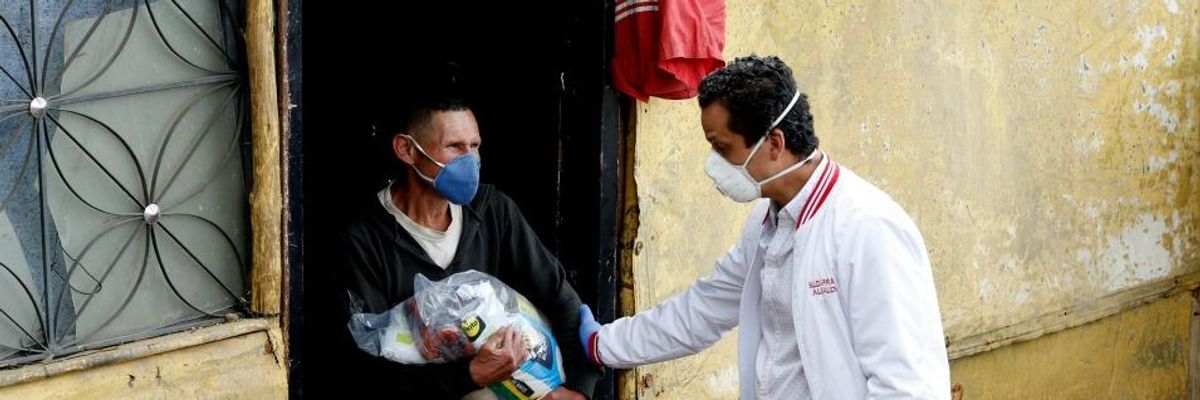
Soacha's Mayor Juan Carlos Saldarriaga, delivers food to the community during the mandatory quarantine to prevent the spread of the new coronavirus in Soacha, Colombia on April 15, 2020. Colombia extended its national lock down until April 26 to control spread of COVID-19. (Photo: Leonardo Munoz/VIEWpress via Getty Images)
Top food security experts at the United Nations on Tuesday will present to the U.N. Security Council a new report on how the global coronavirus pandemic could double the number of people around the world suffering from acute hunger unless wealthy countries step up humanitarian aid immediately.
The World Food Program (WFP), the U.N. Food and Agriculture Organization (FAO), and a dozen other groups are imploring global policymakers to send $350 million in food aid to the most vulnerable countries on the planet, particularly in the Middle East and Africa, to keep people from starving as the pandemic shuts down economies and makes it more difficult to access food.
"Our utmost responsibility is to protect those who need us the most," tweeted the WFP ahead of the meeting.
According to the "Global Report on Food Crises," (pdf) published Tuesday, 265 million people are expected to face food insecurity and hunger by the end of 2020--more than doubling the number from the previous year, when 130 million people worldwide were already chronically hungry.
"It's critical that commercial trade continues to flow. Hoarding food supplies or putting up trade barriers does not work. Starving your neighbor is not good policy."
--Arif Husain, WFP
The new coronavirus, which causes the disease COVID-19, was added to the report's list of key drivers of hunger, along with violent conflicts, weather extremes, economic shocks, and desert locusts--which were already threatening crops in East Africa before the pandemic began spreading across the globe in January, putting at risk enough food to feed 35,000 people per day.
Arif Husain, chief economist for WFP, told reporters Tuesday that people in regions that were already experiencing such shocks, as well as displaced people living in refugee camps in countries like South Sudan, Nigeria, Yemen, and Syria, are among those most at risk for starvation.
"These are the people I'm most worried about," said Husain. "They did not need COVID-19. Even without it their lives were hanging by a thread. They literally depend on us for their lives. If we cannot get to them for any reason they end up paying the ultimate price. We need to prioritize the people and make sure we're there. Because if it's not us, it's no one else."
To protect vulnerable populations, the WFP is expected to tell the Security Council, governments must avoid export bans and should begin releasing hundreds of millions of dollars in aid, only a quarter of which has been made available so far.
In recent weeks, countries including Russia, Ukraine, and Kazakhstan have suspended exports on certain crops, raising concerns over high food prices in the developing world--and evoking memories of unrest in 2007 and 2008 during the global economic meltdown.
"It's critical that commercial trade continues to flow," Husain said. "Hoarding food supplies or putting up trade barriers does not work. Starving your neighbor is not good policy. We have seen this many times in the food and fuel crisis in 2008 and the financial crisis of 2009."
In addition to limits on exports, people in developing countries face restricted movement which will make harvesting and distributing crops difficult if not impossible and labor shortages as people become ill, which could threaten food production.
The effects of the pandemic, Husain said, amount to a "hammer blow" for millions of people "who can only eat if they earn a wage."
"We all need to come together to deal with this because if we don't the cost will be too high--the global cost will be too high: many lost lives and many, many more lost livelihoods," Husain told the press.
Dear Common Dreams reader, It’s been nearly 30 years since I co-founded Common Dreams with my late wife, Lina Newhouser. We had the radical notion that journalism should serve the public good, not corporate profits. It was clear to us from the outset what it would take to build such a project. No paid advertisements. No corporate sponsors. No millionaire publisher telling us what to think or do. Many people said we wouldn't last a year, but we proved those doubters wrong. Together with a tremendous team of journalists and dedicated staff, we built an independent media outlet free from the constraints of profits and corporate control. Our mission has always been simple: To inform. To inspire. To ignite change for the common good. Building Common Dreams was not easy. Our survival was never guaranteed. When you take on the most powerful forces—Wall Street greed, fossil fuel industry destruction, Big Tech lobbyists, and uber-rich oligarchs who have spent billions upon billions rigging the economy and democracy in their favor—the only bulwark you have is supporters who believe in your work. But here’s the urgent message from me today. It's never been this bad out there. And it's never been this hard to keep us going. At the very moment Common Dreams is most needed, the threats we face are intensifying. We need your support now more than ever. We don't accept corporate advertising and never will. We don't have a paywall because we don't think people should be blocked from critical news based on their ability to pay. Everything we do is funded by the donations of readers like you. When everyone does the little they can afford, we are strong. But if that support retreats or dries up, so do we. Will you donate now to make sure Common Dreams not only survives but thrives? —Craig Brown, Co-founder |
Top food security experts at the United Nations on Tuesday will present to the U.N. Security Council a new report on how the global coronavirus pandemic could double the number of people around the world suffering from acute hunger unless wealthy countries step up humanitarian aid immediately.
The World Food Program (WFP), the U.N. Food and Agriculture Organization (FAO), and a dozen other groups are imploring global policymakers to send $350 million in food aid to the most vulnerable countries on the planet, particularly in the Middle East and Africa, to keep people from starving as the pandemic shuts down economies and makes it more difficult to access food.
"Our utmost responsibility is to protect those who need us the most," tweeted the WFP ahead of the meeting.
According to the "Global Report on Food Crises," (pdf) published Tuesday, 265 million people are expected to face food insecurity and hunger by the end of 2020--more than doubling the number from the previous year, when 130 million people worldwide were already chronically hungry.
"It's critical that commercial trade continues to flow. Hoarding food supplies or putting up trade barriers does not work. Starving your neighbor is not good policy."
--Arif Husain, WFP
The new coronavirus, which causes the disease COVID-19, was added to the report's list of key drivers of hunger, along with violent conflicts, weather extremes, economic shocks, and desert locusts--which were already threatening crops in East Africa before the pandemic began spreading across the globe in January, putting at risk enough food to feed 35,000 people per day.
Arif Husain, chief economist for WFP, told reporters Tuesday that people in regions that were already experiencing such shocks, as well as displaced people living in refugee camps in countries like South Sudan, Nigeria, Yemen, and Syria, are among those most at risk for starvation.
"These are the people I'm most worried about," said Husain. "They did not need COVID-19. Even without it their lives were hanging by a thread. They literally depend on us for their lives. If we cannot get to them for any reason they end up paying the ultimate price. We need to prioritize the people and make sure we're there. Because if it's not us, it's no one else."
To protect vulnerable populations, the WFP is expected to tell the Security Council, governments must avoid export bans and should begin releasing hundreds of millions of dollars in aid, only a quarter of which has been made available so far.
In recent weeks, countries including Russia, Ukraine, and Kazakhstan have suspended exports on certain crops, raising concerns over high food prices in the developing world--and evoking memories of unrest in 2007 and 2008 during the global economic meltdown.
"It's critical that commercial trade continues to flow," Husain said. "Hoarding food supplies or putting up trade barriers does not work. Starving your neighbor is not good policy. We have seen this many times in the food and fuel crisis in 2008 and the financial crisis of 2009."
In addition to limits on exports, people in developing countries face restricted movement which will make harvesting and distributing crops difficult if not impossible and labor shortages as people become ill, which could threaten food production.
The effects of the pandemic, Husain said, amount to a "hammer blow" for millions of people "who can only eat if they earn a wage."
"We all need to come together to deal with this because if we don't the cost will be too high--the global cost will be too high: many lost lives and many, many more lost livelihoods," Husain told the press.
Top food security experts at the United Nations on Tuesday will present to the U.N. Security Council a new report on how the global coronavirus pandemic could double the number of people around the world suffering from acute hunger unless wealthy countries step up humanitarian aid immediately.
The World Food Program (WFP), the U.N. Food and Agriculture Organization (FAO), and a dozen other groups are imploring global policymakers to send $350 million in food aid to the most vulnerable countries on the planet, particularly in the Middle East and Africa, to keep people from starving as the pandemic shuts down economies and makes it more difficult to access food.
"Our utmost responsibility is to protect those who need us the most," tweeted the WFP ahead of the meeting.
According to the "Global Report on Food Crises," (pdf) published Tuesday, 265 million people are expected to face food insecurity and hunger by the end of 2020--more than doubling the number from the previous year, when 130 million people worldwide were already chronically hungry.
"It's critical that commercial trade continues to flow. Hoarding food supplies or putting up trade barriers does not work. Starving your neighbor is not good policy."
--Arif Husain, WFP
The new coronavirus, which causes the disease COVID-19, was added to the report's list of key drivers of hunger, along with violent conflicts, weather extremes, economic shocks, and desert locusts--which were already threatening crops in East Africa before the pandemic began spreading across the globe in January, putting at risk enough food to feed 35,000 people per day.
Arif Husain, chief economist for WFP, told reporters Tuesday that people in regions that were already experiencing such shocks, as well as displaced people living in refugee camps in countries like South Sudan, Nigeria, Yemen, and Syria, are among those most at risk for starvation.
"These are the people I'm most worried about," said Husain. "They did not need COVID-19. Even without it their lives were hanging by a thread. They literally depend on us for their lives. If we cannot get to them for any reason they end up paying the ultimate price. We need to prioritize the people and make sure we're there. Because if it's not us, it's no one else."
To protect vulnerable populations, the WFP is expected to tell the Security Council, governments must avoid export bans and should begin releasing hundreds of millions of dollars in aid, only a quarter of which has been made available so far.
In recent weeks, countries including Russia, Ukraine, and Kazakhstan have suspended exports on certain crops, raising concerns over high food prices in the developing world--and evoking memories of unrest in 2007 and 2008 during the global economic meltdown.
"It's critical that commercial trade continues to flow," Husain said. "Hoarding food supplies or putting up trade barriers does not work. Starving your neighbor is not good policy. We have seen this many times in the food and fuel crisis in 2008 and the financial crisis of 2009."
In addition to limits on exports, people in developing countries face restricted movement which will make harvesting and distributing crops difficult if not impossible and labor shortages as people become ill, which could threaten food production.
The effects of the pandemic, Husain said, amount to a "hammer blow" for millions of people "who can only eat if they earn a wage."
"We all need to come together to deal with this because if we don't the cost will be too high--the global cost will be too high: many lost lives and many, many more lost livelihoods," Husain told the press.