

SUBSCRIBE TO OUR FREE NEWSLETTER
Daily news & progressive opinion—funded by the people, not the corporations—delivered straight to your inbox.
5
#000000
#FFFFFF
To donate by check, phone, or other method, see our More Ways to Give page.
Daily news & progressive opinion—funded by the people, not the corporations—delivered straight to your inbox.
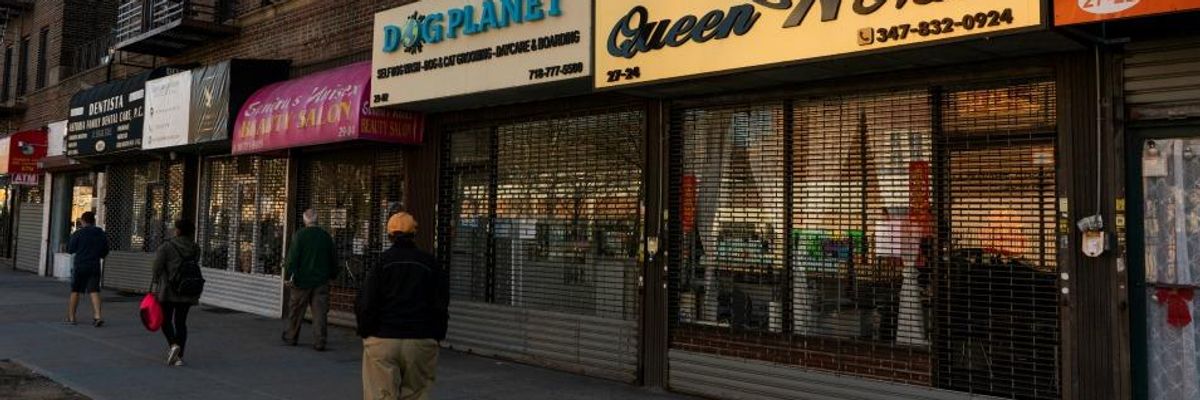
Pedestrians look at the numerous small businesses that are closed in March 2020 in New York City. (Photo: Erin Lefevre/NurPhoto via Getty Images)
Small businesses filed class-action lawsuits against three large banks Monday, accusing them of manipulating the application process for a government program aimed at providing relief for smaller companies amid the coronavirus crisis.
According to the lawsuits, which were filed in California against Bank of America, Wells Fargo, and JPMorgan Chase, the financial institutions allowed large public corporations to skip to the front of the line for benefits offered through the $349 billion Paycheck Protection Program (PPP).
Court filings showed that a bank identified as "Lender 1"--thought to be JPMorgan Chase, according to the New York Times--gave out loans averaging over $515,000. The average sum is "well above the needs of the average small business," the plaintiffs said.
"Public companies that have access to other sources of money should not be using this. Small businesses need this pot to survive."
--Charles Elson, University of Delaware
A recent report from the Small Business Administration (SBA), which began administering the PPP last month as the coronavirus pandemic forced millions of businesses across the country to shut down, many loans for $150,000 or less--likely going to small businesses--were processed three days after larger loans. The lawsuits allege the banks held off on processing small businesses loans and gave precedence to larger companies, in violation of the "first come, first served" system under which the PPP was meant to operate.
"With allegations that major banks shuffled Paycheck Protection Program applications to prioritize larger loan amounts and bigger businesses, Main Street businesses are furious," said small business advocacy group Main Street Alliance. "This possibility points to a clear design flaw in the program that tried to use the private lending market, already rife with discrimination and putting profits over all, as the mechanism for small business relief."
The lawsuits were filed as Congress was preparing to pass a new relief package including over $300 billion more for the PPP--an effort to replenish the fund several days after it ran out of money. The Senate passed the bill approving additional funds Tuesday afternoon.
Both the Associated Press and the Financial Times detailed the distribution of funds through the PPP in reports on Tuesday.
The AP found that companies with thousands of employees, many of which were risking financial failure long before the coronavirus pandemic spread across the U.S., were given loans through the PPP.
At least 75 companies that received loans were publicly traded, while eight companies received the maximum loan allowed of $10 million. More than 4,000 of the loans approved by the SBA were for at least $5 million.
According to the Financial Times, Hallador Energy, a coal company based in Indiana, was one of the companies that received $10 million--weeks after it laid off 60 workers.
"Public companies that have access to other sources of money should not be using this," Charles Elson, a corporate governance expert at the University of Delaware, told the Financial Times. "Small businesses need this pot to survive."
Former Obama administration official Chris Lu tweeted that local businesses in his community have been unable to secure loans in recent days as large companies have monopolized the PPP's resources.
"This is why oversight is important. No matter when or who it hurts, big business and corporations will always try to cash in," tweeted J.D. Scholten, a Democratic congressional candidate in Iowa.
As Congress passed the new relief package promising more funding for small business loans, the Main Street Alliance said the federal government must consider grants for struggling companies.
"Small businesses are demanding that any new funding must come directly to them via subsidies, not loans, and it must prioritize those who were left out," the group said.
Dear Common Dreams reader, It’s been nearly 30 years since I co-founded Common Dreams with my late wife, Lina Newhouser. We had the radical notion that journalism should serve the public good, not corporate profits. It was clear to us from the outset what it would take to build such a project. No paid advertisements. No corporate sponsors. No millionaire publisher telling us what to think or do. Many people said we wouldn't last a year, but we proved those doubters wrong. Together with a tremendous team of journalists and dedicated staff, we built an independent media outlet free from the constraints of profits and corporate control. Our mission has always been simple: To inform. To inspire. To ignite change for the common good. Building Common Dreams was not easy. Our survival was never guaranteed. When you take on the most powerful forces—Wall Street greed, fossil fuel industry destruction, Big Tech lobbyists, and uber-rich oligarchs who have spent billions upon billions rigging the economy and democracy in their favor—the only bulwark you have is supporters who believe in your work. But here’s the urgent message from me today. It's never been this bad out there. And it's never been this hard to keep us going. At the very moment Common Dreams is most needed, the threats we face are intensifying. We need your support now more than ever. We don't accept corporate advertising and never will. We don't have a paywall because we don't think people should be blocked from critical news based on their ability to pay. Everything we do is funded by the donations of readers like you. When everyone does the little they can afford, we are strong. But if that support retreats or dries up, so do we. Will you donate now to make sure Common Dreams not only survives but thrives? —Craig Brown, Co-founder |
Small businesses filed class-action lawsuits against three large banks Monday, accusing them of manipulating the application process for a government program aimed at providing relief for smaller companies amid the coronavirus crisis.
According to the lawsuits, which were filed in California against Bank of America, Wells Fargo, and JPMorgan Chase, the financial institutions allowed large public corporations to skip to the front of the line for benefits offered through the $349 billion Paycheck Protection Program (PPP).
Court filings showed that a bank identified as "Lender 1"--thought to be JPMorgan Chase, according to the New York Times--gave out loans averaging over $515,000. The average sum is "well above the needs of the average small business," the plaintiffs said.
"Public companies that have access to other sources of money should not be using this. Small businesses need this pot to survive."
--Charles Elson, University of Delaware
A recent report from the Small Business Administration (SBA), which began administering the PPP last month as the coronavirus pandemic forced millions of businesses across the country to shut down, many loans for $150,000 or less--likely going to small businesses--were processed three days after larger loans. The lawsuits allege the banks held off on processing small businesses loans and gave precedence to larger companies, in violation of the "first come, first served" system under which the PPP was meant to operate.
"With allegations that major banks shuffled Paycheck Protection Program applications to prioritize larger loan amounts and bigger businesses, Main Street businesses are furious," said small business advocacy group Main Street Alliance. "This possibility points to a clear design flaw in the program that tried to use the private lending market, already rife with discrimination and putting profits over all, as the mechanism for small business relief."
The lawsuits were filed as Congress was preparing to pass a new relief package including over $300 billion more for the PPP--an effort to replenish the fund several days after it ran out of money. The Senate passed the bill approving additional funds Tuesday afternoon.
Both the Associated Press and the Financial Times detailed the distribution of funds through the PPP in reports on Tuesday.
The AP found that companies with thousands of employees, many of which were risking financial failure long before the coronavirus pandemic spread across the U.S., were given loans through the PPP.
At least 75 companies that received loans were publicly traded, while eight companies received the maximum loan allowed of $10 million. More than 4,000 of the loans approved by the SBA were for at least $5 million.
According to the Financial Times, Hallador Energy, a coal company based in Indiana, was one of the companies that received $10 million--weeks after it laid off 60 workers.
"Public companies that have access to other sources of money should not be using this," Charles Elson, a corporate governance expert at the University of Delaware, told the Financial Times. "Small businesses need this pot to survive."
Former Obama administration official Chris Lu tweeted that local businesses in his community have been unable to secure loans in recent days as large companies have monopolized the PPP's resources.
"This is why oversight is important. No matter when or who it hurts, big business and corporations will always try to cash in," tweeted J.D. Scholten, a Democratic congressional candidate in Iowa.
As Congress passed the new relief package promising more funding for small business loans, the Main Street Alliance said the federal government must consider grants for struggling companies.
"Small businesses are demanding that any new funding must come directly to them via subsidies, not loans, and it must prioritize those who were left out," the group said.
Small businesses filed class-action lawsuits against three large banks Monday, accusing them of manipulating the application process for a government program aimed at providing relief for smaller companies amid the coronavirus crisis.
According to the lawsuits, which were filed in California against Bank of America, Wells Fargo, and JPMorgan Chase, the financial institutions allowed large public corporations to skip to the front of the line for benefits offered through the $349 billion Paycheck Protection Program (PPP).
Court filings showed that a bank identified as "Lender 1"--thought to be JPMorgan Chase, according to the New York Times--gave out loans averaging over $515,000. The average sum is "well above the needs of the average small business," the plaintiffs said.
"Public companies that have access to other sources of money should not be using this. Small businesses need this pot to survive."
--Charles Elson, University of Delaware
A recent report from the Small Business Administration (SBA), which began administering the PPP last month as the coronavirus pandemic forced millions of businesses across the country to shut down, many loans for $150,000 or less--likely going to small businesses--were processed three days after larger loans. The lawsuits allege the banks held off on processing small businesses loans and gave precedence to larger companies, in violation of the "first come, first served" system under which the PPP was meant to operate.
"With allegations that major banks shuffled Paycheck Protection Program applications to prioritize larger loan amounts and bigger businesses, Main Street businesses are furious," said small business advocacy group Main Street Alliance. "This possibility points to a clear design flaw in the program that tried to use the private lending market, already rife with discrimination and putting profits over all, as the mechanism for small business relief."
The lawsuits were filed as Congress was preparing to pass a new relief package including over $300 billion more for the PPP--an effort to replenish the fund several days after it ran out of money. The Senate passed the bill approving additional funds Tuesday afternoon.
Both the Associated Press and the Financial Times detailed the distribution of funds through the PPP in reports on Tuesday.
The AP found that companies with thousands of employees, many of which were risking financial failure long before the coronavirus pandemic spread across the U.S., were given loans through the PPP.
At least 75 companies that received loans were publicly traded, while eight companies received the maximum loan allowed of $10 million. More than 4,000 of the loans approved by the SBA were for at least $5 million.
According to the Financial Times, Hallador Energy, a coal company based in Indiana, was one of the companies that received $10 million--weeks after it laid off 60 workers.
"Public companies that have access to other sources of money should not be using this," Charles Elson, a corporate governance expert at the University of Delaware, told the Financial Times. "Small businesses need this pot to survive."
Former Obama administration official Chris Lu tweeted that local businesses in his community have been unable to secure loans in recent days as large companies have monopolized the PPP's resources.
"This is why oversight is important. No matter when or who it hurts, big business and corporations will always try to cash in," tweeted J.D. Scholten, a Democratic congressional candidate in Iowa.
As Congress passed the new relief package promising more funding for small business loans, the Main Street Alliance said the federal government must consider grants for struggling companies.
"Small businesses are demanding that any new funding must come directly to them via subsidies, not loans, and it must prioritize those who were left out," the group said.

