SUBSCRIBE TO OUR FREE NEWSLETTER
Daily news & progressive opinion—funded by the people, not the corporations—delivered straight to your inbox.
5
#000000
#FFFFFF
To donate by check, phone, or other method, see our More Ways to Give page.
Daily news & progressive opinion—funded by the people, not the corporations—delivered straight to your inbox.

Dr. Anthony Fauci on Sunday told Margaret Brennan on "Face the Nation" that scientific evidence does not support President Donald Trump's repeated claim that hydroxychloroquine can prevent the coronavirus. (Photo: Alliance for Health Policy/Flickr/cc)
The nation's top expert on infectious diseases was forced once again on Sunday to negate President Donald Trump's latest claim that an anti-malaria drug can treat coronavirus, which the president made at his Saturday evening press conference.
On CBS's "Face the Nation," National Institute of Allergy and Infectious Diseases (NIAID) director Dr. Anthony Fauci told host Margaret Brennan that "in terms of science, I don't think we could definitively say it works," regarding the use of hydroxychloroquine for the virus.
"As I've said many times, Margaret, the data are really just at best suggestive," Fauci said. "There have been cases that show there may be an effect and there are others to show there's no effect."
At his press briefing the previous evening, Trump said the federal government is adding millions of doses of hydroxychloroquine to the Strategic National Stockpile (SNS), which states have desperately been attempting to draw from in order to obtain supplies recommended by medical experts, including ventilators and personal protective equipment (PPE) for healthcare providers.
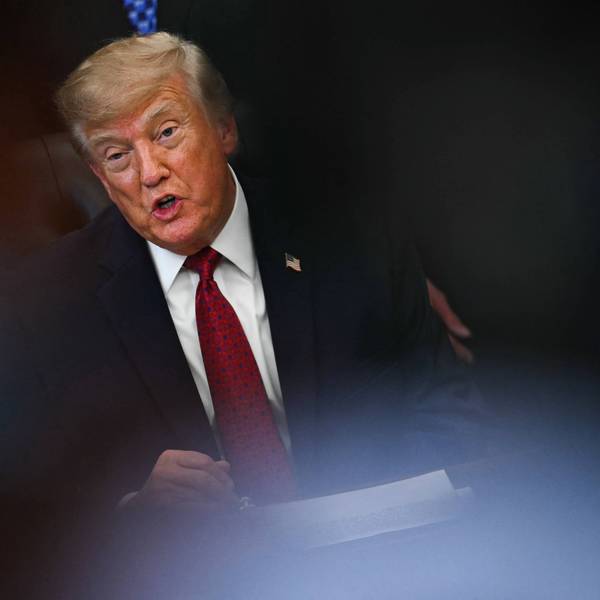
"What do you have to lose? Take it," Trump said of the drug. "I really think they should take it. But it's their choice. And it's their doctor's choice or the doctors in the hospital. But hydroxychloroquine. Try it, if you'd like."
As Common Dreams reported last month, three people in Nigeria were hospitalized after overdosing on the drug following Trump's earlier claims about hydroxychloroquine. A man in Arizona died after ingesting chloroquine phosphate, after his wife cited the president's televised briefings as evidence that it could prevent the coronavirus, officially called COVID-19.
"'What do you have to lose?'" Rep. Ilhan Omar (D-Minn.) tweeted after Trump's briefing. "They can lose their life, you imbecile."
Critics on social media warned others against heeding the president's advice.
Some laboratory studies of a small number of cases have suggested hydroxychloroquine could stop the coronavirus from invading cells, and according to the New York Times, "some researchers think its ability to dial back an overactive immune system--the reason it is used for autoimmune diseases--might help relieve the life-threatening inflammation that develops in some coronavirus patients."
But researchers say far more evidence is needed for the Food and Drug Administration (FDA) to approve the drug for anti-coronavirus use.
Dear Common Dreams reader, It’s been nearly 30 years since I co-founded Common Dreams with my late wife, Lina Newhouser. We had the radical notion that journalism should serve the public good, not corporate profits. It was clear to us from the outset what it would take to build such a project. No paid advertisements. No corporate sponsors. No millionaire publisher telling us what to think or do. Many people said we wouldn't last a year, but we proved those doubters wrong. Together with a tremendous team of journalists and dedicated staff, we built an independent media outlet free from the constraints of profits and corporate control. Our mission has always been simple: To inform. To inspire. To ignite change for the common good. Building Common Dreams was not easy. Our survival was never guaranteed. When you take on the most powerful forces—Wall Street greed, fossil fuel industry destruction, Big Tech lobbyists, and uber-rich oligarchs who have spent billions upon billions rigging the economy and democracy in their favor—the only bulwark you have is supporters who believe in your work. But here’s the urgent message from me today. It's never been this bad out there. And it's never been this hard to keep us going. At the very moment Common Dreams is most needed, the threats we face are intensifying. We need your support now more than ever. We don't accept corporate advertising and never will. We don't have a paywall because we don't think people should be blocked from critical news based on their ability to pay. Everything we do is funded by the donations of readers like you. When everyone does the little they can afford, we are strong. But if that support retreats or dries up, so do we. Will you donate now to make sure Common Dreams not only survives but thrives? —Craig Brown, Co-founder |
The nation's top expert on infectious diseases was forced once again on Sunday to negate President Donald Trump's latest claim that an anti-malaria drug can treat coronavirus, which the president made at his Saturday evening press conference.
On CBS's "Face the Nation," National Institute of Allergy and Infectious Diseases (NIAID) director Dr. Anthony Fauci told host Margaret Brennan that "in terms of science, I don't think we could definitively say it works," regarding the use of hydroxychloroquine for the virus.
"As I've said many times, Margaret, the data are really just at best suggestive," Fauci said. "There have been cases that show there may be an effect and there are others to show there's no effect."
At his press briefing the previous evening, Trump said the federal government is adding millions of doses of hydroxychloroquine to the Strategic National Stockpile (SNS), which states have desperately been attempting to draw from in order to obtain supplies recommended by medical experts, including ventilators and personal protective equipment (PPE) for healthcare providers.
"What do you have to lose? Take it," Trump said of the drug. "I really think they should take it. But it's their choice. And it's their doctor's choice or the doctors in the hospital. But hydroxychloroquine. Try it, if you'd like."
As Common Dreams reported last month, three people in Nigeria were hospitalized after overdosing on the drug following Trump's earlier claims about hydroxychloroquine. A man in Arizona died after ingesting chloroquine phosphate, after his wife cited the president's televised briefings as evidence that it could prevent the coronavirus, officially called COVID-19.
"'What do you have to lose?'" Rep. Ilhan Omar (D-Minn.) tweeted after Trump's briefing. "They can lose their life, you imbecile."
Critics on social media warned others against heeding the president's advice.
Some laboratory studies of a small number of cases have suggested hydroxychloroquine could stop the coronavirus from invading cells, and according to the New York Times, "some researchers think its ability to dial back an overactive immune system--the reason it is used for autoimmune diseases--might help relieve the life-threatening inflammation that develops in some coronavirus patients."
But researchers say far more evidence is needed for the Food and Drug Administration (FDA) to approve the drug for anti-coronavirus use.
The nation's top expert on infectious diseases was forced once again on Sunday to negate President Donald Trump's latest claim that an anti-malaria drug can treat coronavirus, which the president made at his Saturday evening press conference.
On CBS's "Face the Nation," National Institute of Allergy and Infectious Diseases (NIAID) director Dr. Anthony Fauci told host Margaret Brennan that "in terms of science, I don't think we could definitively say it works," regarding the use of hydroxychloroquine for the virus.
"As I've said many times, Margaret, the data are really just at best suggestive," Fauci said. "There have been cases that show there may be an effect and there are others to show there's no effect."
At his press briefing the previous evening, Trump said the federal government is adding millions of doses of hydroxychloroquine to the Strategic National Stockpile (SNS), which states have desperately been attempting to draw from in order to obtain supplies recommended by medical experts, including ventilators and personal protective equipment (PPE) for healthcare providers.
"What do you have to lose? Take it," Trump said of the drug. "I really think they should take it. But it's their choice. And it's their doctor's choice or the doctors in the hospital. But hydroxychloroquine. Try it, if you'd like."
As Common Dreams reported last month, three people in Nigeria were hospitalized after overdosing on the drug following Trump's earlier claims about hydroxychloroquine. A man in Arizona died after ingesting chloroquine phosphate, after his wife cited the president's televised briefings as evidence that it could prevent the coronavirus, officially called COVID-19.
"'What do you have to lose?'" Rep. Ilhan Omar (D-Minn.) tweeted after Trump's briefing. "They can lose their life, you imbecile."
Critics on social media warned others against heeding the president's advice.
Some laboratory studies of a small number of cases have suggested hydroxychloroquine could stop the coronavirus from invading cells, and according to the New York Times, "some researchers think its ability to dial back an overactive immune system--the reason it is used for autoimmune diseases--might help relieve the life-threatening inflammation that develops in some coronavirus patients."
But researchers say far more evidence is needed for the Food and Drug Administration (FDA) to approve the drug for anti-coronavirus use.