

SUBSCRIBE TO OUR FREE NEWSLETTER
Daily news & progressive opinion—funded by the people, not the corporations—delivered straight to your inbox.
5
#000000
#FFFFFF
To donate by check, phone, or other method, see our More Ways to Give page.
Daily news & progressive opinion—funded by the people, not the corporations—delivered straight to your inbox.
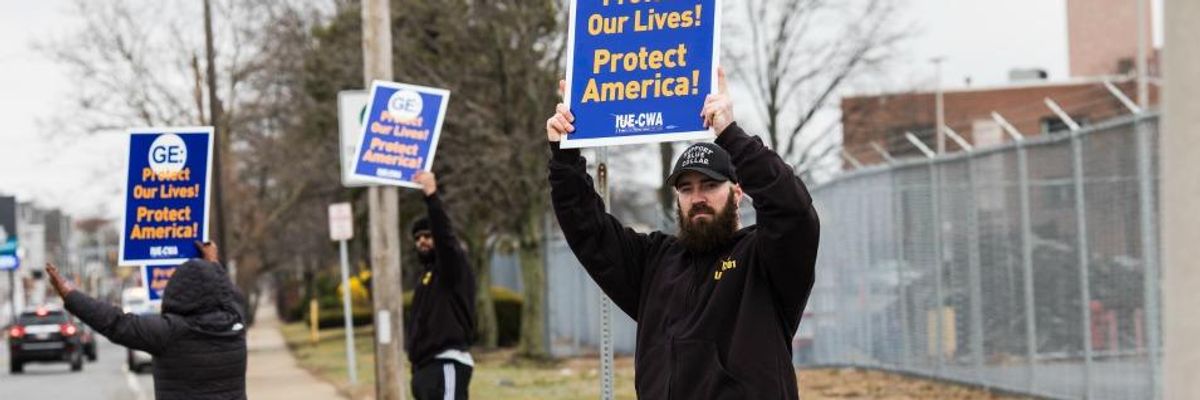
General Electric workers in Lynn, Massachusetts called on the company to allow them to build badly-needed ventilators rather than laying off thousands of employees. (Photo: IUE-CWA)
As strikes by delivery and grocery store employees on Monday signaled that the coronavirus pandemic is revitalizing the labor movement, workers at General Electric drew national attention to their company's desire to save money rather than keep its workforce employed and mitigate a public health crisis.
Workers at a jet engine factory in Lynn, Massachusetts stood six feet apart at a protest outside the facility, following social distancing guidelines while calling on General Electric (GE) to reverse its recent decision to lay off thousands of workers and instead put them to work building badly-needed ventilators for coronavirus patients. In nearby Boston, GE employees also marched six feet apart to their company's headquarters with the same demand.
The workers' show of solidarity with coronavirus patients and the healthcare providers desperately trying to save lives was applauded by labor advocates on social media.
GE announced last week it was laying off nearly 2,600 workers--10% of its domestic aviation workforce--as the coronavirus pandemic sharply reduced demand in the aviation industry. The layoffs would help GE save between $500 million and $1 billion, the company said, while GE Healthcare, one of the country's largest producers of ventilators, would step up its efforts to produce the supplies.
Sen. Bernie Sanders (I-Vt.) expressed solidarity with the workers and demanded GE end all "layoffs, outsourcing, and tax dodging" and instead invest its vast resources in serving the public, particularly during the national crisis.
With hospitals across the country reporting a shortage of ventilators and Dr. Anthony Fauci, director of the National Institute of Allergy and Infectious Diseases, warning that 100,000 to 200,000 Americans could die of the coronavirus, officially known as COVID-19, the GE workers demanded that their skills be put to good use and that the company use all its resources to alleviate the critical shortage.
"The crisis we face with the COVID-19 pandemic is unlike anything we have seen in our lifetimes. It requires us--all of us--to work for the common good and save lives," said Chris Shelton, president of Communications Workers of America (CWA), which represents GE workers. "But at a time when our country is depending on skilled workers to make essential products like ventilators, our members are left wondering why they are facing layoffs instead of having the opportunity to use their skills to help save lives. We challenge GE to partner with our members and the management of its own Aviation and Electronic Lighting divisions to convert some of its unused capacity to alleviate our critical national shortage of life-saving ventilators."
The GE protest demonstrates, one public school teacher tweeted, that Americans must look to workers, not billionaires, "to save us."
"Companies don't give a shit about us. The workers do," wrote comedian Hari Kondabolu.
Combined with demands for paid sick leave from Amazon and Whole Foods employees; for better safety precautions by Instacart delivery workers and Pittsburgh sanitation workers; and a number of other protests at workplaces across the country in recent weeks, brought on by the COVID-19 pandemic, the GE workers may be an integral part of a new era for the U.S. labor rights movement, wrote legal scholar Tiffany C. Li.
"This is how movements begin," Li wrote.
Dear Common Dreams reader, It’s been nearly 30 years since I co-founded Common Dreams with my late wife, Lina Newhouser. We had the radical notion that journalism should serve the public good, not corporate profits. It was clear to us from the outset what it would take to build such a project. No paid advertisements. No corporate sponsors. No millionaire publisher telling us what to think or do. Many people said we wouldn't last a year, but we proved those doubters wrong. Together with a tremendous team of journalists and dedicated staff, we built an independent media outlet free from the constraints of profits and corporate control. Our mission has always been simple: To inform. To inspire. To ignite change for the common good. Building Common Dreams was not easy. Our survival was never guaranteed. When you take on the most powerful forces—Wall Street greed, fossil fuel industry destruction, Big Tech lobbyists, and uber-rich oligarchs who have spent billions upon billions rigging the economy and democracy in their favor—the only bulwark you have is supporters who believe in your work. But here’s the urgent message from me today. It's never been this bad out there. And it's never been this hard to keep us going. At the very moment Common Dreams is most needed, the threats we face are intensifying. We need your support now more than ever. We don't accept corporate advertising and never will. We don't have a paywall because we don't think people should be blocked from critical news based on their ability to pay. Everything we do is funded by the donations of readers like you. When everyone does the little they can afford, we are strong. But if that support retreats or dries up, so do we. Will you donate now to make sure Common Dreams not only survives but thrives? —Craig Brown, Co-founder |
As strikes by delivery and grocery store employees on Monday signaled that the coronavirus pandemic is revitalizing the labor movement, workers at General Electric drew national attention to their company's desire to save money rather than keep its workforce employed and mitigate a public health crisis.
Workers at a jet engine factory in Lynn, Massachusetts stood six feet apart at a protest outside the facility, following social distancing guidelines while calling on General Electric (GE) to reverse its recent decision to lay off thousands of workers and instead put them to work building badly-needed ventilators for coronavirus patients. In nearby Boston, GE employees also marched six feet apart to their company's headquarters with the same demand.
The workers' show of solidarity with coronavirus patients and the healthcare providers desperately trying to save lives was applauded by labor advocates on social media.
GE announced last week it was laying off nearly 2,600 workers--10% of its domestic aviation workforce--as the coronavirus pandemic sharply reduced demand in the aviation industry. The layoffs would help GE save between $500 million and $1 billion, the company said, while GE Healthcare, one of the country's largest producers of ventilators, would step up its efforts to produce the supplies.
Sen. Bernie Sanders (I-Vt.) expressed solidarity with the workers and demanded GE end all "layoffs, outsourcing, and tax dodging" and instead invest its vast resources in serving the public, particularly during the national crisis.
With hospitals across the country reporting a shortage of ventilators and Dr. Anthony Fauci, director of the National Institute of Allergy and Infectious Diseases, warning that 100,000 to 200,000 Americans could die of the coronavirus, officially known as COVID-19, the GE workers demanded that their skills be put to good use and that the company use all its resources to alleviate the critical shortage.
"The crisis we face with the COVID-19 pandemic is unlike anything we have seen in our lifetimes. It requires us--all of us--to work for the common good and save lives," said Chris Shelton, president of Communications Workers of America (CWA), which represents GE workers. "But at a time when our country is depending on skilled workers to make essential products like ventilators, our members are left wondering why they are facing layoffs instead of having the opportunity to use their skills to help save lives. We challenge GE to partner with our members and the management of its own Aviation and Electronic Lighting divisions to convert some of its unused capacity to alleviate our critical national shortage of life-saving ventilators."
The GE protest demonstrates, one public school teacher tweeted, that Americans must look to workers, not billionaires, "to save us."
"Companies don't give a shit about us. The workers do," wrote comedian Hari Kondabolu.
Combined with demands for paid sick leave from Amazon and Whole Foods employees; for better safety precautions by Instacart delivery workers and Pittsburgh sanitation workers; and a number of other protests at workplaces across the country in recent weeks, brought on by the COVID-19 pandemic, the GE workers may be an integral part of a new era for the U.S. labor rights movement, wrote legal scholar Tiffany C. Li.
"This is how movements begin," Li wrote.
As strikes by delivery and grocery store employees on Monday signaled that the coronavirus pandemic is revitalizing the labor movement, workers at General Electric drew national attention to their company's desire to save money rather than keep its workforce employed and mitigate a public health crisis.
Workers at a jet engine factory in Lynn, Massachusetts stood six feet apart at a protest outside the facility, following social distancing guidelines while calling on General Electric (GE) to reverse its recent decision to lay off thousands of workers and instead put them to work building badly-needed ventilators for coronavirus patients. In nearby Boston, GE employees also marched six feet apart to their company's headquarters with the same demand.
The workers' show of solidarity with coronavirus patients and the healthcare providers desperately trying to save lives was applauded by labor advocates on social media.
GE announced last week it was laying off nearly 2,600 workers--10% of its domestic aviation workforce--as the coronavirus pandemic sharply reduced demand in the aviation industry. The layoffs would help GE save between $500 million and $1 billion, the company said, while GE Healthcare, one of the country's largest producers of ventilators, would step up its efforts to produce the supplies.
Sen. Bernie Sanders (I-Vt.) expressed solidarity with the workers and demanded GE end all "layoffs, outsourcing, and tax dodging" and instead invest its vast resources in serving the public, particularly during the national crisis.
With hospitals across the country reporting a shortage of ventilators and Dr. Anthony Fauci, director of the National Institute of Allergy and Infectious Diseases, warning that 100,000 to 200,000 Americans could die of the coronavirus, officially known as COVID-19, the GE workers demanded that their skills be put to good use and that the company use all its resources to alleviate the critical shortage.
"The crisis we face with the COVID-19 pandemic is unlike anything we have seen in our lifetimes. It requires us--all of us--to work for the common good and save lives," said Chris Shelton, president of Communications Workers of America (CWA), which represents GE workers. "But at a time when our country is depending on skilled workers to make essential products like ventilators, our members are left wondering why they are facing layoffs instead of having the opportunity to use their skills to help save lives. We challenge GE to partner with our members and the management of its own Aviation and Electronic Lighting divisions to convert some of its unused capacity to alleviate our critical national shortage of life-saving ventilators."
The GE protest demonstrates, one public school teacher tweeted, that Americans must look to workers, not billionaires, "to save us."
"Companies don't give a shit about us. The workers do," wrote comedian Hari Kondabolu.
Combined with demands for paid sick leave from Amazon and Whole Foods employees; for better safety precautions by Instacart delivery workers and Pittsburgh sanitation workers; and a number of other protests at workplaces across the country in recent weeks, brought on by the COVID-19 pandemic, the GE workers may be an integral part of a new era for the U.S. labor rights movement, wrote legal scholar Tiffany C. Li.
"This is how movements begin," Li wrote.

