

SUBSCRIBE TO OUR FREE NEWSLETTER
Daily news & progressive opinion—funded by the people, not the corporations—delivered straight to your inbox.
5
#000000
#FFFFFF
To donate by check, phone, or other method, see our More Ways to Give page.
Daily news & progressive opinion—funded by the people, not the corporations—delivered straight to your inbox.
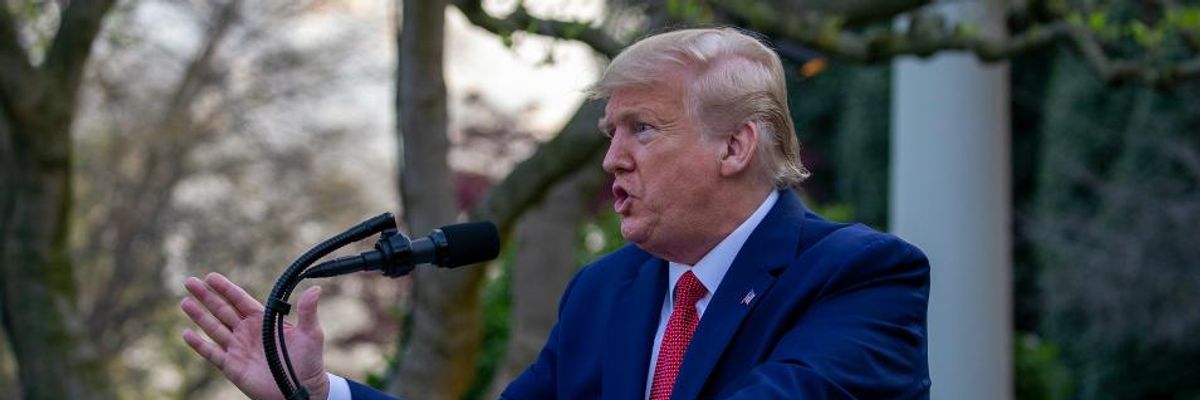
President Donald Trump takes questions from reporters in the Rose Garden for the daily coronavirus briefing at the White House on March 29, 2020 in Washington, D.C. (Photo by Tasos Katopodis/Getty Images)
Just over a month after proclaiming that the number of coronavirus cases in the United States would soon "be down to close to zero," President Donald Trump said during a press briefing on the White House lawn Sunday that limiting U.S. deaths from the pandemic to between 100,000 and 200,000 people would mean his administration and the country as a whole did "a very good job."
Speaking as the death toll from the novel coronavirus climbed above 2,300 in the U.S.--which has the most confirmed cases of the virus in the world--Trump cited recent research warning that 2.2 million people in the U.S. could die from COVID-19 if the nation's government and population take no action to mitigate the threat.
"You're talking about 2.2 million deaths, 2.2 million people from this," the president said. "And so, if we can hold that down, as we're saying, to 100,000--that's a horrible number--maybe even less, but to 100,000, so we have between 100- and 200,000, we all together have done a very good job."
Watch:
Critics condemned Trump's remarks as remarkably cruel and callous, particularly coming from someone who has repeatedly downplayed the threat of the virus--at one point suggesting it was a "new hoax" perpetrated by the Democratic Party--and urged Americans to get back to work despite warnings from medical professionals.
"There really are no words for this level of insensitivity and inhumanity. A serial killer would be jealous," said Charles Idelson of National Nurses United in response to Trump's comments.
Others reacted with similar alarm and disgust:
Trump announced Sunday that the White House is extending federal social distancing guidelines to at least April 30, a retreat from the president's insistence last week that the country could be "rarin' to go" by Easter--April 12.
Noting the president's rapidly shifting goalposts, CNN reporter Daniel Dale tweeted late Sunday, "Trump has come a long way from the 15-cases-but-we're-going-down-to-zero."
Dear Common Dreams reader, It’s been nearly 30 years since I co-founded Common Dreams with my late wife, Lina Newhouser. We had the radical notion that journalism should serve the public good, not corporate profits. It was clear to us from the outset what it would take to build such a project. No paid advertisements. No corporate sponsors. No millionaire publisher telling us what to think or do. Many people said we wouldn't last a year, but we proved those doubters wrong. Together with a tremendous team of journalists and dedicated staff, we built an independent media outlet free from the constraints of profits and corporate control. Our mission has always been simple: To inform. To inspire. To ignite change for the common good. Building Common Dreams was not easy. Our survival was never guaranteed. When you take on the most powerful forces—Wall Street greed, fossil fuel industry destruction, Big Tech lobbyists, and uber-rich oligarchs who have spent billions upon billions rigging the economy and democracy in their favor—the only bulwark you have is supporters who believe in your work. But here’s the urgent message from me today. It's never been this bad out there. And it's never been this hard to keep us going. At the very moment Common Dreams is most needed, the threats we face are intensifying. We need your support now more than ever. We don't accept corporate advertising and never will. We don't have a paywall because we don't think people should be blocked from critical news based on their ability to pay. Everything we do is funded by the donations of readers like you. When everyone does the little they can afford, we are strong. But if that support retreats or dries up, so do we. Will you donate now to make sure Common Dreams not only survives but thrives? —Craig Brown, Co-founder |
Just over a month after proclaiming that the number of coronavirus cases in the United States would soon "be down to close to zero," President Donald Trump said during a press briefing on the White House lawn Sunday that limiting U.S. deaths from the pandemic to between 100,000 and 200,000 people would mean his administration and the country as a whole did "a very good job."
Speaking as the death toll from the novel coronavirus climbed above 2,300 in the U.S.--which has the most confirmed cases of the virus in the world--Trump cited recent research warning that 2.2 million people in the U.S. could die from COVID-19 if the nation's government and population take no action to mitigate the threat.
"You're talking about 2.2 million deaths, 2.2 million people from this," the president said. "And so, if we can hold that down, as we're saying, to 100,000--that's a horrible number--maybe even less, but to 100,000, so we have between 100- and 200,000, we all together have done a very good job."
Watch:
Critics condemned Trump's remarks as remarkably cruel and callous, particularly coming from someone who has repeatedly downplayed the threat of the virus--at one point suggesting it was a "new hoax" perpetrated by the Democratic Party--and urged Americans to get back to work despite warnings from medical professionals.
"There really are no words for this level of insensitivity and inhumanity. A serial killer would be jealous," said Charles Idelson of National Nurses United in response to Trump's comments.
Others reacted with similar alarm and disgust:
Trump announced Sunday that the White House is extending federal social distancing guidelines to at least April 30, a retreat from the president's insistence last week that the country could be "rarin' to go" by Easter--April 12.
Noting the president's rapidly shifting goalposts, CNN reporter Daniel Dale tweeted late Sunday, "Trump has come a long way from the 15-cases-but-we're-going-down-to-zero."
Just over a month after proclaiming that the number of coronavirus cases in the United States would soon "be down to close to zero," President Donald Trump said during a press briefing on the White House lawn Sunday that limiting U.S. deaths from the pandemic to between 100,000 and 200,000 people would mean his administration and the country as a whole did "a very good job."
Speaking as the death toll from the novel coronavirus climbed above 2,300 in the U.S.--which has the most confirmed cases of the virus in the world--Trump cited recent research warning that 2.2 million people in the U.S. could die from COVID-19 if the nation's government and population take no action to mitigate the threat.
"You're talking about 2.2 million deaths, 2.2 million people from this," the president said. "And so, if we can hold that down, as we're saying, to 100,000--that's a horrible number--maybe even less, but to 100,000, so we have between 100- and 200,000, we all together have done a very good job."
Watch:
Critics condemned Trump's remarks as remarkably cruel and callous, particularly coming from someone who has repeatedly downplayed the threat of the virus--at one point suggesting it was a "new hoax" perpetrated by the Democratic Party--and urged Americans to get back to work despite warnings from medical professionals.
"There really are no words for this level of insensitivity and inhumanity. A serial killer would be jealous," said Charles Idelson of National Nurses United in response to Trump's comments.
Others reacted with similar alarm and disgust:
Trump announced Sunday that the White House is extending federal social distancing guidelines to at least April 30, a retreat from the president's insistence last week that the country could be "rarin' to go" by Easter--April 12.
Noting the president's rapidly shifting goalposts, CNN reporter Daniel Dale tweeted late Sunday, "Trump has come a long way from the 15-cases-but-we're-going-down-to-zero."

