

SUBSCRIBE TO OUR FREE NEWSLETTER
Daily news & progressive opinion—funded by the people, not the corporations—delivered straight to your inbox.
5
#000000
#FFFFFF
To donate by check, phone, or other method, see our More Ways to Give page.
Daily news & progressive opinion—funded by the people, not the corporations—delivered straight to your inbox.
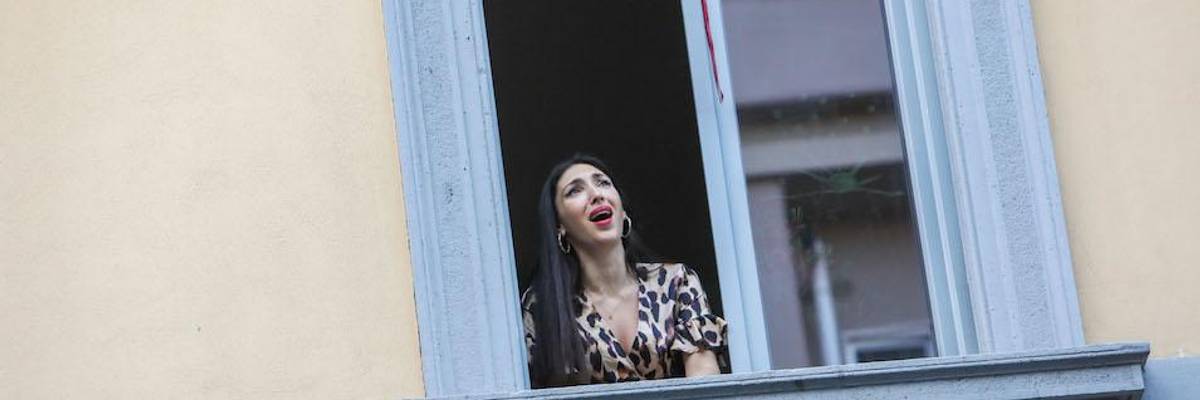
A young woman sings from the window in Milan, Italy on March 13, 2020. Some people in the country asked the public to stand on the balcony and sing or play something, to make people feel united in the quarantine. (Photo: Mairo Cinquetti/NurPhoto via Getty Images)
Italians under lockdown due to the coronavirus outbreak crisis have inspired people around the world by singing and creating music together from balconies despite not being able to leave their homes.
A montage video showing Italians serenading one another in high rise apartment buildings and playing music together was "a kind of triumph of spirit," as one Italy-centric Twitter account put it on Friday.
Videos have poured in from across Italy:
Similar displays took place in Lebanon:
And in Spain, people took to balconies to clap and sing together:
In January in the Chinese city of Wuhan, where the outbreak is believed to have begun, residents chanted "jiayou," or "keep up the fight," for the city and its people.
Spanish people under lockdown have also taken time every day to celebrate the efforts of health professionals in the country, as Chef Jose Andres shared on social media:
The unprecedented nature and threat of the coronavirus outbreak has led to "social distancing," or a self-imposed quarantine, in most countries in the world in order to slow the rate of infection. But such radical changes to everyday life can come with consequences to one's mental health and immune system, as the University of Washington's Center for the Science of Social Connection director Jonathan Kanter and university PhD psychology student Adam Kuczynski noted on Monday in an article for The Conversation.
"In times of stress and illness, being deprived of social connection can create more stress and illness," Kanter and Kucynski wrote.
By reaching out to one another with song and music, Italians--and others around the world--are seeking out human connection.
Dear Common Dreams reader, It’s been nearly 30 years since I co-founded Common Dreams with my late wife, Lina Newhouser. We had the radical notion that journalism should serve the public good, not corporate profits. It was clear to us from the outset what it would take to build such a project. No paid advertisements. No corporate sponsors. No millionaire publisher telling us what to think or do. Many people said we wouldn't last a year, but we proved those doubters wrong. Together with a tremendous team of journalists and dedicated staff, we built an independent media outlet free from the constraints of profits and corporate control. Our mission has always been simple: To inform. To inspire. To ignite change for the common good. Building Common Dreams was not easy. Our survival was never guaranteed. When you take on the most powerful forces—Wall Street greed, fossil fuel industry destruction, Big Tech lobbyists, and uber-rich oligarchs who have spent billions upon billions rigging the economy and democracy in their favor—the only bulwark you have is supporters who believe in your work. But here’s the urgent message from me today. It's never been this bad out there. And it's never been this hard to keep us going. At the very moment Common Dreams is most needed, the threats we face are intensifying. We need your support now more than ever. We don't accept corporate advertising and never will. We don't have a paywall because we don't think people should be blocked from critical news based on their ability to pay. Everything we do is funded by the donations of readers like you. When everyone does the little they can afford, we are strong. But if that support retreats or dries up, so do we. Will you donate now to make sure Common Dreams not only survives but thrives? —Craig Brown, Co-founder |
Italians under lockdown due to the coronavirus outbreak crisis have inspired people around the world by singing and creating music together from balconies despite not being able to leave their homes.
A montage video showing Italians serenading one another in high rise apartment buildings and playing music together was "a kind of triumph of spirit," as one Italy-centric Twitter account put it on Friday.
Videos have poured in from across Italy:
Similar displays took place in Lebanon:
And in Spain, people took to balconies to clap and sing together:
In January in the Chinese city of Wuhan, where the outbreak is believed to have begun, residents chanted "jiayou," or "keep up the fight," for the city and its people.
Spanish people under lockdown have also taken time every day to celebrate the efforts of health professionals in the country, as Chef Jose Andres shared on social media:
The unprecedented nature and threat of the coronavirus outbreak has led to "social distancing," or a self-imposed quarantine, in most countries in the world in order to slow the rate of infection. But such radical changes to everyday life can come with consequences to one's mental health and immune system, as the University of Washington's Center for the Science of Social Connection director Jonathan Kanter and university PhD psychology student Adam Kuczynski noted on Monday in an article for The Conversation.
"In times of stress and illness, being deprived of social connection can create more stress and illness," Kanter and Kucynski wrote.
By reaching out to one another with song and music, Italians--and others around the world--are seeking out human connection.
Italians under lockdown due to the coronavirus outbreak crisis have inspired people around the world by singing and creating music together from balconies despite not being able to leave their homes.
A montage video showing Italians serenading one another in high rise apartment buildings and playing music together was "a kind of triumph of spirit," as one Italy-centric Twitter account put it on Friday.
Videos have poured in from across Italy:
Similar displays took place in Lebanon:
And in Spain, people took to balconies to clap and sing together:
In January in the Chinese city of Wuhan, where the outbreak is believed to have begun, residents chanted "jiayou," or "keep up the fight," for the city and its people.
Spanish people under lockdown have also taken time every day to celebrate the efforts of health professionals in the country, as Chef Jose Andres shared on social media:
The unprecedented nature and threat of the coronavirus outbreak has led to "social distancing," or a self-imposed quarantine, in most countries in the world in order to slow the rate of infection. But such radical changes to everyday life can come with consequences to one's mental health and immune system, as the University of Washington's Center for the Science of Social Connection director Jonathan Kanter and university PhD psychology student Adam Kuczynski noted on Monday in an article for The Conversation.
"In times of stress and illness, being deprived of social connection can create more stress and illness," Kanter and Kucynski wrote.
By reaching out to one another with song and music, Italians--and others around the world--are seeking out human connection.

