

SUBSCRIBE TO OUR FREE NEWSLETTER
Daily news & progressive opinion—funded by the people, not the corporations—delivered straight to your inbox.
5
#000000
#FFFFFF
To donate by check, phone, or other method, see our More Ways to Give page.
Daily news & progressive opinion—funded by the people, not the corporations—delivered straight to your inbox.
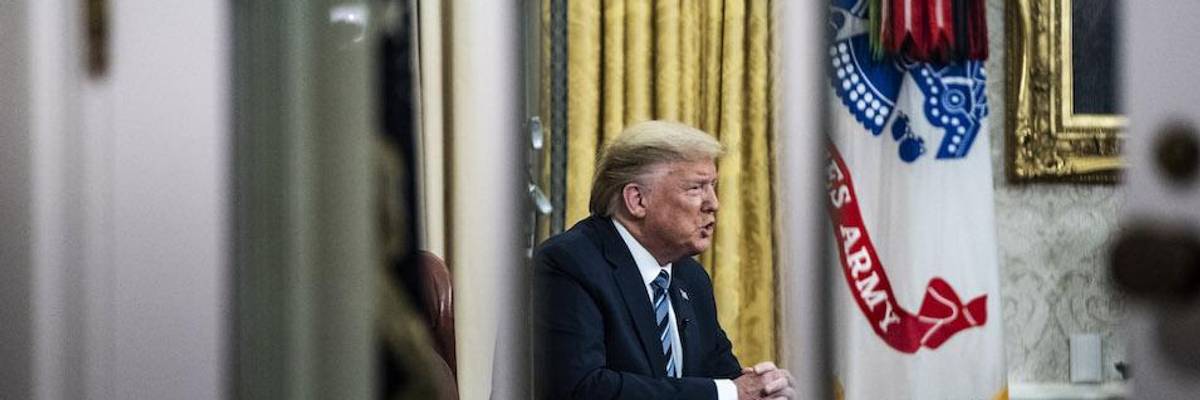
President Donald J. Trump delivers a television national address on the coronavirus pandemic from the Oval Office at the White House on Wednesday, March 11, 2020. (Photo: Jabin Botsford/The Washington Post via Getty Images)
President Donald Trump's announcement Wednesday night that the U.S. would in response to the coronavirus outbreak ban flights into the country for 30 days from most European nations starting Friday was made without consulting world leaders and triggered another global stock market meltdown Thursday morning.
European leaders condemned the move, calling the approach from the president one that would not help the world address the pandemic.
"The coronavirus is a global crisis, not limited to any continent, and it requires cooperation rather than unilateral action," European Union Council President Charles Michel and European Commission President Ursula von der Leyen said in a joint statement Thursday.
The United Kingdom, Ireland, Bulgaria, Croatia, and Romania are all reportedly exempt from the order as it only applies to the "Shengen Zone," where Europeans can move freely between member states.
As Mother Jones reported, Michel and von der Leyen's response was a strong and unambiguous statement on the crisis:
The scathing condemnation made clear that Trump's move--which limits travel from 26 European countries but does not include the United Kingdom, Ireland, or other countries that are not part of the continent's visa-free travel zone--had largely blindsided European countries, sending stock markets across the region into yet another free-fall. Meanwhile, in the United States, lawmakers, experts, and local communities are scrambling for answers on crucial issues Trump failed to address in his televised remarks on Wednesday: the continued lack of rapid testing and a coherent messaging on what social distancing policies to follow.
Trump's decision had Americans abroad scrambling to get home before the lockdown and sent markets around the world tumbling.
New York Times reporter Mike McIntire, in a Twitter thread, described how panic over flights back to the U.S.--exacerbated by unclear rules on whether or not Americans could return after the lockdown--led to overpaying for flights and a logjam at France's Paris-Charles De Gaulle airport.
Stocks plummeted Thursday, with the U.S. market shutting down temporarily from the so-called "circuit breaker" which suspends trading if the market falls far enough. In Europe, markets cratered on the president's announcement of the travel ban, which he initially said would also apply to trade and cargo as well before the White House walked that portion of the statement back.
Gerard Araud, former French ambassador to Washington, tweeted that Trump's comments made sense for the U.S. president--even if they were destructive for the rest of the world.
"Trump needed a narrative to exonerate his administration from any responsibility in the crisis," said Araud. "The foreigner is always a good scapegoat."
Dear Common Dreams reader, It’s been nearly 30 years since I co-founded Common Dreams with my late wife, Lina Newhouser. We had the radical notion that journalism should serve the public good, not corporate profits. It was clear to us from the outset what it would take to build such a project. No paid advertisements. No corporate sponsors. No millionaire publisher telling us what to think or do. Many people said we wouldn't last a year, but we proved those doubters wrong. Together with a tremendous team of journalists and dedicated staff, we built an independent media outlet free from the constraints of profits and corporate control. Our mission has always been simple: To inform. To inspire. To ignite change for the common good. Building Common Dreams was not easy. Our survival was never guaranteed. When you take on the most powerful forces—Wall Street greed, fossil fuel industry destruction, Big Tech lobbyists, and uber-rich oligarchs who have spent billions upon billions rigging the economy and democracy in their favor—the only bulwark you have is supporters who believe in your work. But here’s the urgent message from me today. It's never been this bad out there. And it's never been this hard to keep us going. At the very moment Common Dreams is most needed, the threats we face are intensifying. We need your support now more than ever. We don't accept corporate advertising and never will. We don't have a paywall because we don't think people should be blocked from critical news based on their ability to pay. Everything we do is funded by the donations of readers like you. When everyone does the little they can afford, we are strong. But if that support retreats or dries up, so do we. Will you donate now to make sure Common Dreams not only survives but thrives? —Craig Brown, Co-founder |
President Donald Trump's announcement Wednesday night that the U.S. would in response to the coronavirus outbreak ban flights into the country for 30 days from most European nations starting Friday was made without consulting world leaders and triggered another global stock market meltdown Thursday morning.
European leaders condemned the move, calling the approach from the president one that would not help the world address the pandemic.
"The coronavirus is a global crisis, not limited to any continent, and it requires cooperation rather than unilateral action," European Union Council President Charles Michel and European Commission President Ursula von der Leyen said in a joint statement Thursday.
The United Kingdom, Ireland, Bulgaria, Croatia, and Romania are all reportedly exempt from the order as it only applies to the "Shengen Zone," where Europeans can move freely between member states.
As Mother Jones reported, Michel and von der Leyen's response was a strong and unambiguous statement on the crisis:
The scathing condemnation made clear that Trump's move--which limits travel from 26 European countries but does not include the United Kingdom, Ireland, or other countries that are not part of the continent's visa-free travel zone--had largely blindsided European countries, sending stock markets across the region into yet another free-fall. Meanwhile, in the United States, lawmakers, experts, and local communities are scrambling for answers on crucial issues Trump failed to address in his televised remarks on Wednesday: the continued lack of rapid testing and a coherent messaging on what social distancing policies to follow.
Trump's decision had Americans abroad scrambling to get home before the lockdown and sent markets around the world tumbling.
New York Times reporter Mike McIntire, in a Twitter thread, described how panic over flights back to the U.S.--exacerbated by unclear rules on whether or not Americans could return after the lockdown--led to overpaying for flights and a logjam at France's Paris-Charles De Gaulle airport.
Stocks plummeted Thursday, with the U.S. market shutting down temporarily from the so-called "circuit breaker" which suspends trading if the market falls far enough. In Europe, markets cratered on the president's announcement of the travel ban, which he initially said would also apply to trade and cargo as well before the White House walked that portion of the statement back.
Gerard Araud, former French ambassador to Washington, tweeted that Trump's comments made sense for the U.S. president--even if they were destructive for the rest of the world.
"Trump needed a narrative to exonerate his administration from any responsibility in the crisis," said Araud. "The foreigner is always a good scapegoat."
President Donald Trump's announcement Wednesday night that the U.S. would in response to the coronavirus outbreak ban flights into the country for 30 days from most European nations starting Friday was made without consulting world leaders and triggered another global stock market meltdown Thursday morning.
European leaders condemned the move, calling the approach from the president one that would not help the world address the pandemic.
"The coronavirus is a global crisis, not limited to any continent, and it requires cooperation rather than unilateral action," European Union Council President Charles Michel and European Commission President Ursula von der Leyen said in a joint statement Thursday.
The United Kingdom, Ireland, Bulgaria, Croatia, and Romania are all reportedly exempt from the order as it only applies to the "Shengen Zone," where Europeans can move freely between member states.
As Mother Jones reported, Michel and von der Leyen's response was a strong and unambiguous statement on the crisis:
The scathing condemnation made clear that Trump's move--which limits travel from 26 European countries but does not include the United Kingdom, Ireland, or other countries that are not part of the continent's visa-free travel zone--had largely blindsided European countries, sending stock markets across the region into yet another free-fall. Meanwhile, in the United States, lawmakers, experts, and local communities are scrambling for answers on crucial issues Trump failed to address in his televised remarks on Wednesday: the continued lack of rapid testing and a coherent messaging on what social distancing policies to follow.
Trump's decision had Americans abroad scrambling to get home before the lockdown and sent markets around the world tumbling.
New York Times reporter Mike McIntire, in a Twitter thread, described how panic over flights back to the U.S.--exacerbated by unclear rules on whether or not Americans could return after the lockdown--led to overpaying for flights and a logjam at France's Paris-Charles De Gaulle airport.
Stocks plummeted Thursday, with the U.S. market shutting down temporarily from the so-called "circuit breaker" which suspends trading if the market falls far enough. In Europe, markets cratered on the president's announcement of the travel ban, which he initially said would also apply to trade and cargo as well before the White House walked that portion of the statement back.
Gerard Araud, former French ambassador to Washington, tweeted that Trump's comments made sense for the U.S. president--even if they were destructive for the rest of the world.
"Trump needed a narrative to exonerate his administration from any responsibility in the crisis," said Araud. "The foreigner is always a good scapegoat."

