SUBSCRIBE TO OUR FREE NEWSLETTER
Daily news & progressive opinion—funded by the people, not the corporations—delivered straight to your inbox.
5
#000000
#FFFFFF
To donate by check, phone, or other method, see our More Ways to Give page.
Daily news & progressive opinion—funded by the people, not the corporations—delivered straight to your inbox.
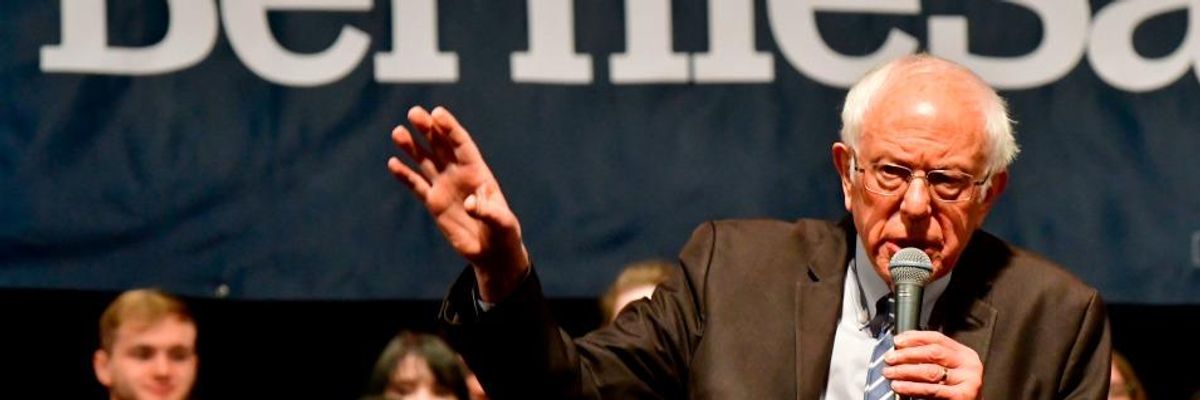
Democratic presidential hopeful Senator Bernie Sanders speaks at a Bernie 2020 rally at the Stifel Theater in downtown St. Louis, Missouri on March 9, 2020. (Photo: Tim Vizer/AFP via Getty Images)
Despite predictions made by pundits and journalists in the corporate media regarding electability in the 2020 general election, exit polls in the states where Americans have voted so far show that Sen. Bernie Sanders is the most popular Democratic candidate among voters who are likely to be considered "swing voters" in November.
As Sanders's speechwriter, David Sirota, tweeted Friday, the Vermont senator is winning far more votes from independent voters than former Vice President Joe Biden.
According to CNN, Sanders has won independents in 13 out of 16 states where exit polls are conducted, including Minnesota and North Carolina, which are expected to be competitive in the general election.
"Weird that this hasn't been mentioned by anyone on cable TV in the 24-7 coverage of 'electability,'" Sirota wrote.
In CNN's polls, Sanders won the support of independent voters in every state so far except Virginia, South Carolina, and Alabama.
The Washington Post also reported that a majority of independent voters supported Sanders in the states that voted last Tuesday--34% versus 26% for Biden.
Rep. Alexandria Ocasio-Cortez (D-N.Y.) also pointed to Sanders's success with independents, saying the exit polls are a sign that the senator could beat President Donald Trump in November.
"He is a stronger candidate than Biden against Trump," tweeted Ocasio-Cortez. "I'm not just saying that because we align on progressive policy. I'm saying it because I believe it is true."
In 2016, independent voters supported President Donald Trump over Hillary Clinton.
"The criteria by which we should judge any Democratic presidential candidate's electability is their popularity among Democratic-leaning independents and 'true independents' in swing states," wrote Nathan Tankus at Jacobin earlier this month. "And by that metric, Sanders excels."
Biden's electoral strategy is leaving independents and other groups out in the same way that Clinton's did, added Tankus--putting his potential success in November in question.
"Biden has little shot of improving upon the expected turnout boosts from anti-Trump sentiment because of his weakness among younger people and Latino voters as well as his underwhelming field operation," Tankus wrote. "There would be no equivalent to a South Carolina primary to save Biden in the general election--especially not if he's repeating the same failed strategy as Hillary Clinton, which kept Democrats and Democratic-leaning independents unenthusiastic and disengaged."
Unless the Democratic candidate energizes Democratic-leaning independents and independents who don't lean toward any party affiliation, he added, the party will not be able to boost turnout in 2020.
"Sanders's strategy is not a pie-in-the-sky leftist dream, but a straightforward, clear-eyed understanding of electoral math," Tankus wrote.
NYU Law School professor Rob Howse pointed to recent polling that showed American voters' views on healthcare to help explain why Sanders has had success with independent voters which would likely carry over into the general election.
More than Democrats and Republicans, independents in the survey by the Financial Times said they believed rising healthcare costs are the biggest threat to the U.S. economy.
Dear Common Dreams reader, It’s been nearly 30 years since I co-founded Common Dreams with my late wife, Lina Newhouser. We had the radical notion that journalism should serve the public good, not corporate profits. It was clear to us from the outset what it would take to build such a project. No paid advertisements. No corporate sponsors. No millionaire publisher telling us what to think or do. Many people said we wouldn't last a year, but we proved those doubters wrong. Together with a tremendous team of journalists and dedicated staff, we built an independent media outlet free from the constraints of profits and corporate control. Our mission has always been simple: To inform. To inspire. To ignite change for the common good. Building Common Dreams was not easy. Our survival was never guaranteed. When you take on the most powerful forces—Wall Street greed, fossil fuel industry destruction, Big Tech lobbyists, and uber-rich oligarchs who have spent billions upon billions rigging the economy and democracy in their favor—the only bulwark you have is supporters who believe in your work. But here’s the urgent message from me today. It's never been this bad out there. And it's never been this hard to keep us going. At the very moment Common Dreams is most needed, the threats we face are intensifying. We need your support now more than ever. We don't accept corporate advertising and never will. We don't have a paywall because we don't think people should be blocked from critical news based on their ability to pay. Everything we do is funded by the donations of readers like you. When everyone does the little they can afford, we are strong. But if that support retreats or dries up, so do we. Will you donate now to make sure Common Dreams not only survives but thrives? —Craig Brown, Co-founder |
Despite predictions made by pundits and journalists in the corporate media regarding electability in the 2020 general election, exit polls in the states where Americans have voted so far show that Sen. Bernie Sanders is the most popular Democratic candidate among voters who are likely to be considered "swing voters" in November.
As Sanders's speechwriter, David Sirota, tweeted Friday, the Vermont senator is winning far more votes from independent voters than former Vice President Joe Biden.
According to CNN, Sanders has won independents in 13 out of 16 states where exit polls are conducted, including Minnesota and North Carolina, which are expected to be competitive in the general election.
"Weird that this hasn't been mentioned by anyone on cable TV in the 24-7 coverage of 'electability,'" Sirota wrote.
In CNN's polls, Sanders won the support of independent voters in every state so far except Virginia, South Carolina, and Alabama.
The Washington Post also reported that a majority of independent voters supported Sanders in the states that voted last Tuesday--34% versus 26% for Biden.
Rep. Alexandria Ocasio-Cortez (D-N.Y.) also pointed to Sanders's success with independents, saying the exit polls are a sign that the senator could beat President Donald Trump in November.
"He is a stronger candidate than Biden against Trump," tweeted Ocasio-Cortez. "I'm not just saying that because we align on progressive policy. I'm saying it because I believe it is true."
In 2016, independent voters supported President Donald Trump over Hillary Clinton.
"The criteria by which we should judge any Democratic presidential candidate's electability is their popularity among Democratic-leaning independents and 'true independents' in swing states," wrote Nathan Tankus at Jacobin earlier this month. "And by that metric, Sanders excels."
Biden's electoral strategy is leaving independents and other groups out in the same way that Clinton's did, added Tankus--putting his potential success in November in question.
"Biden has little shot of improving upon the expected turnout boosts from anti-Trump sentiment because of his weakness among younger people and Latino voters as well as his underwhelming field operation," Tankus wrote. "There would be no equivalent to a South Carolina primary to save Biden in the general election--especially not if he's repeating the same failed strategy as Hillary Clinton, which kept Democrats and Democratic-leaning independents unenthusiastic and disengaged."
Unless the Democratic candidate energizes Democratic-leaning independents and independents who don't lean toward any party affiliation, he added, the party will not be able to boost turnout in 2020.
"Sanders's strategy is not a pie-in-the-sky leftist dream, but a straightforward, clear-eyed understanding of electoral math," Tankus wrote.
NYU Law School professor Rob Howse pointed to recent polling that showed American voters' views on healthcare to help explain why Sanders has had success with independent voters which would likely carry over into the general election.
More than Democrats and Republicans, independents in the survey by the Financial Times said they believed rising healthcare costs are the biggest threat to the U.S. economy.
Despite predictions made by pundits and journalists in the corporate media regarding electability in the 2020 general election, exit polls in the states where Americans have voted so far show that Sen. Bernie Sanders is the most popular Democratic candidate among voters who are likely to be considered "swing voters" in November.
As Sanders's speechwriter, David Sirota, tweeted Friday, the Vermont senator is winning far more votes from independent voters than former Vice President Joe Biden.
According to CNN, Sanders has won independents in 13 out of 16 states where exit polls are conducted, including Minnesota and North Carolina, which are expected to be competitive in the general election.
"Weird that this hasn't been mentioned by anyone on cable TV in the 24-7 coverage of 'electability,'" Sirota wrote.
In CNN's polls, Sanders won the support of independent voters in every state so far except Virginia, South Carolina, and Alabama.
The Washington Post also reported that a majority of independent voters supported Sanders in the states that voted last Tuesday--34% versus 26% for Biden.
Rep. Alexandria Ocasio-Cortez (D-N.Y.) also pointed to Sanders's success with independents, saying the exit polls are a sign that the senator could beat President Donald Trump in November.
"He is a stronger candidate than Biden against Trump," tweeted Ocasio-Cortez. "I'm not just saying that because we align on progressive policy. I'm saying it because I believe it is true."
In 2016, independent voters supported President Donald Trump over Hillary Clinton.
"The criteria by which we should judge any Democratic presidential candidate's electability is their popularity among Democratic-leaning independents and 'true independents' in swing states," wrote Nathan Tankus at Jacobin earlier this month. "And by that metric, Sanders excels."
Biden's electoral strategy is leaving independents and other groups out in the same way that Clinton's did, added Tankus--putting his potential success in November in question.
"Biden has little shot of improving upon the expected turnout boosts from anti-Trump sentiment because of his weakness among younger people and Latino voters as well as his underwhelming field operation," Tankus wrote. "There would be no equivalent to a South Carolina primary to save Biden in the general election--especially not if he's repeating the same failed strategy as Hillary Clinton, which kept Democrats and Democratic-leaning independents unenthusiastic and disengaged."
Unless the Democratic candidate energizes Democratic-leaning independents and independents who don't lean toward any party affiliation, he added, the party will not be able to boost turnout in 2020.
"Sanders's strategy is not a pie-in-the-sky leftist dream, but a straightforward, clear-eyed understanding of electoral math," Tankus wrote.
NYU Law School professor Rob Howse pointed to recent polling that showed American voters' views on healthcare to help explain why Sanders has had success with independent voters which would likely carry over into the general election.
More than Democrats and Republicans, independents in the survey by the Financial Times said they believed rising healthcare costs are the biggest threat to the U.S. economy.