SUBSCRIBE TO OUR FREE NEWSLETTER
Daily news & progressive opinion—funded by the people, not the corporations—delivered straight to your inbox.
5
#000000
#FFFFFF
To donate by check, phone, or other method, see our More Ways to Give page.
Daily news & progressive opinion—funded by the people, not the corporations—delivered straight to your inbox.
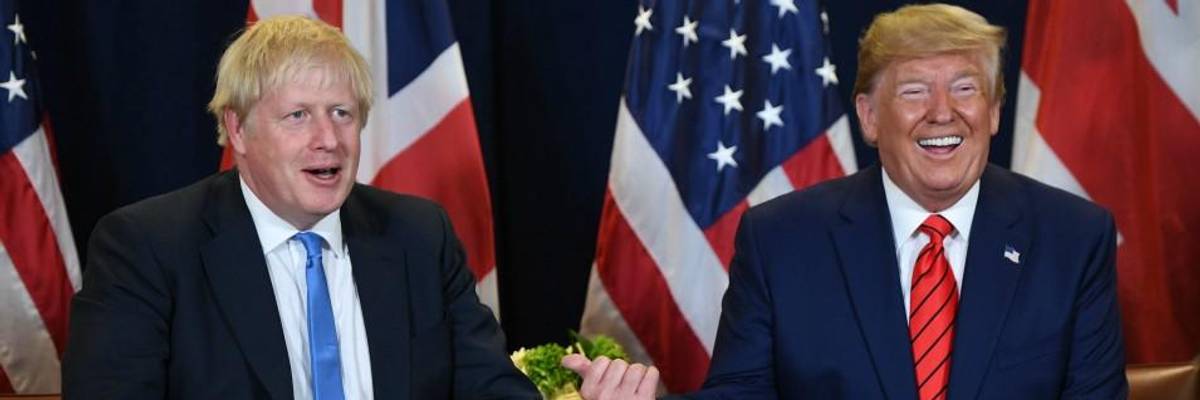
US President Donald Trump and British Prime Minister Boris Johnson at UN Headquarters in New York, September 24, 2019, on the sidelines of the United Nations General Assembly. (Photo: Saul Loeb/AFP/Getty Images)
Social justice advocates in the United Kingdom are raising concerns over a trade deal being negotiated with the United States by Prime Minister Boris Johnson, after reports surfaced that American leaders are planning to use leverage provided by Brexit to force a scheme of privavitzation and the stripping of protections from British workers.
"These trade talks are being conducted with excessive levels of secrecy," Global Justice Now director Nick Dearden said in a statement Sunday.
After the U.K. left the European Union on Friday through Brexit, Britons were left wondering how the island nation would renegotiate trade deals with its global partners. Johnson is expected to begin formal talks with both the U.S. and E.U. on Monday.
While the U.K. is now officially out of the E.U., the two sides have eleven months to work out what exactly that separation looks like.
The deal with the U.S. is slightly more straightforward, in theory, though Johnson and his government have kept negotiations a secret from the public and Parliament. Documents from the talks leaked in November show a push to privatize the National Health Service to make the U.K.'s popular universal system more like the U.S. private insurance scheme.
Beyond the NHS, Global Justice said in a press release, "U.S.demands are to radically alter the sort of food on sale in Britain after Brexit, undermine farmers' livelihoods, threaten the NHS, make tackling climate change more difficult, and allow big tech companies like Facebook an effective veto over Britain's tax policy; all things which would be impossible if Britain were to retain closer alignment with Brussels."
Labour shadow Brexit secretary Keir Starmer told the Guardian Friday that Johnson's approach to Brexit and subsequent trade deals could sink the U.K. economy and cause major damage to the country's way of life.
"Johnson either doesn't understand or doesn't care about the damage the Brexit deal he is proposing will do to the country," said Starmer.
Global Justice's Dearden said that while a deal with the U.S. "would be a bonanza for big business," it would likely hurt Britons.
"For all of this to happen, Britain would have to move away from our current standards and protections," said Dearden. "That's what Donald Trump is pushing, and the U.K.'s current position suggests that he's succeeded and is pulling the prime minister's strings in these trade talks, pushing us into a 'shock doctrine Brexit.'"
Dear Common Dreams reader, It’s been nearly 30 years since I co-founded Common Dreams with my late wife, Lina Newhouser. We had the radical notion that journalism should serve the public good, not corporate profits. It was clear to us from the outset what it would take to build such a project. No paid advertisements. No corporate sponsors. No millionaire publisher telling us what to think or do. Many people said we wouldn't last a year, but we proved those doubters wrong. Together with a tremendous team of journalists and dedicated staff, we built an independent media outlet free from the constraints of profits and corporate control. Our mission has always been simple: To inform. To inspire. To ignite change for the common good. Building Common Dreams was not easy. Our survival was never guaranteed. When you take on the most powerful forces—Wall Street greed, fossil fuel industry destruction, Big Tech lobbyists, and uber-rich oligarchs who have spent billions upon billions rigging the economy and democracy in their favor—the only bulwark you have is supporters who believe in your work. But here’s the urgent message from me today. It's never been this bad out there. And it's never been this hard to keep us going. At the very moment Common Dreams is most needed, the threats we face are intensifying. We need your support now more than ever. We don't accept corporate advertising and never will. We don't have a paywall because we don't think people should be blocked from critical news based on their ability to pay. Everything we do is funded by the donations of readers like you. When everyone does the little they can afford, we are strong. But if that support retreats or dries up, so do we. Will you donate now to make sure Common Dreams not only survives but thrives? —Craig Brown, Co-founder |
Social justice advocates in the United Kingdom are raising concerns over a trade deal being negotiated with the United States by Prime Minister Boris Johnson, after reports surfaced that American leaders are planning to use leverage provided by Brexit to force a scheme of privavitzation and the stripping of protections from British workers.
"These trade talks are being conducted with excessive levels of secrecy," Global Justice Now director Nick Dearden said in a statement Sunday.
After the U.K. left the European Union on Friday through Brexit, Britons were left wondering how the island nation would renegotiate trade deals with its global partners. Johnson is expected to begin formal talks with both the U.S. and E.U. on Monday.
While the U.K. is now officially out of the E.U., the two sides have eleven months to work out what exactly that separation looks like.
The deal with the U.S. is slightly more straightforward, in theory, though Johnson and his government have kept negotiations a secret from the public and Parliament. Documents from the talks leaked in November show a push to privatize the National Health Service to make the U.K.'s popular universal system more like the U.S. private insurance scheme.
Beyond the NHS, Global Justice said in a press release, "U.S.demands are to radically alter the sort of food on sale in Britain after Brexit, undermine farmers' livelihoods, threaten the NHS, make tackling climate change more difficult, and allow big tech companies like Facebook an effective veto over Britain's tax policy; all things which would be impossible if Britain were to retain closer alignment with Brussels."
Labour shadow Brexit secretary Keir Starmer told the Guardian Friday that Johnson's approach to Brexit and subsequent trade deals could sink the U.K. economy and cause major damage to the country's way of life.
"Johnson either doesn't understand or doesn't care about the damage the Brexit deal he is proposing will do to the country," said Starmer.
Global Justice's Dearden said that while a deal with the U.S. "would be a bonanza for big business," it would likely hurt Britons.
"For all of this to happen, Britain would have to move away from our current standards and protections," said Dearden. "That's what Donald Trump is pushing, and the U.K.'s current position suggests that he's succeeded and is pulling the prime minister's strings in these trade talks, pushing us into a 'shock doctrine Brexit.'"
Social justice advocates in the United Kingdom are raising concerns over a trade deal being negotiated with the United States by Prime Minister Boris Johnson, after reports surfaced that American leaders are planning to use leverage provided by Brexit to force a scheme of privavitzation and the stripping of protections from British workers.
"These trade talks are being conducted with excessive levels of secrecy," Global Justice Now director Nick Dearden said in a statement Sunday.
After the U.K. left the European Union on Friday through Brexit, Britons were left wondering how the island nation would renegotiate trade deals with its global partners. Johnson is expected to begin formal talks with both the U.S. and E.U. on Monday.
While the U.K. is now officially out of the E.U., the two sides have eleven months to work out what exactly that separation looks like.
The deal with the U.S. is slightly more straightforward, in theory, though Johnson and his government have kept negotiations a secret from the public and Parliament. Documents from the talks leaked in November show a push to privatize the National Health Service to make the U.K.'s popular universal system more like the U.S. private insurance scheme.
Beyond the NHS, Global Justice said in a press release, "U.S.demands are to radically alter the sort of food on sale in Britain after Brexit, undermine farmers' livelihoods, threaten the NHS, make tackling climate change more difficult, and allow big tech companies like Facebook an effective veto over Britain's tax policy; all things which would be impossible if Britain were to retain closer alignment with Brussels."
Labour shadow Brexit secretary Keir Starmer told the Guardian Friday that Johnson's approach to Brexit and subsequent trade deals could sink the U.K. economy and cause major damage to the country's way of life.
"Johnson either doesn't understand or doesn't care about the damage the Brexit deal he is proposing will do to the country," said Starmer.
Global Justice's Dearden said that while a deal with the U.S. "would be a bonanza for big business," it would likely hurt Britons.
"For all of this to happen, Britain would have to move away from our current standards and protections," said Dearden. "That's what Donald Trump is pushing, and the U.K.'s current position suggests that he's succeeded and is pulling the prime minister's strings in these trade talks, pushing us into a 'shock doctrine Brexit.'"