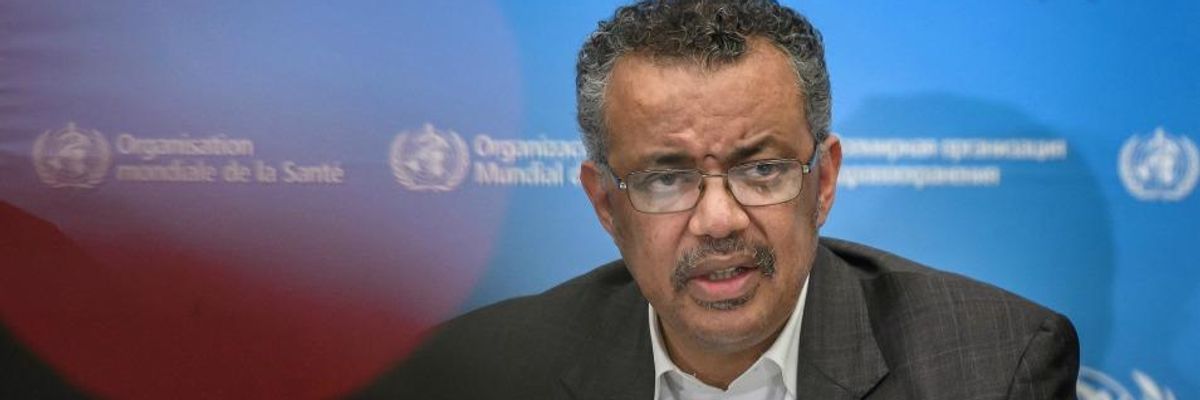
World Health Organization (WHO) Director-General Tedros Adhanom Ghebreyesus speaks during a press conference following a WHO Emergency committee to discuss whether the Coronavirus, the SARS-like virus, outbreak that began in China constitutes an international health emergency, on January 30, 2020 in Geneva. (Photo: Fabrice Coffrini/AFP/Getty Images)
Calling for Spread of 'Facts, Not Fear,' WHO Declares Global Health Emergency as Coronavirus Cases Confirmed in 18 Countries
The World Health Organization warned that restricting movement may have limited benefits for the global population as health officials work to fight the respiratory disease.
Amid reports that the strain of coronavirus first detected in Wuhan, China has now spread to 18 countries, the World Health Organization declared a global health emergency on Thursday.
WHO held an emergency committee meeting to discuss the respiratory disease, called 2019-nCoV by global health experts, which has spread from person-to-person in at least five countries, including China, Germany, Japan, Vietnam, and the United States.
"There are now 98 2019-nCoV cases in 18 countries outside China," said Tedros Adhanom Ghebreyesus, director-general of WHO.
"We don't know what sort of damage this 2019-nCoV virus could do if it were to spread in a country with a weaker health system. We must act now to help countries prepare for that possibility," he added. "For all of these reasons, I am declaring a public health emergency of international concern over the global outbreak of 2019-nCoV."
Watch:
Following the declaration, countries will be required to follow more stringent disease reporting guidelines. More funding and resources are expected to be released to fight the outbreak.
China has reported more than 7,700 cases of the disease and 170 deaths. So far, there have been no deaths from the disease outside of China.
On Thursday, the first human-to-human transmission case was confirmed in the U.S., where at least six people have been sickened. A man in the Chicago area reportedly contracted the coronavirus from his wife, who had recently returned from Wuhan.
Tedros emphasized that all but seven coronavirus cases outside China have been detected in patients who recently traveled to Wuhan.
On Thursday, Russia closed its 2,600-mile border with China to stop the transmission of the virus.
WHO said at its meeting that while countries should be prepared for containment and isolation of patients with confirmed coronavirus cases, restricting movement may have limited benefits and many drawbacks for the global population.
"Evidence has shown that restricting the movement of people and goods during public health emergencies may be ineffective and may divert resources from other interventions," the organization said. "Further, restrictions may interrupt needed aid and technical support, may disrupt businesses, and may have negative effects on the economies of countries affected by the emergencies."
Tedros also praised the Chinese government for its swift detection and reporting of the outbreak.
"We would have seen many more cases outside China by now--and probably deaths--if it were not for the government's efforts, and the progress they have made to protect their own people and the people of the world," the director-general said.
Ninety-nine percent of the coronavirus cases have been in China, and the disease has a 2% death rate as of Thursday. The number of cases has surpassed the cases of Severe Acute Respiratory Syndrome (SARS) that were reported during an outbreak in 2002 and 2003.
Other global health organizations pledged to work in cooperation to help fight the spread of the illness, while health professionals worked to combat the spread of misinformation about coronavirus on social media.
"This is the time for facts, not fear," tweeted Tedros. "This is the time for science, not rumors. This is the time for solidarity, not stigma."
We are at a crossroads
This country and this world are at a monumental crossroads. In a few short weeks, US voters will have an opportunity to beat back the forces of fascism and confront the billionaires who are rigging the economy, our media system, and our democracy, making it increasingly impossible for ordinary people to get by. We’re not just talking about the election. We’re talking about what must be done once these fascist elements are vanquished from power. We need a bolder set of solutions than what either major party has so far been willing to offer and a working-class movement ready to fight like hell for it. Trump didn't emerge from nowhere. The conditions that fueled MAGA authoritarianism were created by decades of radical neoliberal economic policies and a corrupt political system dominated by corporate interests. They slashed taxes on the super-rich, promising that the benefits would trickle down. They said giveaways to the corporate titans would make life more affordable for the rest of us. It was all bullshit. And when a bitter, betrayed populace searches for someone to blame, right-wing demagogues have little trouble finding scapegoats. People know when they're being lied to, but you won't hear any of this from the corporate media. Only independent journalism—powered and funded by people who believe in building a better world—can deliver truly trustworthy daily news. Our Fall Campaign is underway, and we need your help. To power our newsroom through the rest of the year, we need to raise $125,000 by midnight on October 31. So if you share our vision, please contribute whatever you can to sustain our work. |
Amid reports that the strain of coronavirus first detected in Wuhan, China has now spread to 18 countries, the World Health Organization declared a global health emergency on Thursday.
WHO held an emergency committee meeting to discuss the respiratory disease, called 2019-nCoV by global health experts, which has spread from person-to-person in at least five countries, including China, Germany, Japan, Vietnam, and the United States.
"There are now 98 2019-nCoV cases in 18 countries outside China," said Tedros Adhanom Ghebreyesus, director-general of WHO.
"We don't know what sort of damage this 2019-nCoV virus could do if it were to spread in a country with a weaker health system. We must act now to help countries prepare for that possibility," he added. "For all of these reasons, I am declaring a public health emergency of international concern over the global outbreak of 2019-nCoV."
Watch:
Following the declaration, countries will be required to follow more stringent disease reporting guidelines. More funding and resources are expected to be released to fight the outbreak.
China has reported more than 7,700 cases of the disease and 170 deaths. So far, there have been no deaths from the disease outside of China.
On Thursday, the first human-to-human transmission case was confirmed in the U.S., where at least six people have been sickened. A man in the Chicago area reportedly contracted the coronavirus from his wife, who had recently returned from Wuhan.
Tedros emphasized that all but seven coronavirus cases outside China have been detected in patients who recently traveled to Wuhan.
On Thursday, Russia closed its 2,600-mile border with China to stop the transmission of the virus.
WHO said at its meeting that while countries should be prepared for containment and isolation of patients with confirmed coronavirus cases, restricting movement may have limited benefits and many drawbacks for the global population.
"Evidence has shown that restricting the movement of people and goods during public health emergencies may be ineffective and may divert resources from other interventions," the organization said. "Further, restrictions may interrupt needed aid and technical support, may disrupt businesses, and may have negative effects on the economies of countries affected by the emergencies."
Tedros also praised the Chinese government for its swift detection and reporting of the outbreak.
"We would have seen many more cases outside China by now--and probably deaths--if it were not for the government's efforts, and the progress they have made to protect their own people and the people of the world," the director-general said.
Ninety-nine percent of the coronavirus cases have been in China, and the disease has a 2% death rate as of Thursday. The number of cases has surpassed the cases of Severe Acute Respiratory Syndrome (SARS) that were reported during an outbreak in 2002 and 2003.
Other global health organizations pledged to work in cooperation to help fight the spread of the illness, while health professionals worked to combat the spread of misinformation about coronavirus on social media.
"This is the time for facts, not fear," tweeted Tedros. "This is the time for science, not rumors. This is the time for solidarity, not stigma."
Amid reports that the strain of coronavirus first detected in Wuhan, China has now spread to 18 countries, the World Health Organization declared a global health emergency on Thursday.
WHO held an emergency committee meeting to discuss the respiratory disease, called 2019-nCoV by global health experts, which has spread from person-to-person in at least five countries, including China, Germany, Japan, Vietnam, and the United States.
"There are now 98 2019-nCoV cases in 18 countries outside China," said Tedros Adhanom Ghebreyesus, director-general of WHO.
"We don't know what sort of damage this 2019-nCoV virus could do if it were to spread in a country with a weaker health system. We must act now to help countries prepare for that possibility," he added. "For all of these reasons, I am declaring a public health emergency of international concern over the global outbreak of 2019-nCoV."
Watch:
Following the declaration, countries will be required to follow more stringent disease reporting guidelines. More funding and resources are expected to be released to fight the outbreak.
China has reported more than 7,700 cases of the disease and 170 deaths. So far, there have been no deaths from the disease outside of China.
On Thursday, the first human-to-human transmission case was confirmed in the U.S., where at least six people have been sickened. A man in the Chicago area reportedly contracted the coronavirus from his wife, who had recently returned from Wuhan.
Tedros emphasized that all but seven coronavirus cases outside China have been detected in patients who recently traveled to Wuhan.
On Thursday, Russia closed its 2,600-mile border with China to stop the transmission of the virus.
WHO said at its meeting that while countries should be prepared for containment and isolation of patients with confirmed coronavirus cases, restricting movement may have limited benefits and many drawbacks for the global population.
"Evidence has shown that restricting the movement of people and goods during public health emergencies may be ineffective and may divert resources from other interventions," the organization said. "Further, restrictions may interrupt needed aid and technical support, may disrupt businesses, and may have negative effects on the economies of countries affected by the emergencies."
Tedros also praised the Chinese government for its swift detection and reporting of the outbreak.
"We would have seen many more cases outside China by now--and probably deaths--if it were not for the government's efforts, and the progress they have made to protect their own people and the people of the world," the director-general said.
Ninety-nine percent of the coronavirus cases have been in China, and the disease has a 2% death rate as of Thursday. The number of cases has surpassed the cases of Severe Acute Respiratory Syndrome (SARS) that were reported during an outbreak in 2002 and 2003.
Other global health organizations pledged to work in cooperation to help fight the spread of the illness, while health professionals worked to combat the spread of misinformation about coronavirus on social media.
"This is the time for facts, not fear," tweeted Tedros. "This is the time for science, not rumors. This is the time for solidarity, not stigma."