SUBSCRIBE TO OUR FREE NEWSLETTER
Daily news & progressive opinion—funded by the people, not the corporations—delivered straight to your inbox.
5
#000000
#FFFFFF
To donate by check, phone, or other method, see our More Ways to Give page.
Daily news & progressive opinion—funded by the people, not the corporations—delivered straight to your inbox.
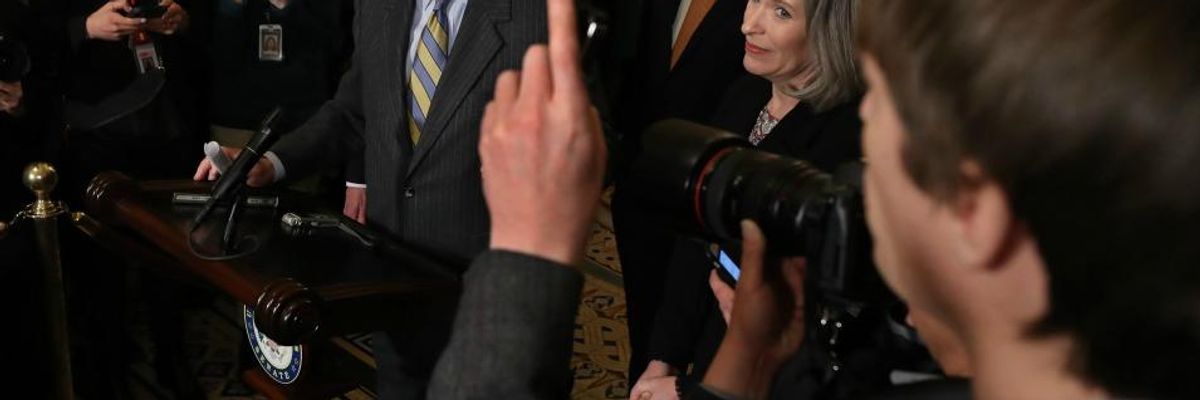
Under rules proposed by the Senate Rules Committee, journalists on Capitol Hill may have restricted access to President Donald Trump's impeachment trial. (Photo: Chip Somodevilla/Getty Images)
Journalists, lawmakers, and free press advocates are condemning the Senate's proposed rules for reporters as President Donald Trump's impeachment trial gets underway--restrictions which critics say will limit in "unprecedented" ways the media's ability to cover the proceedings.
As Capitol Hill journalists learned this week of the proposed rules, many took to social media to express outrage.
"Pretty much an outrage," tweeted New York Times reporter Carl Hulse. "Either Senate Republican leadership has no interest in recording history or perhaps they just want to play down the coming events altogether."
The rules, proposed by the Sergeant-at-Arms and the Senate Rules Committee, stipulate that reporters would be confined to a single small pen on the second floor of the Senate during Trump's trial. During normal Senate business--and even major events--journalists have traditionally been permitted to approach senators in Capitol Hill hallways and outside the Senate chamber.
Restricting correspondents to a single area will significantly reduce their access to lawmakers during the historic proceedings, reporters said.
Journalists may also be subjected to additional security screening and their movement around the Capitol may be restricted.
"Every other occasion, including SOTUs, we have been able to balance the equities of lawmakers and media without metal detectors or reporter pens," tweeted Mike DeBonis, a congressional reporter for the Washington Post. "Completely unclear why this should be any different."
The Standing Committee of Correspondents, which represents and advocates for journalists on Capitol Hill, reportedly suggested several less restrictive rules to the Sergeant-at-Arms and Sen. Roy Blunt (R-Mo.), chairman of the Rules Committee--but Sarah D. Wire, who leads the Standing Committee, said the proposals were flatly rejected.
The Standing Committee wrote to leaders including Blunt, Rules Committee Ranking Member Amy Klobuchar (D-Minn.), Senate Majority Leader Mitch McConnell (R-Ky.), and Minority Leader Chuck Schumer (D-N.Y.) on Wednesday.
"Capitol Hill is one of the most accessible places in Washington, but the proposed restrictions exceed those put in place during the State of the Union, Inauguration Day, or even during the Clinton impeachment trial 20 years ago," reads the letter.
Journalists on Capitol HIll have the support of PEN America, the national freedom of expression organization.
The proposed rules will "establish unprecedented limitations on the Congressional press corps," the group said in a statement on Wednesday.
"Moments of national crisis require credible and consistent reporting. Instead, Capitol Police and the sergeant-at-arms are jeopardizing press freedom and the public's right to know," said Thomas O. Melia, the group's Washington director. "These measures would obstruct the work of journalists covering the Senate. They constitute an unacceptable effort to block the free flow of information at a time when that information is necessary to the functioning of our democracy."
"Officials should reject these types of inappropriate limitations," he added.
Klobuchar joined several senators on both sides of the aisle in decrying the proposed restrictions.
Republican Sen. John Kennedy of Louisiana called the proposed rules a "huge mistake."
As Common Dreams reported in 2017, Capitol Police and the Sergeant-at-Arms previously cracked down on reporters' access to protests on Capitol Hill as Republicans were ramping up their effort to repeal key provisions of the Affordable Care Act, with officers ordering at least one journalist to delete photos from his phone.
Common Cause called the Republican-led Senate leadership's proposed rules "completely unjustified."
"Americans expect and deserve a fully transparent impeachment trial that examines all the facts, utilizes all pertinent evidence, and hears from witnesses," said Karen Hobert Flynn, president of the group. "For the Senate to produce anything less would be a show of GOP contempt for our justice system, and it would be a show of GOP contempt for the American people."
Dear Common Dreams reader, It’s been nearly 30 years since I co-founded Common Dreams with my late wife, Lina Newhouser. We had the radical notion that journalism should serve the public good, not corporate profits. It was clear to us from the outset what it would take to build such a project. No paid advertisements. No corporate sponsors. No millionaire publisher telling us what to think or do. Many people said we wouldn't last a year, but we proved those doubters wrong. Together with a tremendous team of journalists and dedicated staff, we built an independent media outlet free from the constraints of profits and corporate control. Our mission has always been simple: To inform. To inspire. To ignite change for the common good. Building Common Dreams was not easy. Our survival was never guaranteed. When you take on the most powerful forces—Wall Street greed, fossil fuel industry destruction, Big Tech lobbyists, and uber-rich oligarchs who have spent billions upon billions rigging the economy and democracy in their favor—the only bulwark you have is supporters who believe in your work. But here’s the urgent message from me today. It's never been this bad out there. And it's never been this hard to keep us going. At the very moment Common Dreams is most needed, the threats we face are intensifying. We need your support now more than ever. We don't accept corporate advertising and never will. We don't have a paywall because we don't think people should be blocked from critical news based on their ability to pay. Everything we do is funded by the donations of readers like you. When everyone does the little they can afford, we are strong. But if that support retreats or dries up, so do we. Will you donate now to make sure Common Dreams not only survives but thrives? —Craig Brown, Co-founder |
Journalists, lawmakers, and free press advocates are condemning the Senate's proposed rules for reporters as President Donald Trump's impeachment trial gets underway--restrictions which critics say will limit in "unprecedented" ways the media's ability to cover the proceedings.
As Capitol Hill journalists learned this week of the proposed rules, many took to social media to express outrage.
"Pretty much an outrage," tweeted New York Times reporter Carl Hulse. "Either Senate Republican leadership has no interest in recording history or perhaps they just want to play down the coming events altogether."
The rules, proposed by the Sergeant-at-Arms and the Senate Rules Committee, stipulate that reporters would be confined to a single small pen on the second floor of the Senate during Trump's trial. During normal Senate business--and even major events--journalists have traditionally been permitted to approach senators in Capitol Hill hallways and outside the Senate chamber.
Restricting correspondents to a single area will significantly reduce their access to lawmakers during the historic proceedings, reporters said.
Journalists may also be subjected to additional security screening and their movement around the Capitol may be restricted.
"Every other occasion, including SOTUs, we have been able to balance the equities of lawmakers and media without metal detectors or reporter pens," tweeted Mike DeBonis, a congressional reporter for the Washington Post. "Completely unclear why this should be any different."
The Standing Committee of Correspondents, which represents and advocates for journalists on Capitol Hill, reportedly suggested several less restrictive rules to the Sergeant-at-Arms and Sen. Roy Blunt (R-Mo.), chairman of the Rules Committee--but Sarah D. Wire, who leads the Standing Committee, said the proposals were flatly rejected.
The Standing Committee wrote to leaders including Blunt, Rules Committee Ranking Member Amy Klobuchar (D-Minn.), Senate Majority Leader Mitch McConnell (R-Ky.), and Minority Leader Chuck Schumer (D-N.Y.) on Wednesday.
"Capitol Hill is one of the most accessible places in Washington, but the proposed restrictions exceed those put in place during the State of the Union, Inauguration Day, or even during the Clinton impeachment trial 20 years ago," reads the letter.
Journalists on Capitol HIll have the support of PEN America, the national freedom of expression organization.
The proposed rules will "establish unprecedented limitations on the Congressional press corps," the group said in a statement on Wednesday.
"Moments of national crisis require credible and consistent reporting. Instead, Capitol Police and the sergeant-at-arms are jeopardizing press freedom and the public's right to know," said Thomas O. Melia, the group's Washington director. "These measures would obstruct the work of journalists covering the Senate. They constitute an unacceptable effort to block the free flow of information at a time when that information is necessary to the functioning of our democracy."
"Officials should reject these types of inappropriate limitations," he added.
Klobuchar joined several senators on both sides of the aisle in decrying the proposed restrictions.
Republican Sen. John Kennedy of Louisiana called the proposed rules a "huge mistake."
As Common Dreams reported in 2017, Capitol Police and the Sergeant-at-Arms previously cracked down on reporters' access to protests on Capitol Hill as Republicans were ramping up their effort to repeal key provisions of the Affordable Care Act, with officers ordering at least one journalist to delete photos from his phone.
Common Cause called the Republican-led Senate leadership's proposed rules "completely unjustified."
"Americans expect and deserve a fully transparent impeachment trial that examines all the facts, utilizes all pertinent evidence, and hears from witnesses," said Karen Hobert Flynn, president of the group. "For the Senate to produce anything less would be a show of GOP contempt for our justice system, and it would be a show of GOP contempt for the American people."
Journalists, lawmakers, and free press advocates are condemning the Senate's proposed rules for reporters as President Donald Trump's impeachment trial gets underway--restrictions which critics say will limit in "unprecedented" ways the media's ability to cover the proceedings.
As Capitol Hill journalists learned this week of the proposed rules, many took to social media to express outrage.
"Pretty much an outrage," tweeted New York Times reporter Carl Hulse. "Either Senate Republican leadership has no interest in recording history or perhaps they just want to play down the coming events altogether."
The rules, proposed by the Sergeant-at-Arms and the Senate Rules Committee, stipulate that reporters would be confined to a single small pen on the second floor of the Senate during Trump's trial. During normal Senate business--and even major events--journalists have traditionally been permitted to approach senators in Capitol Hill hallways and outside the Senate chamber.
Restricting correspondents to a single area will significantly reduce their access to lawmakers during the historic proceedings, reporters said.
Journalists may also be subjected to additional security screening and their movement around the Capitol may be restricted.
"Every other occasion, including SOTUs, we have been able to balance the equities of lawmakers and media without metal detectors or reporter pens," tweeted Mike DeBonis, a congressional reporter for the Washington Post. "Completely unclear why this should be any different."
The Standing Committee of Correspondents, which represents and advocates for journalists on Capitol Hill, reportedly suggested several less restrictive rules to the Sergeant-at-Arms and Sen. Roy Blunt (R-Mo.), chairman of the Rules Committee--but Sarah D. Wire, who leads the Standing Committee, said the proposals were flatly rejected.
The Standing Committee wrote to leaders including Blunt, Rules Committee Ranking Member Amy Klobuchar (D-Minn.), Senate Majority Leader Mitch McConnell (R-Ky.), and Minority Leader Chuck Schumer (D-N.Y.) on Wednesday.
"Capitol Hill is one of the most accessible places in Washington, but the proposed restrictions exceed those put in place during the State of the Union, Inauguration Day, or even during the Clinton impeachment trial 20 years ago," reads the letter.
Journalists on Capitol HIll have the support of PEN America, the national freedom of expression organization.
The proposed rules will "establish unprecedented limitations on the Congressional press corps," the group said in a statement on Wednesday.
"Moments of national crisis require credible and consistent reporting. Instead, Capitol Police and the sergeant-at-arms are jeopardizing press freedom and the public's right to know," said Thomas O. Melia, the group's Washington director. "These measures would obstruct the work of journalists covering the Senate. They constitute an unacceptable effort to block the free flow of information at a time when that information is necessary to the functioning of our democracy."
"Officials should reject these types of inappropriate limitations," he added.
Klobuchar joined several senators on both sides of the aisle in decrying the proposed restrictions.
Republican Sen. John Kennedy of Louisiana called the proposed rules a "huge mistake."
As Common Dreams reported in 2017, Capitol Police and the Sergeant-at-Arms previously cracked down on reporters' access to protests on Capitol Hill as Republicans were ramping up their effort to repeal key provisions of the Affordable Care Act, with officers ordering at least one journalist to delete photos from his phone.
Common Cause called the Republican-led Senate leadership's proposed rules "completely unjustified."
"Americans expect and deserve a fully transparent impeachment trial that examines all the facts, utilizes all pertinent evidence, and hears from witnesses," said Karen Hobert Flynn, president of the group. "For the Senate to produce anything less would be a show of GOP contempt for our justice system, and it would be a show of GOP contempt for the American people."