SUBSCRIBE TO OUR FREE NEWSLETTER
Daily news & progressive opinion—funded by the people, not the corporations—delivered straight to your inbox.
5
#000000
#FFFFFF
To donate by check, phone, or other method, see our More Ways to Give page.
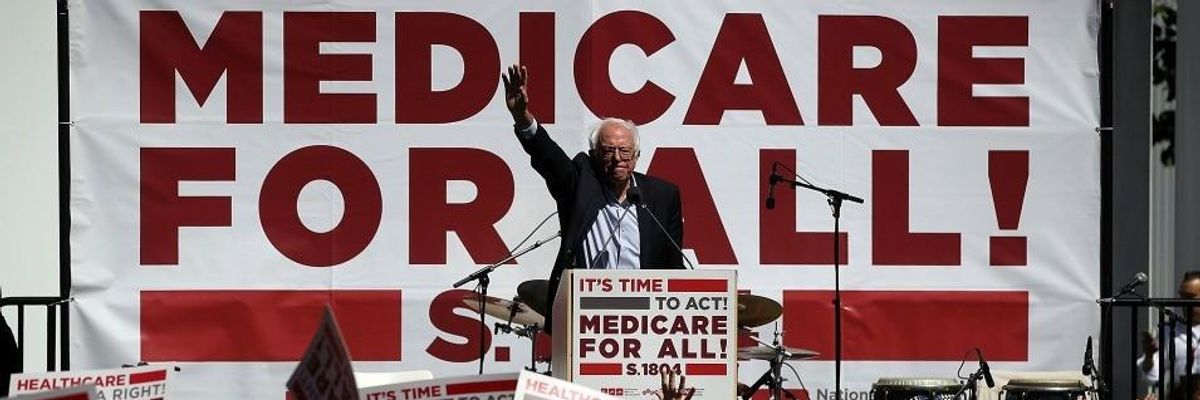
Sen. Bernie Sanders doubled down on his argument for establishing a universal, single-payer healthcare system Friday in response to a New York Times report which showed the cost differences of hospital care, outpatient procedures, and prescription drugs in the United States compared with other countries.
"Other major countries cover all their people and pay half of what we do. Don't tell me we can't afford Medicare for All," tweeted Sanders (I-Vt.), a candidate for the Democratic Party's 2020 presidential nomination who has campaigned on implementing a single-payer system.
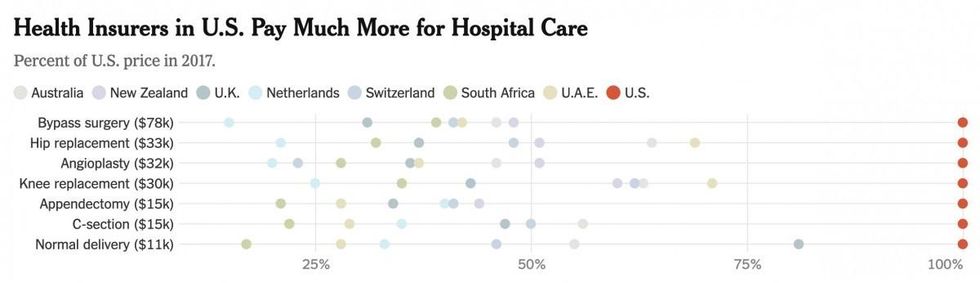
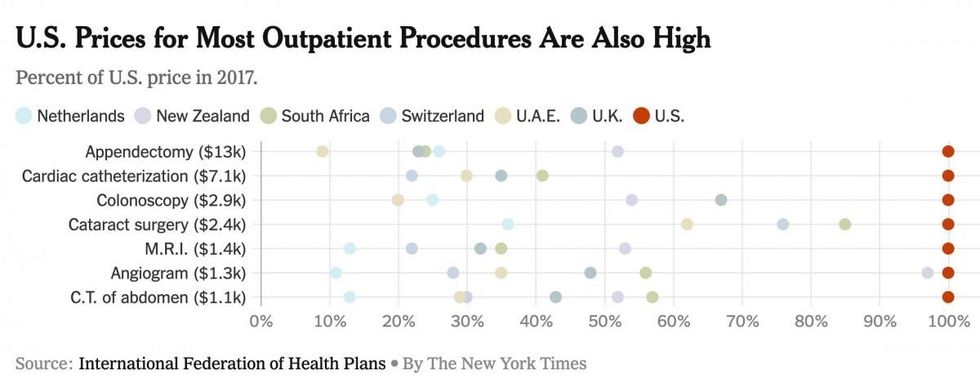
Sanders linked to the Times piece, which features graphs showing prices for common medical services around the world. The Times uses 2017 data from a report released this month by the International Federation of Health Plans, a group that represents chief executives of health insurers.
"Every time, the upshot is vivid and similar: For almost everything on the list, there is a large divergence between the United States and everyone else," the newspaper notes.
The Times highlights specific examples of cost differences, some of which Sanders shared on Twitter:
For a typical angioplasty, a procedure that opens a blocked blood vessel to the heart, the average U.S. price is $32,200, compared with $6,400 in the Netherlands, or $7,400 in Switzerland, the survey finds. A typical MRI scan costs $1,420 in the United States, but around $450 in Britain. An injection of Herceptin, an important breast cancer treatment, costs $211 in the United States, compared with $44 in South Africa. These examples aren't outliers.
There are so few cases where the United States price isn't the highest that they jump out. Cataract surgery costs more in New Zealand; Kalydeco, a new drug for cystic fibrosis, costs more in the United Arab Emirates. But for most of the studied cases, prices for services and drugs in other developed countries are less than half of those in the United States.
"It is staggering how much the United States is more expensive," said John Hargraves, the director of data strategy at the Health Care Cost Institute, a group that aggregates claims data from several large American insurance companies and provided the U.S. data to the study.
See the graphs below:
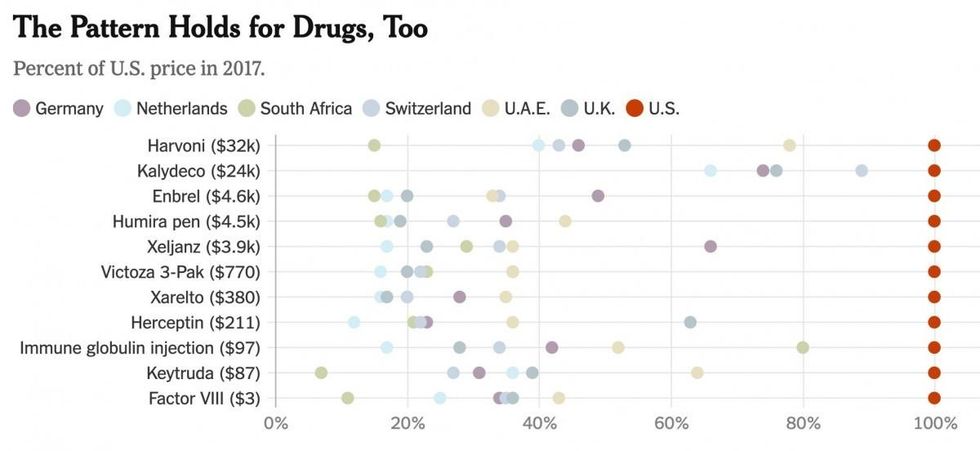
"Higher prices are not new for the United States," the Times explains, "but they have become newly salient, as more health insurance comes with high deductibles and other forms of cost sharing that require patients to pay a larger part of the bill or even the full cost of their care."
The Times acknowledges that two White House hopefuls--Sanders and Sen. Elizabeth Warren (D-Mass.)--have put forth single-payer plans that would rely on a government insurer to set prices as part of their presidential platforms, and that "both campaigns assume substantial savings would result as that government system lowered prices across the board: for doctors, hospitals, medical devices, and drugs."
Sanders introduced the Medicare for All Act of 2019 (S. 1129) in the Senate in April. Although Warren and Sen. Cory Booker (D-N.J.), another 2020 presidential contender, are among the bill's original co-sponsors, Warren has come under fire from progressives for a "transition plan" she proposed last month while Booker--as The Washington Post has reported--is among the candidates who don't believe we need to get rid of private health insurance.
Sen. Bernie Sanders doubled down on his argument for establishing a universal, single-payer healthcare system Friday in response to a New York Times report which showed the cost differences of hospital care, outpatient procedures, and prescription drugs in the United States compared with other countries.
"Other major countries cover all their people and pay half of what we do. Don't tell me we can't afford Medicare for All," tweeted Sanders (I-Vt.), a candidate for the Democratic Party's 2020 presidential nomination who has campaigned on implementing a single-payer system.
Sanders linked to the Times piece, which features graphs showing prices for common medical services around the world. The Times uses 2017 data from a report released this month by the International Federation of Health Plans, a group that represents chief executives of health insurers.
"Every time, the upshot is vivid and similar: For almost everything on the list, there is a large divergence between the United States and everyone else," the newspaper notes.
The Times highlights specific examples of cost differences, some of which Sanders shared on Twitter:
For a typical angioplasty, a procedure that opens a blocked blood vessel to the heart, the average U.S. price is $32,200, compared with $6,400 in the Netherlands, or $7,400 in Switzerland, the survey finds. A typical MRI scan costs $1,420 in the United States, but around $450 in Britain. An injection of Herceptin, an important breast cancer treatment, costs $211 in the United States, compared with $44 in South Africa. These examples aren't outliers.
There are so few cases where the United States price isn't the highest that they jump out. Cataract surgery costs more in New Zealand; Kalydeco, a new drug for cystic fibrosis, costs more in the United Arab Emirates. But for most of the studied cases, prices for services and drugs in other developed countries are less than half of those in the United States.
"It is staggering how much the United States is more expensive," said John Hargraves, the director of data strategy at the Health Care Cost Institute, a group that aggregates claims data from several large American insurance companies and provided the U.S. data to the study.
See the graphs below:
"Higher prices are not new for the United States," the Times explains, "but they have become newly salient, as more health insurance comes with high deductibles and other forms of cost sharing that require patients to pay a larger part of the bill or even the full cost of their care."
The Times acknowledges that two White House hopefuls--Sanders and Sen. Elizabeth Warren (D-Mass.)--have put forth single-payer plans that would rely on a government insurer to set prices as part of their presidential platforms, and that "both campaigns assume substantial savings would result as that government system lowered prices across the board: for doctors, hospitals, medical devices, and drugs."
Sanders introduced the Medicare for All Act of 2019 (S. 1129) in the Senate in April. Although Warren and Sen. Cory Booker (D-N.J.), another 2020 presidential contender, are among the bill's original co-sponsors, Warren has come under fire from progressives for a "transition plan" she proposed last month while Booker--as The Washington Post has reported--is among the candidates who don't believe we need to get rid of private health insurance.
Sen. Bernie Sanders doubled down on his argument for establishing a universal, single-payer healthcare system Friday in response to a New York Times report which showed the cost differences of hospital care, outpatient procedures, and prescription drugs in the United States compared with other countries.
"Other major countries cover all their people and pay half of what we do. Don't tell me we can't afford Medicare for All," tweeted Sanders (I-Vt.), a candidate for the Democratic Party's 2020 presidential nomination who has campaigned on implementing a single-payer system.
Sanders linked to the Times piece, which features graphs showing prices for common medical services around the world. The Times uses 2017 data from a report released this month by the International Federation of Health Plans, a group that represents chief executives of health insurers.
"Every time, the upshot is vivid and similar: For almost everything on the list, there is a large divergence between the United States and everyone else," the newspaper notes.
The Times highlights specific examples of cost differences, some of which Sanders shared on Twitter:
For a typical angioplasty, a procedure that opens a blocked blood vessel to the heart, the average U.S. price is $32,200, compared with $6,400 in the Netherlands, or $7,400 in Switzerland, the survey finds. A typical MRI scan costs $1,420 in the United States, but around $450 in Britain. An injection of Herceptin, an important breast cancer treatment, costs $211 in the United States, compared with $44 in South Africa. These examples aren't outliers.
There are so few cases where the United States price isn't the highest that they jump out. Cataract surgery costs more in New Zealand; Kalydeco, a new drug for cystic fibrosis, costs more in the United Arab Emirates. But for most of the studied cases, prices for services and drugs in other developed countries are less than half of those in the United States.
"It is staggering how much the United States is more expensive," said John Hargraves, the director of data strategy at the Health Care Cost Institute, a group that aggregates claims data from several large American insurance companies and provided the U.S. data to the study.
See the graphs below:
"Higher prices are not new for the United States," the Times explains, "but they have become newly salient, as more health insurance comes with high deductibles and other forms of cost sharing that require patients to pay a larger part of the bill or even the full cost of their care."
The Times acknowledges that two White House hopefuls--Sanders and Sen. Elizabeth Warren (D-Mass.)--have put forth single-payer plans that would rely on a government insurer to set prices as part of their presidential platforms, and that "both campaigns assume substantial savings would result as that government system lowered prices across the board: for doctors, hospitals, medical devices, and drugs."
Sanders introduced the Medicare for All Act of 2019 (S. 1129) in the Senate in April. Although Warren and Sen. Cory Booker (D-N.J.), another 2020 presidential contender, are among the bill's original co-sponsors, Warren has come under fire from progressives for a "transition plan" she proposed last month while Booker--as The Washington Post has reported--is among the candidates who don't believe we need to get rid of private health insurance.