SUBSCRIBE TO OUR FREE NEWSLETTER
Daily news & progressive opinion—funded by the people, not the corporations—delivered straight to your inbox.
5
#000000
#FFFFFF
To donate by check, phone, or other method, see our More Ways to Give page.
Daily news & progressive opinion—funded by the people, not the corporations—delivered straight to your inbox.
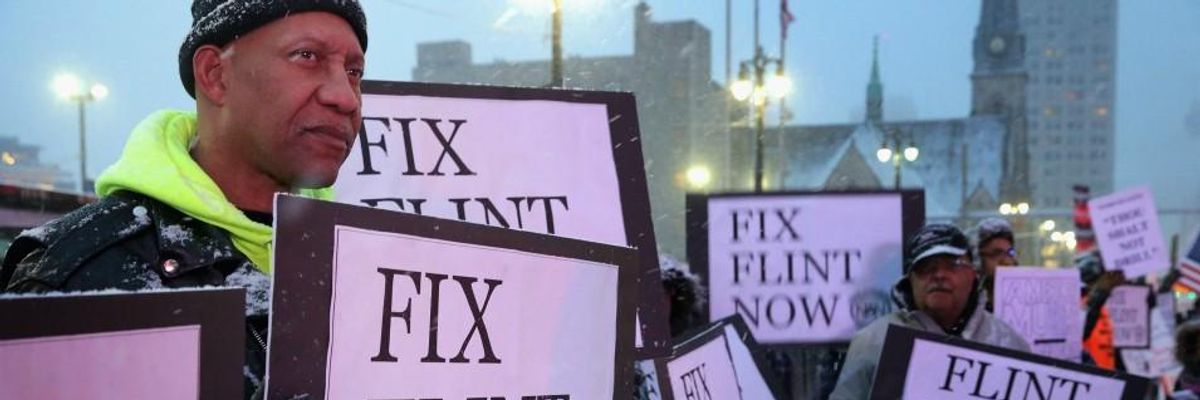
Demonstrators demand action about the water crisis in Flint before the GOP presidential debate March 3, 2016 in Detroit, Michigan. (Photo: Chip Somodevilla/Getty Images)
Internal emails reported on Tuesday by The Guardian and MLive reveal that executives at a water company contracted to assess the water system in Flint, Michigan privately expressed concerns that residents "might be at risk of being poisoned by lead in their tap water months before the city publicly admitted the problem in 2015."
"The documents show a Veolia executive, a month before the corporation told the city its water was safe, saying that 'lead seems to be a problem.'"
--Alissa Weinman, Corporate Accountability
The emails, obtained by the watchdog group Corporate Accountability, came to light through a lawsuit filed in the Genesee County Circuit Court by the Michigan Attorney General Dana Nessel, a Democrat who took office in January. The state's suit accused the company, Veolia, of "professional negligence, negligence, public nuisance, unjust enrichment, and fraud." Last month a state judge threw out all but the unjust enrichment claim.
Corporate Accountability spokesperson Alissa Weinman told the newspapers that Veolia's actions related to Flint were "despicable."
"The documents show a Veolia executive, a month before the corporation told the city its water was safe, saying that 'lead seems to be a problem,'" Weinman said. "I think anyone has to ask themselves how the story in Flint would be different five years later now if Veolia had made those private concerns public."
In April 2014, an emergency manager appointed by Michigan's then-governor, Republican Rick Snyder, switched Flint's water supply from Detroit's system to the Flint River in a bid to save money. By August, city officials had issued boil-water alerts because of coliform bacteria. In February 2015, high levels of lead were found in the drinking water at the home of Lee Anne Walters, who notified the U.S. Environmental Protection Agency.
However, it wasn't until September that public health experts began publicly raising alarm about Flint's corrosive water causing lead to leach from the city's aging pipes, and it wasn't until October that officials told residents to not drink the water, distributed filters, and expanded testing. Although Flint reconnected to Detroit's water system in October, Flint's residents still live with the consequences of the water crisis.
In February 2015, Veolia signed a $40,000 contract with Flint. According to the company, the assessment was only focused on bacteria and chlorine compounds called trihalomethanes. The reporting Tuesday raises questions about what that timeline might have looked like had Veolia, one of the largest utility companies in the world, publicly raised concerns about lead earlier. It also points out that while senior employees were privately raising such concerns, "Veolia was exploring other lucrative contracts with the city."
Veolia sent a 20-page response to the newspapers, accusing city and state officials of "trying to create a corporate villain where one does not exist." The company added that "we now know in 2019 the myriad of ways that the government officials behaved badly, but as the Flint water crisis unfolded many of those facts were unknown, concealed, and covered up by the government perpetrators."
The Guardian and MLive detail some of the emails sent internally by Veolia's senior staff about lead concerns dating back to February 2015:
"Do not pass this on," wrote Rob Nicholas, then the vice president of development, in an email to Veolia executives. "The City however needs to be aware of this problem with lead and operate the system to minimize this as much as possible and consider the impact in future plans. We had already identified that as something to be reviewed."
Nicholas forwarded the information to Veolia engineer Marvin Gnagy, adding: "Yep. Lead seems to be a problem."
Days later, Veolia technology vice president Bill Fahey emailed senior executives calling for the company to advise Flint to change its water supply, adding that "the politics of this should not get in the way of making the best recommendation." Reiterating the call in another email, he added: "PLEASE... this will come back and bite us."
Nayyirah Shariff, who directs the local group Flint Rising, told the papers she feels Veolia downplayed concerns publicly. From February to March 2015, the company held a news conference and public meetings, plus put out an interim water quality report. As Shariff put it, "They were like, 'everything is fine.'"
Dear Common Dreams reader, It’s been nearly 30 years since I co-founded Common Dreams with my late wife, Lina Newhouser. We had the radical notion that journalism should serve the public good, not corporate profits. It was clear to us from the outset what it would take to build such a project. No paid advertisements. No corporate sponsors. No millionaire publisher telling us what to think or do. Many people said we wouldn't last a year, but we proved those doubters wrong. Together with a tremendous team of journalists and dedicated staff, we built an independent media outlet free from the constraints of profits and corporate control. Our mission has always been simple: To inform. To inspire. To ignite change for the common good. Building Common Dreams was not easy. Our survival was never guaranteed. When you take on the most powerful forces—Wall Street greed, fossil fuel industry destruction, Big Tech lobbyists, and uber-rich oligarchs who have spent billions upon billions rigging the economy and democracy in their favor—the only bulwark you have is supporters who believe in your work. But here’s the urgent message from me today. It's never been this bad out there. And it's never been this hard to keep us going. At the very moment Common Dreams is most needed, the threats we face are intensifying. We need your support now more than ever. We don't accept corporate advertising and never will. We don't have a paywall because we don't think people should be blocked from critical news based on their ability to pay. Everything we do is funded by the donations of readers like you. When everyone does the little they can afford, we are strong. But if that support retreats or dries up, so do we. Will you donate now to make sure Common Dreams not only survives but thrives? —Craig Brown, Co-founder |
Internal emails reported on Tuesday by The Guardian and MLive reveal that executives at a water company contracted to assess the water system in Flint, Michigan privately expressed concerns that residents "might be at risk of being poisoned by lead in their tap water months before the city publicly admitted the problem in 2015."
"The documents show a Veolia executive, a month before the corporation told the city its water was safe, saying that 'lead seems to be a problem.'"
--Alissa Weinman, Corporate Accountability
The emails, obtained by the watchdog group Corporate Accountability, came to light through a lawsuit filed in the Genesee County Circuit Court by the Michigan Attorney General Dana Nessel, a Democrat who took office in January. The state's suit accused the company, Veolia, of "professional negligence, negligence, public nuisance, unjust enrichment, and fraud." Last month a state judge threw out all but the unjust enrichment claim.
Corporate Accountability spokesperson Alissa Weinman told the newspapers that Veolia's actions related to Flint were "despicable."
"The documents show a Veolia executive, a month before the corporation told the city its water was safe, saying that 'lead seems to be a problem,'" Weinman said. "I think anyone has to ask themselves how the story in Flint would be different five years later now if Veolia had made those private concerns public."
In April 2014, an emergency manager appointed by Michigan's then-governor, Republican Rick Snyder, switched Flint's water supply from Detroit's system to the Flint River in a bid to save money. By August, city officials had issued boil-water alerts because of coliform bacteria. In February 2015, high levels of lead were found in the drinking water at the home of Lee Anne Walters, who notified the U.S. Environmental Protection Agency.
However, it wasn't until September that public health experts began publicly raising alarm about Flint's corrosive water causing lead to leach from the city's aging pipes, and it wasn't until October that officials told residents to not drink the water, distributed filters, and expanded testing. Although Flint reconnected to Detroit's water system in October, Flint's residents still live with the consequences of the water crisis.
In February 2015, Veolia signed a $40,000 contract with Flint. According to the company, the assessment was only focused on bacteria and chlorine compounds called trihalomethanes. The reporting Tuesday raises questions about what that timeline might have looked like had Veolia, one of the largest utility companies in the world, publicly raised concerns about lead earlier. It also points out that while senior employees were privately raising such concerns, "Veolia was exploring other lucrative contracts with the city."
Veolia sent a 20-page response to the newspapers, accusing city and state officials of "trying to create a corporate villain where one does not exist." The company added that "we now know in 2019 the myriad of ways that the government officials behaved badly, but as the Flint water crisis unfolded many of those facts were unknown, concealed, and covered up by the government perpetrators."
The Guardian and MLive detail some of the emails sent internally by Veolia's senior staff about lead concerns dating back to February 2015:
"Do not pass this on," wrote Rob Nicholas, then the vice president of development, in an email to Veolia executives. "The City however needs to be aware of this problem with lead and operate the system to minimize this as much as possible and consider the impact in future plans. We had already identified that as something to be reviewed."
Nicholas forwarded the information to Veolia engineer Marvin Gnagy, adding: "Yep. Lead seems to be a problem."
Days later, Veolia technology vice president Bill Fahey emailed senior executives calling for the company to advise Flint to change its water supply, adding that "the politics of this should not get in the way of making the best recommendation." Reiterating the call in another email, he added: "PLEASE... this will come back and bite us."
Nayyirah Shariff, who directs the local group Flint Rising, told the papers she feels Veolia downplayed concerns publicly. From February to March 2015, the company held a news conference and public meetings, plus put out an interim water quality report. As Shariff put it, "They were like, 'everything is fine.'"
Internal emails reported on Tuesday by The Guardian and MLive reveal that executives at a water company contracted to assess the water system in Flint, Michigan privately expressed concerns that residents "might be at risk of being poisoned by lead in their tap water months before the city publicly admitted the problem in 2015."
"The documents show a Veolia executive, a month before the corporation told the city its water was safe, saying that 'lead seems to be a problem.'"
--Alissa Weinman, Corporate Accountability
The emails, obtained by the watchdog group Corporate Accountability, came to light through a lawsuit filed in the Genesee County Circuit Court by the Michigan Attorney General Dana Nessel, a Democrat who took office in January. The state's suit accused the company, Veolia, of "professional negligence, negligence, public nuisance, unjust enrichment, and fraud." Last month a state judge threw out all but the unjust enrichment claim.
Corporate Accountability spokesperson Alissa Weinman told the newspapers that Veolia's actions related to Flint were "despicable."
"The documents show a Veolia executive, a month before the corporation told the city its water was safe, saying that 'lead seems to be a problem,'" Weinman said. "I think anyone has to ask themselves how the story in Flint would be different five years later now if Veolia had made those private concerns public."
In April 2014, an emergency manager appointed by Michigan's then-governor, Republican Rick Snyder, switched Flint's water supply from Detroit's system to the Flint River in a bid to save money. By August, city officials had issued boil-water alerts because of coliform bacteria. In February 2015, high levels of lead were found in the drinking water at the home of Lee Anne Walters, who notified the U.S. Environmental Protection Agency.
However, it wasn't until September that public health experts began publicly raising alarm about Flint's corrosive water causing lead to leach from the city's aging pipes, and it wasn't until October that officials told residents to not drink the water, distributed filters, and expanded testing. Although Flint reconnected to Detroit's water system in October, Flint's residents still live with the consequences of the water crisis.
In February 2015, Veolia signed a $40,000 contract with Flint. According to the company, the assessment was only focused on bacteria and chlorine compounds called trihalomethanes. The reporting Tuesday raises questions about what that timeline might have looked like had Veolia, one of the largest utility companies in the world, publicly raised concerns about lead earlier. It also points out that while senior employees were privately raising such concerns, "Veolia was exploring other lucrative contracts with the city."
Veolia sent a 20-page response to the newspapers, accusing city and state officials of "trying to create a corporate villain where one does not exist." The company added that "we now know in 2019 the myriad of ways that the government officials behaved badly, but as the Flint water crisis unfolded many of those facts were unknown, concealed, and covered up by the government perpetrators."
The Guardian and MLive detail some of the emails sent internally by Veolia's senior staff about lead concerns dating back to February 2015:
"Do not pass this on," wrote Rob Nicholas, then the vice president of development, in an email to Veolia executives. "The City however needs to be aware of this problem with lead and operate the system to minimize this as much as possible and consider the impact in future plans. We had already identified that as something to be reviewed."
Nicholas forwarded the information to Veolia engineer Marvin Gnagy, adding: "Yep. Lead seems to be a problem."
Days later, Veolia technology vice president Bill Fahey emailed senior executives calling for the company to advise Flint to change its water supply, adding that "the politics of this should not get in the way of making the best recommendation." Reiterating the call in another email, he added: "PLEASE... this will come back and bite us."
Nayyirah Shariff, who directs the local group Flint Rising, told the papers she feels Veolia downplayed concerns publicly. From February to March 2015, the company held a news conference and public meetings, plus put out an interim water quality report. As Shariff put it, "They were like, 'everything is fine.'"