SUBSCRIBE TO OUR FREE NEWSLETTER
Daily news & progressive opinion—funded by the people, not the corporations—delivered straight to your inbox.
5
#000000
#FFFFFF
To donate by check, phone, or other method, see our More Ways to Give page.
Daily news & progressive opinion—funded by the people, not the corporations—delivered straight to your inbox.
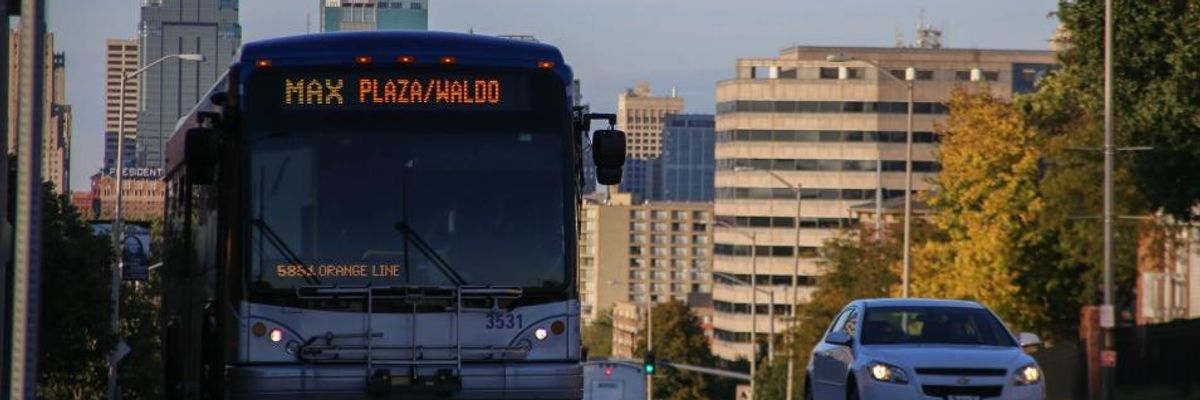
The Kansas City Council unanimously voted Thursday to make public transit in the city free of charge. (Photo: Paul Sableman/Flickr/cc)
Lawmakers in Kansas City, Missouri took a "visionary step" on Thursday by unanimously voting to make public transportation in the city free of charge, setting the stage for it to be the first major U.S. city to have free public transit.
The Kansas City Council voted to direct the city manager to set aside $8 million to eliminate the $1.50 per ride fare that currently applies to the city's bus system.
Some frequent riders could save about $1,000 per year under the new plan, according to KCUR, the city's public radio station.
"It'd help me out a lot," college student Michael Mumford, who rides the city's buses at least once per day, told the station. "Put some change in my pocket...buy some books for class."
The Kansas City Area Transportation Authority also expressed approval, with CEO Robbie Makinen telling KCUR that residents will be able to put the money they save on transportation toward other necessities, boosting the economy.
The city still needs to work out details of the proposal, including how it will be funded and where that money will come from, according to local news station KSHB.
Supporters of the measure on social media pointed out that free public transit could have positive impacts on economic inequality, the city's efforts to fight the climate crisis, and mass incarceration--as other cities, like New York, are cracking down on public transit fare evasion.
Free public transit has been shown to drastically reduce automobile use and emissions elsewhere, such as in Tallinn, Estonia, wrote economic researcher Curtis Myers.
Universal free transport is a solution
The main case study is in Estonia, Tallinn where free buses & trams have been given to all citizens since 2013
It's reduced private car use by a half, reduced 742 tons of CO2 emissions, saving people EUR750 per year
https://t.co/lRWfoaXV0b-- Curtis Myers (@curtis_1myers) December 6, 2019
City council member Eric Bunch, who co-sponsored the measure, told the local press that he aims to help marginalized communities access the city.
"When we're talking about improving people's lives who are our most vulnerable citizens, I don't think there's any question that we need to find that money," Bunch said.
"I don't want to do it for any sort of national recognition, I want to do it because it's the right thing to do, I believe that people have a right to move about this city," he told KCUR.
The move did win national recognition, with lawmakers in other large cities praising the initiative and saying they aimed to push for similar programs for their constituents.
"Now let's do this everywhere," tweeted Matt Haugen, a member of the Democratic Socialists of America environmental steering committee.
Dear Common Dreams reader, It’s been nearly 30 years since I co-founded Common Dreams with my late wife, Lina Newhouser. We had the radical notion that journalism should serve the public good, not corporate profits. It was clear to us from the outset what it would take to build such a project. No paid advertisements. No corporate sponsors. No millionaire publisher telling us what to think or do. Many people said we wouldn't last a year, but we proved those doubters wrong. Together with a tremendous team of journalists and dedicated staff, we built an independent media outlet free from the constraints of profits and corporate control. Our mission has always been simple: To inform. To inspire. To ignite change for the common good. Building Common Dreams was not easy. Our survival was never guaranteed. When you take on the most powerful forces—Wall Street greed, fossil fuel industry destruction, Big Tech lobbyists, and uber-rich oligarchs who have spent billions upon billions rigging the economy and democracy in their favor—the only bulwark you have is supporters who believe in your work. But here’s the urgent message from me today. It's never been this bad out there. And it's never been this hard to keep us going. At the very moment Common Dreams is most needed, the threats we face are intensifying. We need your support now more than ever. We don't accept corporate advertising and never will. We don't have a paywall because we don't think people should be blocked from critical news based on their ability to pay. Everything we do is funded by the donations of readers like you. When everyone does the little they can afford, we are strong. But if that support retreats or dries up, so do we. Will you donate now to make sure Common Dreams not only survives but thrives? —Craig Brown, Co-founder |
Lawmakers in Kansas City, Missouri took a "visionary step" on Thursday by unanimously voting to make public transportation in the city free of charge, setting the stage for it to be the first major U.S. city to have free public transit.
The Kansas City Council voted to direct the city manager to set aside $8 million to eliminate the $1.50 per ride fare that currently applies to the city's bus system.
Some frequent riders could save about $1,000 per year under the new plan, according to KCUR, the city's public radio station.
"It'd help me out a lot," college student Michael Mumford, who rides the city's buses at least once per day, told the station. "Put some change in my pocket...buy some books for class."
The Kansas City Area Transportation Authority also expressed approval, with CEO Robbie Makinen telling KCUR that residents will be able to put the money they save on transportation toward other necessities, boosting the economy.
The city still needs to work out details of the proposal, including how it will be funded and where that money will come from, according to local news station KSHB.
Supporters of the measure on social media pointed out that free public transit could have positive impacts on economic inequality, the city's efforts to fight the climate crisis, and mass incarceration--as other cities, like New York, are cracking down on public transit fare evasion.
Free public transit has been shown to drastically reduce automobile use and emissions elsewhere, such as in Tallinn, Estonia, wrote economic researcher Curtis Myers.
Universal free transport is a solution
The main case study is in Estonia, Tallinn where free buses & trams have been given to all citizens since 2013
It's reduced private car use by a half, reduced 742 tons of CO2 emissions, saving people EUR750 per year
https://t.co/lRWfoaXV0b-- Curtis Myers (@curtis_1myers) December 6, 2019
City council member Eric Bunch, who co-sponsored the measure, told the local press that he aims to help marginalized communities access the city.
"When we're talking about improving people's lives who are our most vulnerable citizens, I don't think there's any question that we need to find that money," Bunch said.
"I don't want to do it for any sort of national recognition, I want to do it because it's the right thing to do, I believe that people have a right to move about this city," he told KCUR.
The move did win national recognition, with lawmakers in other large cities praising the initiative and saying they aimed to push for similar programs for their constituents.
"Now let's do this everywhere," tweeted Matt Haugen, a member of the Democratic Socialists of America environmental steering committee.
Lawmakers in Kansas City, Missouri took a "visionary step" on Thursday by unanimously voting to make public transportation in the city free of charge, setting the stage for it to be the first major U.S. city to have free public transit.
The Kansas City Council voted to direct the city manager to set aside $8 million to eliminate the $1.50 per ride fare that currently applies to the city's bus system.
Some frequent riders could save about $1,000 per year under the new plan, according to KCUR, the city's public radio station.
"It'd help me out a lot," college student Michael Mumford, who rides the city's buses at least once per day, told the station. "Put some change in my pocket...buy some books for class."
The Kansas City Area Transportation Authority also expressed approval, with CEO Robbie Makinen telling KCUR that residents will be able to put the money they save on transportation toward other necessities, boosting the economy.
The city still needs to work out details of the proposal, including how it will be funded and where that money will come from, according to local news station KSHB.
Supporters of the measure on social media pointed out that free public transit could have positive impacts on economic inequality, the city's efforts to fight the climate crisis, and mass incarceration--as other cities, like New York, are cracking down on public transit fare evasion.
Free public transit has been shown to drastically reduce automobile use and emissions elsewhere, such as in Tallinn, Estonia, wrote economic researcher Curtis Myers.
Universal free transport is a solution
The main case study is in Estonia, Tallinn where free buses & trams have been given to all citizens since 2013
It's reduced private car use by a half, reduced 742 tons of CO2 emissions, saving people EUR750 per year
https://t.co/lRWfoaXV0b-- Curtis Myers (@curtis_1myers) December 6, 2019
City council member Eric Bunch, who co-sponsored the measure, told the local press that he aims to help marginalized communities access the city.
"When we're talking about improving people's lives who are our most vulnerable citizens, I don't think there's any question that we need to find that money," Bunch said.
"I don't want to do it for any sort of national recognition, I want to do it because it's the right thing to do, I believe that people have a right to move about this city," he told KCUR.
The move did win national recognition, with lawmakers in other large cities praising the initiative and saying they aimed to push for similar programs for their constituents.
"Now let's do this everywhere," tweeted Matt Haugen, a member of the Democratic Socialists of America environmental steering committee.