SUBSCRIBE TO OUR FREE NEWSLETTER
Daily news & progressive opinion—funded by the people, not the corporations—delivered straight to your inbox.
5
#000000
#FFFFFF
To donate by check, phone, or other method, see our More Ways to Give page.
Daily news & progressive opinion—funded by the people, not the corporations—delivered straight to your inbox.
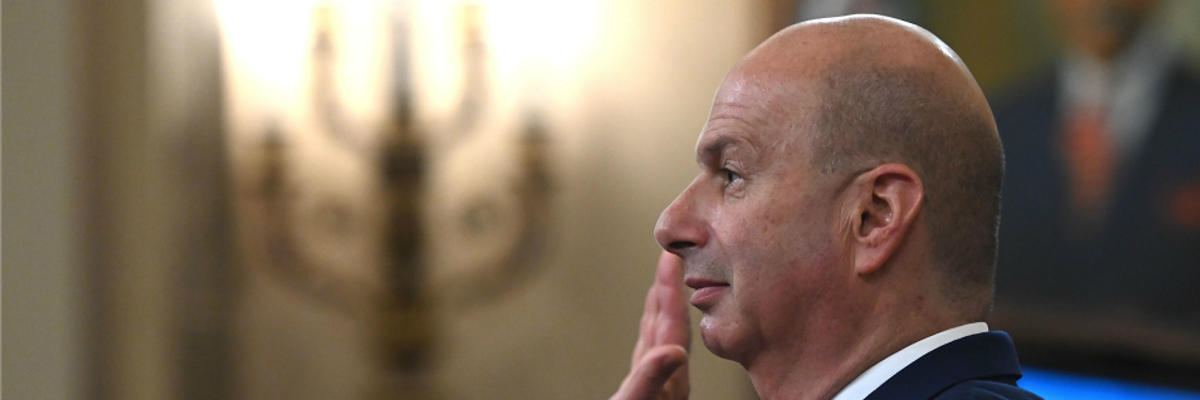
U.S. Ambassador to the European Union Gordon Sondland takes the oath ahead of his House Intelligence Committee hearing as part of the impeachment inquiry into US President Donald Trump on Capitol Hill in Washington, D.C. on November 20, 2019. (Photo: Andrew Caballero-Reynolds/AFP via Getty Images)
U.S. ambassador to the European Union Gordon Sondland on Wednesday delivered an "explosive" opening statement for his impeachment testimony in which he confirmed there was a quid pro quo in which the president made Ukrainian aid conditional on that government's cooperation with investigations into former Vice President Joe Biden and his son.
Sondland testified that under Trump's orders and against his own wishes, he worked with Rudy Giuliani, the president's personal lawyer, last summer on matters involving Ukraine.
The president and other top administration officials were "in the loop," said Sondland, regarding an effort to threaten military aid to Ukraine unless the country agreed to investigate Burisma, the oil company where 2020 Democratic presidential candidate Joe Biden's son was a board member.
After State Department officials expressed positive views of Ukrainian President Volodymyr Zelensky's new administration last spring, Giuliani and Trump expressed skepticism that the new president would reform the country's corruption issues.
The president's lawyer confirmed to Sondland that "the president wanted a public statement from President Zelensky committing Ukraine to look into corruption issues--specifically "the 2016 election (including the DNC server) and Burisma as two topics of importance to the president."
The statement, he confirmed, was conditional for "the resumption of U.S. aid."
Sondland named Secretary of State Mike Pompeo, Vice President Mike Pence, and White House Chief of Staff Mick Mulvaney as three top Trump administration officials who knew the president and Giuliani wanted to threaten Ukrainian aid if Zelensky did not publicly announce the investigation.
"Everyone was in the loop," Sondland said. "It was no secret. Everyone was informed via email on July 19, days before the Presidential call. As I communicated to the team, I told President Zelensky in advance that assurances to 'run a fully transparent investigation' and 'turn over every stone' were necessary in his call with President Trump."
"I know that members of this Committee have frequently framed these complicated issues in the form of a simple question: Was there a 'quid pro quo?' As I testified previously, with regard to the requested White House call and White House meeting, the answer is yes," the ambassador added.
On social media, political observers compared Sondland's testimony to that of John Dean, the White House counsel who told Congress and the U.S. public in the 1974 Watergate hearings that President Richard Nixon was directly involved in the Watergate cover-up.
In his own opening remarks, House Intelligence Committee Ranking Member Devin Nunes (R-Calif.), a vehement defender of the president, appeared unaware that Sondland was moments away from implicating Trump, as he warned the ambassador that he and the administration would be "smeared by the Democrats" at the hearing.
ProPublica noted that aside from Sondland's clear indication that the president was involved in a plot to bribe Ukrainian officials into investigating alleged corruption linked to Biden, the ambassador also said that the White House is currently keeping the ambassador's records from being publicly released.
Dear Common Dreams reader, It’s been nearly 30 years since I co-founded Common Dreams with my late wife, Lina Newhouser. We had the radical notion that journalism should serve the public good, not corporate profits. It was clear to us from the outset what it would take to build such a project. No paid advertisements. No corporate sponsors. No millionaire publisher telling us what to think or do. Many people said we wouldn't last a year, but we proved those doubters wrong. Together with a tremendous team of journalists and dedicated staff, we built an independent media outlet free from the constraints of profits and corporate control. Our mission has always been simple: To inform. To inspire. To ignite change for the common good. Building Common Dreams was not easy. Our survival was never guaranteed. When you take on the most powerful forces—Wall Street greed, fossil fuel industry destruction, Big Tech lobbyists, and uber-rich oligarchs who have spent billions upon billions rigging the economy and democracy in their favor—the only bulwark you have is supporters who believe in your work. But here’s the urgent message from me today. It's never been this bad out there. And it's never been this hard to keep us going. At the very moment Common Dreams is most needed, the threats we face are intensifying. We need your support now more than ever. We don't accept corporate advertising and never will. We don't have a paywall because we don't think people should be blocked from critical news based on their ability to pay. Everything we do is funded by the donations of readers like you. When everyone does the little they can afford, we are strong. But if that support retreats or dries up, so do we. Will you donate now to make sure Common Dreams not only survives but thrives? —Craig Brown, Co-founder |
U.S. ambassador to the European Union Gordon Sondland on Wednesday delivered an "explosive" opening statement for his impeachment testimony in which he confirmed there was a quid pro quo in which the president made Ukrainian aid conditional on that government's cooperation with investigations into former Vice President Joe Biden and his son.
Sondland testified that under Trump's orders and against his own wishes, he worked with Rudy Giuliani, the president's personal lawyer, last summer on matters involving Ukraine.
The president and other top administration officials were "in the loop," said Sondland, regarding an effort to threaten military aid to Ukraine unless the country agreed to investigate Burisma, the oil company where 2020 Democratic presidential candidate Joe Biden's son was a board member.
After State Department officials expressed positive views of Ukrainian President Volodymyr Zelensky's new administration last spring, Giuliani and Trump expressed skepticism that the new president would reform the country's corruption issues.
The president's lawyer confirmed to Sondland that "the president wanted a public statement from President Zelensky committing Ukraine to look into corruption issues--specifically "the 2016 election (including the DNC server) and Burisma as two topics of importance to the president."
The statement, he confirmed, was conditional for "the resumption of U.S. aid."
Sondland named Secretary of State Mike Pompeo, Vice President Mike Pence, and White House Chief of Staff Mick Mulvaney as three top Trump administration officials who knew the president and Giuliani wanted to threaten Ukrainian aid if Zelensky did not publicly announce the investigation.
"Everyone was in the loop," Sondland said. "It was no secret. Everyone was informed via email on July 19, days before the Presidential call. As I communicated to the team, I told President Zelensky in advance that assurances to 'run a fully transparent investigation' and 'turn over every stone' were necessary in his call with President Trump."
"I know that members of this Committee have frequently framed these complicated issues in the form of a simple question: Was there a 'quid pro quo?' As I testified previously, with regard to the requested White House call and White House meeting, the answer is yes," the ambassador added.
On social media, political observers compared Sondland's testimony to that of John Dean, the White House counsel who told Congress and the U.S. public in the 1974 Watergate hearings that President Richard Nixon was directly involved in the Watergate cover-up.
In his own opening remarks, House Intelligence Committee Ranking Member Devin Nunes (R-Calif.), a vehement defender of the president, appeared unaware that Sondland was moments away from implicating Trump, as he warned the ambassador that he and the administration would be "smeared by the Democrats" at the hearing.
ProPublica noted that aside from Sondland's clear indication that the president was involved in a plot to bribe Ukrainian officials into investigating alleged corruption linked to Biden, the ambassador also said that the White House is currently keeping the ambassador's records from being publicly released.
U.S. ambassador to the European Union Gordon Sondland on Wednesday delivered an "explosive" opening statement for his impeachment testimony in which he confirmed there was a quid pro quo in which the president made Ukrainian aid conditional on that government's cooperation with investigations into former Vice President Joe Biden and his son.
Sondland testified that under Trump's orders and against his own wishes, he worked with Rudy Giuliani, the president's personal lawyer, last summer on matters involving Ukraine.
The president and other top administration officials were "in the loop," said Sondland, regarding an effort to threaten military aid to Ukraine unless the country agreed to investigate Burisma, the oil company where 2020 Democratic presidential candidate Joe Biden's son was a board member.
After State Department officials expressed positive views of Ukrainian President Volodymyr Zelensky's new administration last spring, Giuliani and Trump expressed skepticism that the new president would reform the country's corruption issues.
The president's lawyer confirmed to Sondland that "the president wanted a public statement from President Zelensky committing Ukraine to look into corruption issues--specifically "the 2016 election (including the DNC server) and Burisma as two topics of importance to the president."
The statement, he confirmed, was conditional for "the resumption of U.S. aid."
Sondland named Secretary of State Mike Pompeo, Vice President Mike Pence, and White House Chief of Staff Mick Mulvaney as three top Trump administration officials who knew the president and Giuliani wanted to threaten Ukrainian aid if Zelensky did not publicly announce the investigation.
"Everyone was in the loop," Sondland said. "It was no secret. Everyone was informed via email on July 19, days before the Presidential call. As I communicated to the team, I told President Zelensky in advance that assurances to 'run a fully transparent investigation' and 'turn over every stone' were necessary in his call with President Trump."
"I know that members of this Committee have frequently framed these complicated issues in the form of a simple question: Was there a 'quid pro quo?' As I testified previously, with regard to the requested White House call and White House meeting, the answer is yes," the ambassador added.
On social media, political observers compared Sondland's testimony to that of John Dean, the White House counsel who told Congress and the U.S. public in the 1974 Watergate hearings that President Richard Nixon was directly involved in the Watergate cover-up.
In his own opening remarks, House Intelligence Committee Ranking Member Devin Nunes (R-Calif.), a vehement defender of the president, appeared unaware that Sondland was moments away from implicating Trump, as he warned the ambassador that he and the administration would be "smeared by the Democrats" at the hearing.
ProPublica noted that aside from Sondland's clear indication that the president was involved in a plot to bribe Ukrainian officials into investigating alleged corruption linked to Biden, the ambassador also said that the White House is currently keeping the ambassador's records from being publicly released.