SUBSCRIBE TO OUR FREE NEWSLETTER
Daily news & progressive opinion—funded by the people, not the corporations—delivered straight to your inbox.
5
#000000
#FFFFFF
To donate by check, phone, or other method, see our More Ways to Give page.
Daily news & progressive opinion—funded by the people, not the corporations—delivered straight to your inbox.
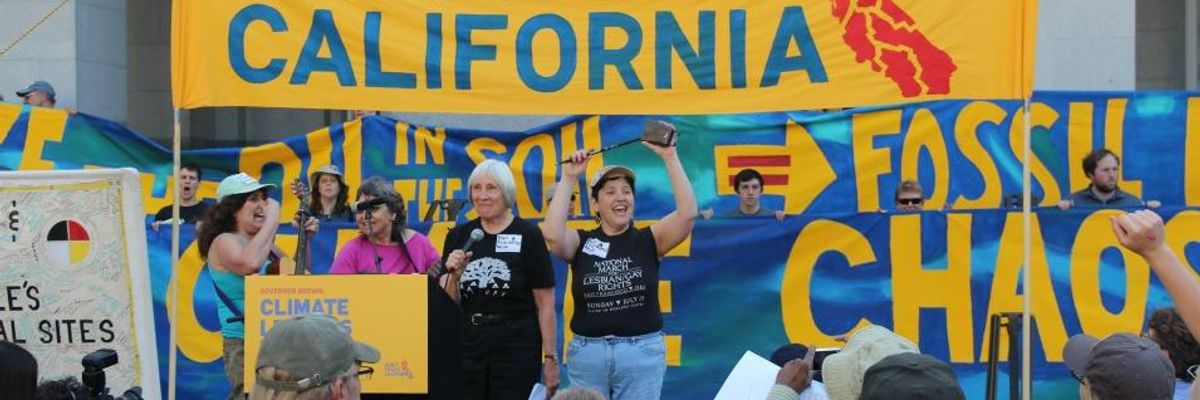
Californians attend an anti-fracking demonstration in Sacramento in 2014. (Photo: Lisa Werner/Getty)
Anti-fracking advocates were cautiously optimistic Tuesday after California Gov. Gavin Newsom announced a moratorium on fracking in the state and new steps to mitigate the disastrous public health effects that extractive industries have on communities.
Author and 350.org co-founder Bill McKibben credited "relentless organizing" with pressuring the Democratic governor to ban--at least temporarily--the high-pressure steam injection central to the fracking process and pledge to reverse the increase in drilling permits that's taken place under Newsom's administration.
"It's not all that activists wanted, but that language is an important signal," McKibben wrote of the temporary fracking ban.
Newsom announced that, along with the fracking lease moratorium, the state would also commission an independent audit of regulators tasked with overseeing the oil and gas industries and would have federal scientists conduct third-party reviews of all drilling lease requests going forward.
The state will also strengthen protections for communities near oil and gas wells.
"These are necessary steps to strengthen oversight of oil and gas extraction as we phase out our dependence on fossil fuels and focus on clean energy sources," Newsom said.
The governor's response to years of anti-fracking campaigning in California shows "that the future of climate leadership means saying 'no' to the fossil fuel industry's dreams of endless expansion," said Stephen Kretzmann, executive director at Oil Change International.
"As the world's fifth-largest economy and home to substantial fossil fuel extraction, California has a responsibility to model a just transition away from fossil fuels in line with the scale of action needed to address our climate crisis," Kretzmann said. "Phasing out existing extraction that's too close to communities, stopping all new permits that expand drilling, and investing adequate resources to ensure nobody is left behind in the transition to a renewable economy are critical next steps."
Oil Change International and other groups emphasized, however, that a full ban on fracking is needed.
"Since Governor Newsom took office, thousands of new drilling permits have been issued," said Alexandra Nagy, California state director for Food and Water Action. "We urge Governor Newsom to immediately institute a complete ban on fracking, stop issuing new drilling permits--which have been increasing under his administration--and use his executive authority to protect communities across the state now."
While Tuesday's announcement certainly represents progress, said Nagy, "much more should be done to address oil and gas issues in California."
Dear Common Dreams reader, It’s been nearly 30 years since I co-founded Common Dreams with my late wife, Lina Newhouser. We had the radical notion that journalism should serve the public good, not corporate profits. It was clear to us from the outset what it would take to build such a project. No paid advertisements. No corporate sponsors. No millionaire publisher telling us what to think or do. Many people said we wouldn't last a year, but we proved those doubters wrong. Together with a tremendous team of journalists and dedicated staff, we built an independent media outlet free from the constraints of profits and corporate control. Our mission has always been simple: To inform. To inspire. To ignite change for the common good. Building Common Dreams was not easy. Our survival was never guaranteed. When you take on the most powerful forces—Wall Street greed, fossil fuel industry destruction, Big Tech lobbyists, and uber-rich oligarchs who have spent billions upon billions rigging the economy and democracy in their favor—the only bulwark you have is supporters who believe in your work. But here’s the urgent message from me today. It's never been this bad out there. And it's never been this hard to keep us going. At the very moment Common Dreams is most needed, the threats we face are intensifying. We need your support now more than ever. We don't accept corporate advertising and never will. We don't have a paywall because we don't think people should be blocked from critical news based on their ability to pay. Everything we do is funded by the donations of readers like you. When everyone does the little they can afford, we are strong. But if that support retreats or dries up, so do we. Will you donate now to make sure Common Dreams not only survives but thrives? —Craig Brown, Co-founder |
Anti-fracking advocates were cautiously optimistic Tuesday after California Gov. Gavin Newsom announced a moratorium on fracking in the state and new steps to mitigate the disastrous public health effects that extractive industries have on communities.
Author and 350.org co-founder Bill McKibben credited "relentless organizing" with pressuring the Democratic governor to ban--at least temporarily--the high-pressure steam injection central to the fracking process and pledge to reverse the increase in drilling permits that's taken place under Newsom's administration.
"It's not all that activists wanted, but that language is an important signal," McKibben wrote of the temporary fracking ban.
Newsom announced that, along with the fracking lease moratorium, the state would also commission an independent audit of regulators tasked with overseeing the oil and gas industries and would have federal scientists conduct third-party reviews of all drilling lease requests going forward.
The state will also strengthen protections for communities near oil and gas wells.
"These are necessary steps to strengthen oversight of oil and gas extraction as we phase out our dependence on fossil fuels and focus on clean energy sources," Newsom said.
The governor's response to years of anti-fracking campaigning in California shows "that the future of climate leadership means saying 'no' to the fossil fuel industry's dreams of endless expansion," said Stephen Kretzmann, executive director at Oil Change International.
"As the world's fifth-largest economy and home to substantial fossil fuel extraction, California has a responsibility to model a just transition away from fossil fuels in line with the scale of action needed to address our climate crisis," Kretzmann said. "Phasing out existing extraction that's too close to communities, stopping all new permits that expand drilling, and investing adequate resources to ensure nobody is left behind in the transition to a renewable economy are critical next steps."
Oil Change International and other groups emphasized, however, that a full ban on fracking is needed.
"Since Governor Newsom took office, thousands of new drilling permits have been issued," said Alexandra Nagy, California state director for Food and Water Action. "We urge Governor Newsom to immediately institute a complete ban on fracking, stop issuing new drilling permits--which have been increasing under his administration--and use his executive authority to protect communities across the state now."
While Tuesday's announcement certainly represents progress, said Nagy, "much more should be done to address oil and gas issues in California."
Anti-fracking advocates were cautiously optimistic Tuesday after California Gov. Gavin Newsom announced a moratorium on fracking in the state and new steps to mitigate the disastrous public health effects that extractive industries have on communities.
Author and 350.org co-founder Bill McKibben credited "relentless organizing" with pressuring the Democratic governor to ban--at least temporarily--the high-pressure steam injection central to the fracking process and pledge to reverse the increase in drilling permits that's taken place under Newsom's administration.
"It's not all that activists wanted, but that language is an important signal," McKibben wrote of the temporary fracking ban.
Newsom announced that, along with the fracking lease moratorium, the state would also commission an independent audit of regulators tasked with overseeing the oil and gas industries and would have federal scientists conduct third-party reviews of all drilling lease requests going forward.
The state will also strengthen protections for communities near oil and gas wells.
"These are necessary steps to strengthen oversight of oil and gas extraction as we phase out our dependence on fossil fuels and focus on clean energy sources," Newsom said.
The governor's response to years of anti-fracking campaigning in California shows "that the future of climate leadership means saying 'no' to the fossil fuel industry's dreams of endless expansion," said Stephen Kretzmann, executive director at Oil Change International.
"As the world's fifth-largest economy and home to substantial fossil fuel extraction, California has a responsibility to model a just transition away from fossil fuels in line with the scale of action needed to address our climate crisis," Kretzmann said. "Phasing out existing extraction that's too close to communities, stopping all new permits that expand drilling, and investing adequate resources to ensure nobody is left behind in the transition to a renewable economy are critical next steps."
Oil Change International and other groups emphasized, however, that a full ban on fracking is needed.
"Since Governor Newsom took office, thousands of new drilling permits have been issued," said Alexandra Nagy, California state director for Food and Water Action. "We urge Governor Newsom to immediately institute a complete ban on fracking, stop issuing new drilling permits--which have been increasing under his administration--and use his executive authority to protect communities across the state now."
While Tuesday's announcement certainly represents progress, said Nagy, "much more should be done to address oil and gas issues in California."