SUBSCRIBE TO OUR FREE NEWSLETTER
Daily news & progressive opinion—funded by the people, not the corporations—delivered straight to your inbox.
5
#000000
#FFFFFF
To donate by check, phone, or other method, see our More Ways to Give page.
Daily news & progressive opinion—funded by the people, not the corporations—delivered straight to your inbox.
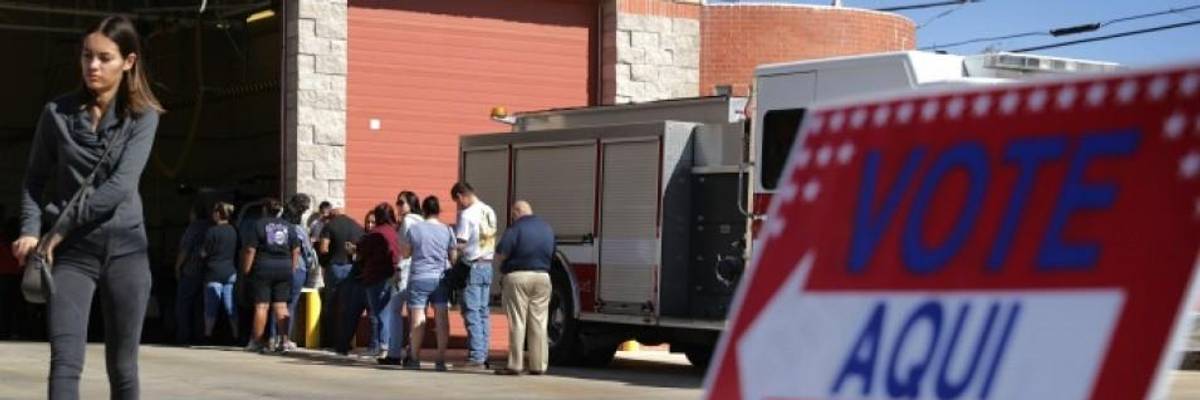
Voters line up outside the polling place at Fire Station Number 2 on Election Day November 06, 2018 in El Paso, Texas. (Photo: Chip Somodevilla/Getty Images)
To protect and strengthen a "democracy in peril," more than 150 civil rights organizations on Thursday released a far-reaching policy platform aimed at pressuring policymakers and 2020 candidates to prioritize voting rights.
Led by the Leadership Conference on Human and Civil Rights, the organizations offered "concrete policy recommendations" and proposed "a unified vision for ensuring that Americans have a strong, functioning democracy."
The six major areas in which bold reforms must be enacted were identified in the platform, called Vision for Democracy, as:
"When our democracy is in peril, so too are our civil rights," said Vanita Gupta, president of the Leadership Conference. "This platform offers tangible proposals to ensure every eligible voter, no matter who they are and regardless of their race, color, language, or ability can participate freely in our democracy. Our vote is our voice."
Policy recommendations within the platform include passing the Native American Voting Rights Act; prohibiting restrictive voter ID requirements; restoring voting rights to all currently and formerly incarcerated citizens; and standardizing the use of early voting systems across the country.
The groups, which also include the Lawyers' Committee for Civil Rights Under Law, the Center for Constitutional Rights, and Voto Latino, noted that none of the 2020 Democratic presidential debates have included questions about voting rights, despite recent reports that 17 million Americans were purged from voter rolls between 2016 and 2018 and that voting machines across the country are at risk for malfunctions and cyberattacks.
"On the eve of the next Democratic presidential candidate debate, we implore the debate moderators to ask candidates questions about their proposals to build a truly representative democracy that ensures all voices are heard," the coalition said.
Sherrilyn Ifill, president of the NAACP Legal Defense and Educational Fund, emphasized that the current vulnerabilities and unequal rights within the U.S. voting system are the result of political choices.
"At the current moment, our voting system is neither secure, equally accessible, nor fair," Ifill said. "The good news is that there are simple and direct solutions to every one of the problems with our voting system. Now all we need is the will, determination, and responsible leadership of elected and other public officials to come together and address this crisis."
Kristen Clarke of the Lawyers' Committee for Civil Rights Under Law added that the policy platform comes six years after the U.S. Supreme Court overturned a key portion of the Voting Rights Act which aimed, among other things, to combat racial discrimination at the polls.
"We face these threats without important statutory protections that have served as a bulwark against voter suppression since 1965, and with a dormant Department of Justice," Clarke said. "Vision for Democracy sets forth a comprehensive and robust blueprint for tearing down the obstacles and barriers that, too often, lock out African Americans and other racial minorities from the electoral process. This blueprint is needed more than ever."
Dear Common Dreams reader, It’s been nearly 30 years since I co-founded Common Dreams with my late wife, Lina Newhouser. We had the radical notion that journalism should serve the public good, not corporate profits. It was clear to us from the outset what it would take to build such a project. No paid advertisements. No corporate sponsors. No millionaire publisher telling us what to think or do. Many people said we wouldn't last a year, but we proved those doubters wrong. Together with a tremendous team of journalists and dedicated staff, we built an independent media outlet free from the constraints of profits and corporate control. Our mission has always been simple: To inform. To inspire. To ignite change for the common good. Building Common Dreams was not easy. Our survival was never guaranteed. When you take on the most powerful forces—Wall Street greed, fossil fuel industry destruction, Big Tech lobbyists, and uber-rich oligarchs who have spent billions upon billions rigging the economy and democracy in their favor—the only bulwark you have is supporters who believe in your work. But here’s the urgent message from me today. It's never been this bad out there. And it's never been this hard to keep us going. At the very moment Common Dreams is most needed, the threats we face are intensifying. We need your support now more than ever. We don't accept corporate advertising and never will. We don't have a paywall because we don't think people should be blocked from critical news based on their ability to pay. Everything we do is funded by the donations of readers like you. When everyone does the little they can afford, we are strong. But if that support retreats or dries up, so do we. Will you donate now to make sure Common Dreams not only survives but thrives? —Craig Brown, Co-founder |
To protect and strengthen a "democracy in peril," more than 150 civil rights organizations on Thursday released a far-reaching policy platform aimed at pressuring policymakers and 2020 candidates to prioritize voting rights.
Led by the Leadership Conference on Human and Civil Rights, the organizations offered "concrete policy recommendations" and proposed "a unified vision for ensuring that Americans have a strong, functioning democracy."
The six major areas in which bold reforms must be enacted were identified in the platform, called Vision for Democracy, as:
"When our democracy is in peril, so too are our civil rights," said Vanita Gupta, president of the Leadership Conference. "This platform offers tangible proposals to ensure every eligible voter, no matter who they are and regardless of their race, color, language, or ability can participate freely in our democracy. Our vote is our voice."
Policy recommendations within the platform include passing the Native American Voting Rights Act; prohibiting restrictive voter ID requirements; restoring voting rights to all currently and formerly incarcerated citizens; and standardizing the use of early voting systems across the country.
The groups, which also include the Lawyers' Committee for Civil Rights Under Law, the Center for Constitutional Rights, and Voto Latino, noted that none of the 2020 Democratic presidential debates have included questions about voting rights, despite recent reports that 17 million Americans were purged from voter rolls between 2016 and 2018 and that voting machines across the country are at risk for malfunctions and cyberattacks.
"On the eve of the next Democratic presidential candidate debate, we implore the debate moderators to ask candidates questions about their proposals to build a truly representative democracy that ensures all voices are heard," the coalition said.
Sherrilyn Ifill, president of the NAACP Legal Defense and Educational Fund, emphasized that the current vulnerabilities and unequal rights within the U.S. voting system are the result of political choices.
"At the current moment, our voting system is neither secure, equally accessible, nor fair," Ifill said. "The good news is that there are simple and direct solutions to every one of the problems with our voting system. Now all we need is the will, determination, and responsible leadership of elected and other public officials to come together and address this crisis."
Kristen Clarke of the Lawyers' Committee for Civil Rights Under Law added that the policy platform comes six years after the U.S. Supreme Court overturned a key portion of the Voting Rights Act which aimed, among other things, to combat racial discrimination at the polls.
"We face these threats without important statutory protections that have served as a bulwark against voter suppression since 1965, and with a dormant Department of Justice," Clarke said. "Vision for Democracy sets forth a comprehensive and robust blueprint for tearing down the obstacles and barriers that, too often, lock out African Americans and other racial minorities from the electoral process. This blueprint is needed more than ever."
To protect and strengthen a "democracy in peril," more than 150 civil rights organizations on Thursday released a far-reaching policy platform aimed at pressuring policymakers and 2020 candidates to prioritize voting rights.
Led by the Leadership Conference on Human and Civil Rights, the organizations offered "concrete policy recommendations" and proposed "a unified vision for ensuring that Americans have a strong, functioning democracy."
The six major areas in which bold reforms must be enacted were identified in the platform, called Vision for Democracy, as:
"When our democracy is in peril, so too are our civil rights," said Vanita Gupta, president of the Leadership Conference. "This platform offers tangible proposals to ensure every eligible voter, no matter who they are and regardless of their race, color, language, or ability can participate freely in our democracy. Our vote is our voice."
Policy recommendations within the platform include passing the Native American Voting Rights Act; prohibiting restrictive voter ID requirements; restoring voting rights to all currently and formerly incarcerated citizens; and standardizing the use of early voting systems across the country.
The groups, which also include the Lawyers' Committee for Civil Rights Under Law, the Center for Constitutional Rights, and Voto Latino, noted that none of the 2020 Democratic presidential debates have included questions about voting rights, despite recent reports that 17 million Americans were purged from voter rolls between 2016 and 2018 and that voting machines across the country are at risk for malfunctions and cyberattacks.
"On the eve of the next Democratic presidential candidate debate, we implore the debate moderators to ask candidates questions about their proposals to build a truly representative democracy that ensures all voices are heard," the coalition said.
Sherrilyn Ifill, president of the NAACP Legal Defense and Educational Fund, emphasized that the current vulnerabilities and unequal rights within the U.S. voting system are the result of political choices.
"At the current moment, our voting system is neither secure, equally accessible, nor fair," Ifill said. "The good news is that there are simple and direct solutions to every one of the problems with our voting system. Now all we need is the will, determination, and responsible leadership of elected and other public officials to come together and address this crisis."
Kristen Clarke of the Lawyers' Committee for Civil Rights Under Law added that the policy platform comes six years after the U.S. Supreme Court overturned a key portion of the Voting Rights Act which aimed, among other things, to combat racial discrimination at the polls.
"We face these threats without important statutory protections that have served as a bulwark against voter suppression since 1965, and with a dormant Department of Justice," Clarke said. "Vision for Democracy sets forth a comprehensive and robust blueprint for tearing down the obstacles and barriers that, too often, lock out African Americans and other racial minorities from the electoral process. This blueprint is needed more than ever."